
Staff Reporter
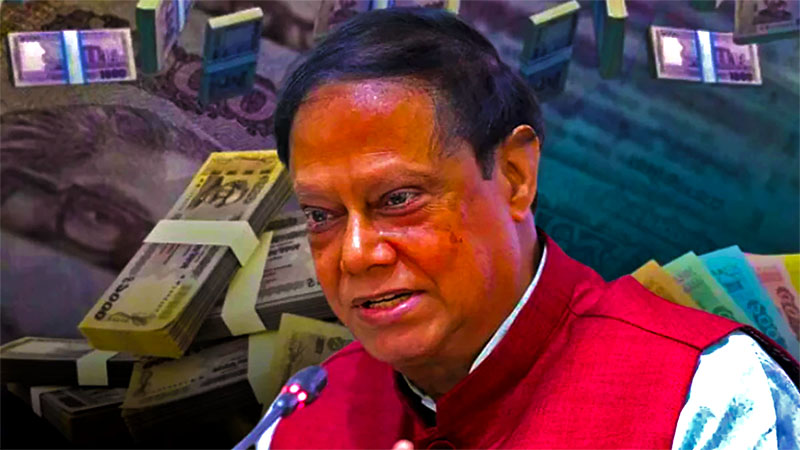
After assuming office, the interim government has decided to change the design of the currency notes, removing the image of the Father of the Nation, Bangabandhu Sheikh Mujibur Rahman. This redesign will result in a significant increase in costs.
Typically, the government spends around 450 to 500 crore Taka each year to replace old, torn, and outdated notes with new ones, maintaining the same design. However, due to the change in the currency design, this expenditure is expected to rise to around 1,500 crore Taka this time.
Officials from Bangladesh Bank have stated that following the political change in the country, the government is altering the design of all types of notes. Previously, only the printing was changed while the design remained the same. This time, the new notes will not feature the image of Bangabandhu, and instead, will showcase religious monuments, graffiti from the July Movement, and other images.
With the new design, there will be additional costs. The notes featuring Bangabandhu’s image will be withdrawn from circulation, and the government will replace them with the new ones. Previously, the cost of printing notes was around 500 crore Taka annually, but this will increase to approximately 1,500 crore Taka due to the redesign.
However, officials from Bangladesh Bank have not specified the exact amount of new currency that will be printed. As a result, the central bank did not release any new notes in the market for this Eid.
Sources from Bangladesh Bank’s relevant department mentioned that the printed notes no longer last as long as before and tend to get damaged within six months. Damaged notes are stored and then burned, after which new notes are printed based on the market demand.
An unnamed senior official from the department said, “This time, the design of all types of notes will be changed. A close government group has demanded the new design, and that is why the notes are being printed. The cost is no longer a major factor, but the expenditure will increase by three times this time.”
The sources further revealed that during the two Eids, Bangladesh Bank typically releases around 25,000 to 30,000 crore Taka worth of new notes. Commercial banks also exchange their new notes. Based on the market demand, new notes are released to ensure that only clean notes are in circulation.
An official from the relevant department of Bangladesh Bank explained the costs: it costs 5 Taka to print a 1,000 Taka note, 4.70 Taka for a 500 Taka note, 3.20 Taka for a 200 Taka note, and 1.50 Taka for notes of 10, 20, and 50 Taka. The highest cost is incurred in the production of metal coins, where the cost per coin is equal to its value. Due to the rise in raw material prices globally, these costs have increased.
Dr. Zahid Hossain, former Chief Economist of the World Bank’s Dhaka office, noted that printing money requires sufficient reserves and gold. It’s not just a matter of printing money; there are requirements and obligations in place. The government, central bank, and board must approve the printing process based on the requirements or the state of the economy.
Arif Hossain Khan, Executive Director and Spokesperson of Bangladesh Bank, commented that previously, the design remained unchanged, and only printing took place. This time, the designers creating the new images will be paid a significant amount, which was not done before. He assured that all denominations will eventually feature the new design, although not all of them will be released at once. The total number of notes will increase, and thus, the cost will also rise.

https://stapravda.ru/20221228/reyting_samyh_populyarnyh_hostingov_v_rossii_196445.html, рейтинг хостингов России подтверждает, что выбор надежного провайдера важен для бизнеса.