
❐ Special Correspondent
Economists assess that despite Dr. Yunus’s interim government repeatedly talking about reforms, there was no real hope for the banking sector from August 2024 until the national parliamentary elections in February 2026.
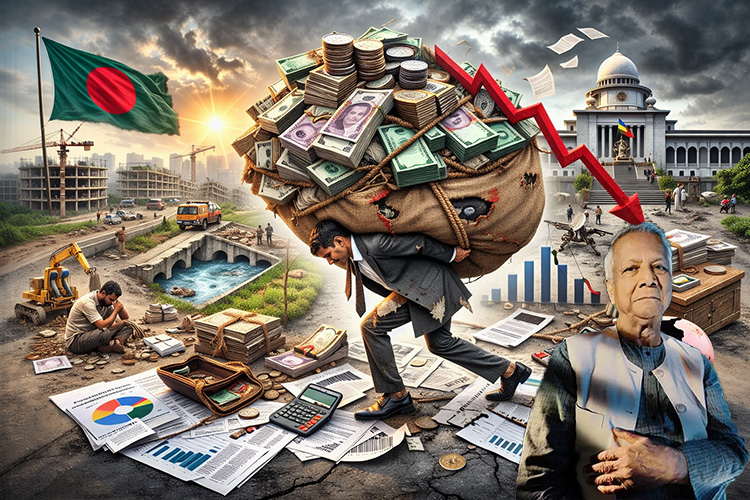
The newly elected BNP government has taken charge of an economy that is burdened with such problems. However, the condition of the banking sector, known as the heart of the economy, is not at all promising. Nearly 6.5 lakh crore taka of defaulted loans, allegations of money laundering of 234 billion dollars and a banking system plagued by irregularities have now become a big headache for the government.
According to experts, the most difficult challenges facing the new government are establishing good governance in the banking sector, recovering defaulted loans, and restoring financial stability by preventing money laundering.
The sector is in deep crisis due to weak supervision, irregularities, and unplanned loan disbursement.
Anis A. Khan, former managing director of Mutual Trust Bank, believes that structural reforms are essential for a sustainable recovery.
He said, a new task force needs to be formed to identify the real wounds of the banking sector. The situation cannot be improved without strict action, especially on the issue of defaulted loans. A huge amount of loans have defaulted due to the distribution of loans without verification; if effective measures are not taken, the sector may suffer further.
According to Bangladesh Bank data as of September 2025, more than one-third of the total loans disbursed by the country’s banks are now defaulted. Out of the total loans of Tk 18 lakh 3 thousand 840 crore, about Tk 6.5 lakh crore, or 35.73 percent, are defaulted. Although there was a tendency to understate defaulted loans earlier, the real picture is now coming to light.
Former Bangladesh Bank Governor Farashuddin Ahmed said restoring order in the economy should now be the top priority.
He said that if discipline is established, fake loan distribution will stop, hundi will come under control, remittances and foreign exchange reserves will increase. He referred to defaulted loans as a ‘cancer’ of the banking sector and said that there is no alternative but to solve this problem.
He also emphasized controlling inflation and increasing revenue.
According to Bangladesh Bank, during the interim government to restore good governance, the boards of directors of 14 banks were dissolved, six banks were merged, and about 52,500 crore taka of liquidity support was provided. Several laws were enacted by issuing ordinances and the policy interest rate was increased to 10 percent, but the desired status was not fully achieved.
According to the central bank, it is not possible to reduce inflation by raising interest rates alone; control over the supply chain is also necessary. However, it has been claimed that there has been some success in reducing hundi. This has increased remittance flows and foreign exchange reserves have also increased.
Agrani Bank Chairman Syed Abu Naser Bakhtiar claimed that Bangladesh Bank has played a positive role in suppressing hundi and stabilizing the foreign exchange market in the last one and a half years. As a result of increased campaigning in diaspora-dominated countries, remittances have also increased, which has helped increase reserves.
According to him, the new government should adopt a zero-tolerance policy against hundi and announce a clear program to restore good governance in the banking sector.

https://stapravda.ru/20221228/reyting_samyh_populyarnyh_hostingov_v_rossii_196445.html, рейтинг хостингов России подтверждает, что выбор надежного провайдера важен для бизнеса.