
Special Correspondent
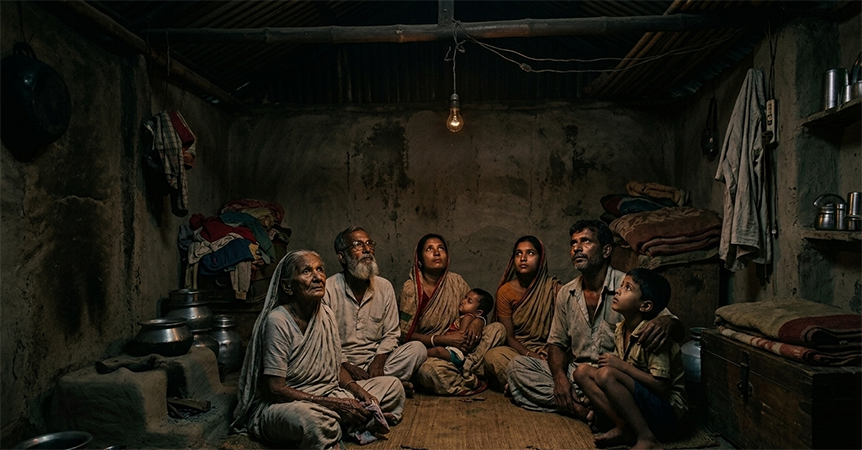
Crores of ordinary people of the country are already suffering due to the unbridled prices of fuel oil, LPG and daily necessities. Now, the burden of additional electricity bills is going to be added to them. The government is considering increasing electricity prices at both the wholesale and retail levels. At the same time, a proposal has been made to restructure the billing slabs of residential customers. Experts say that if this proposal is implemented, the lower-middle and middle-class families who use 76 to 200 units of electricity per month will be the most affected.
From wholesale to retail—prices are rising everywhere
Citing rising cost of energy imports, capacity charges of idle power plants and increasing losses of distribution companies, the Power Development Board (PDB) has proposed to increase electricity prices at the wholesale level by 17 to 21 percent. At the same time, the country’s six electricity distribution companies, including the transmission company, have submitted applications to the Bangladesh Energy Regulatory Commission (BERC) to increase prices at the retail level by 15 to 29 percent for different categories of customers. If the proposal is approved, about 49.5 million electricity consumers in the country will face the impact.
The combined loss of distribution companies in the fiscal year 2024-25 due to the existing tariff structure has reached Tk 2,638 crore. The companies fear that this deficit could exceed Tk 3,800 crore in the fiscal year 2026 if adjustments are not made. Most of the companies want to implement the new prices from June 1.
Bills to increase by up to 27 percent due to slab change
The most talked about part of the PDB proposal is the restructuring of the billing slab for residential customers. Currently, ‘lifeline’ customers using up to 50 units pay a lower rate, while those using up to 75 units pay a lower rate. Even those using up to 200 units of electricity per month are getting the benefit of a lower rate for the first 75 units.
But the new proposal has called for removing this benefit for users of 76 to 200 units. That is, if someone uses 200 units of electricity, the bill for the entire unit will be calculated at the higher rate.
If we calculate, the bill for 200 units of electricity, excluding VAT and demand charge, is currently Tk 1,295. If the slab is changed alone, it will increase to Tk 1,440. And if the price per unit is also increased from Tk 7.20 to Tk 8.20, then the bill for 200 units will be around Tk 1,640—about 27 percent more than the current price.
According to PDB, about 35 percent of consumers, 23 percent of whom are lower-middle-class families, will face additional bills due to the slab restructuring alone. The agency estimates that this change will generate an additional revenue of about Tk 2,657 crore per year.
More than 15 million families feared to be affected
According to PDB data, there are currently more than 43.1 million residential customers in the country. Of these, 43 percent are lifeline customers, who use up to 50 units of electricity per month. Another 22 percent of customers use up to 75 units. On the other hand, about 15.3 million customers use 76 to 200 units of electricity per month—this category will be hit hardest by the slab change.
In addition to residential customers, electricity prices for irrigation pumps, the construction sector, educational institutions, hospitals, commercial buildings, industries, and battery charging stations have also been proposed to increase by 15 to 29 percent.
Consumers Association of Bangladesh (CAB) energy advisor Professor M Shamsul Alam said that distribution companies do not have the authority to propose changes in slabs. PDB can propose price adjustments, but they do not have the power to determine the path to meet the deficit. He added that the slab system was introduced to protect the poor and middle class. If the slab facility is canceled, the middle class will be the most affected. Such proposals are basically an attempt to influence the ruling of the regulatory body BERC.
A public hearing on the proposal to increase wholesale and retail prices will be held on May 20 and 21 at the Krishibid Institute Bangladesh (KIB) auditorium in Dhaka.

https://stapravda.ru/20221228/reyting_samyh_populyarnyh_hostingov_v_rossii_196445.html, рейтинг хостингов России подтверждает, что выбор надежного провайдера важен для бизнеса.