
-Jamil Akhtar
(Former Research Associate, Ministry of Power, Energy and Mineral Resources)
Energy diplomacy is not just about paper and pen. Sometimes a request made at a meeting table becomes the beginning of a major achievement for a country’s future energy security.
The time is May 2023. The entire world’s energy market is unstable due to the impact of the Russia-Ukraine war. European countries are turning their backs on Russian energy and are rushing to find alternative sources. As a result, international demand for Qatari gas has suddenly increased. LNG, which was once available for about $5 per MMBtu in the spot market, has reached $67 due to the impact of the war.
In such a critical time, the biggest question facing Bangladesh was—how would the energy demand of the future be ensured?
Just then , another important chapter in Sheikh Hasina’s energy diplomacy came to the fore .
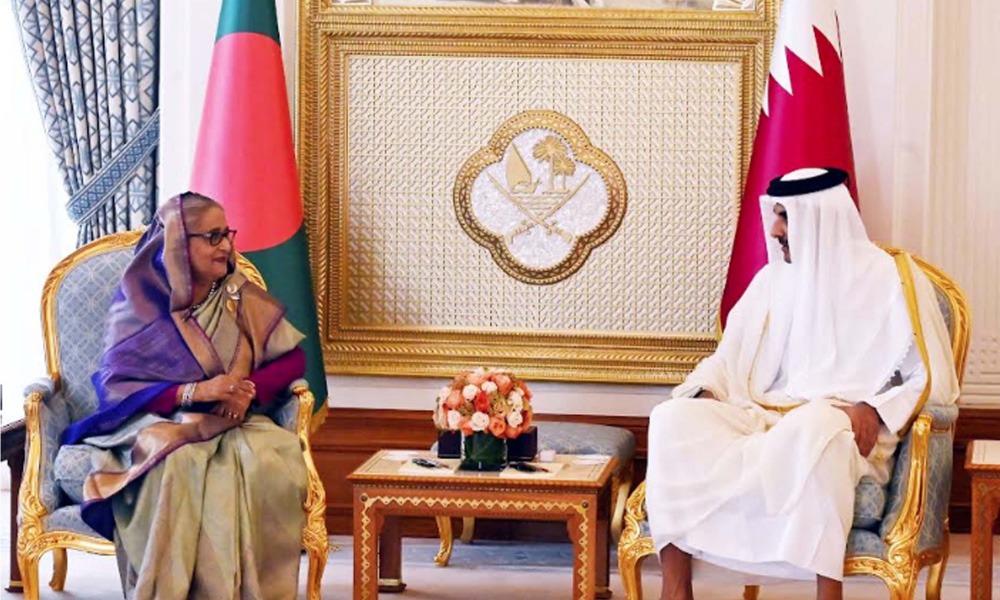
Prime Minister Sheikh Hasina held a bilateral meeting with Qatar’s Emir Sheikh Tamim bin Hamad Al Thani while attending the Qatar Economic Forum in Doha, Qatar on May 24, 2023. Going beyond the formalities of the meeting, she directly raised the issue of Bangladesh’s energy security.
Bangladesh’s economy is progressing rapidly. Industrialization is increasing. Demand for electricity production and gas is increasing. However, there is intense competition for LNG in the global market. Qatar already had a long-term LNG agreement with Bangladesh. But thinking about the future, Sheikh Hasina requested the Emir of Qatar to supply more LNG there.
First contract :
The agreement was signed in September 2017. Under this 15-year government-to-government (G2G) agreement, Bangladesh has been importing 1.5 to 2.5 million metric tons (MTPA) of LNG from Qatar every year, which will expire in 2032.
Second Agreement:
While the first 15-year contract was still in effect, the second contract was signed in June 2023, with a gap of only 6 years. The new 15-year contract is scheduled to come into effect in January 2026. In addition to the previous first contract, under this new contract, Qatar’s state-owned company is expected to supply an additional 1.8 million metric tons of LNG per year from January 2026.
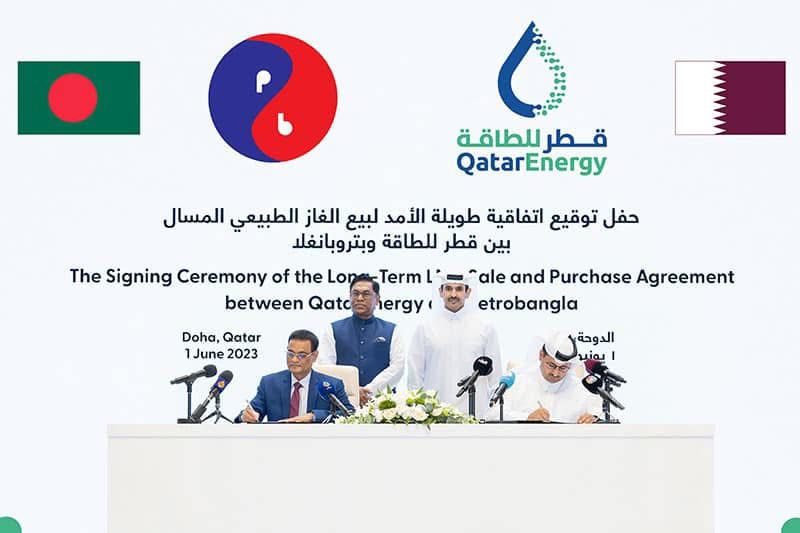
Signing of 2nd long-term LNG supply agreement with Qatar Energy, June 1, 2023
This was the hallmark of Sheikh Hasina’s energy diplomacy. Six years before the first agreement expired, she got another long-term proposal approved, entitled to family relations with the Emir of Qatar, from which Bangladesh’s energy sector gets the full benefit. Instead of waiting for the crisis to begin, she calculated the future before the crisis.
Considering Bangladesh’s needs, Qatar’s Emir Sheikh Tamim bin Hamad Al Thani agreed to supply additional LNG and asked to contact Qatar Energy to initiate a new long-term agreement.
It didn’t take long after that.
Qatar prepared the energy agreement within 7 days of Prime Minister Sheikh Hasina’s request. Then, on June 1, 2023, a new 15-year LNG Sale and Purchase Agreement was signed between Bangladesh and Qatar in Doha—the second long-term LNG agreement between Qatar and Bangladesh. Under the agreement, Bangladesh is expected to receive an additional 1.8 million tons of LNG per year from 2026.
At a time when the whole world is rushing for LNG, European countries are turning to Qatar, and the price of LNG in the international market has increased abnormally, Bangladesh is ensuring another 15 years of LNG supply for the future.
It was not just a commercial agreement. It was the result of diplomatic prowess. It was the result of far-sighted state planning. And behind it was Sheikh Hasina’s direct initiative.
At the time of signing the agreement, the then State Minister for Power, Energy and Mineral Resources of Bangladesh, Nasrul Hamid, also said that Prime Minister Sheikh Hasina’s diplomatic initiative played an important role in the speedy completion of this long-term LNG agreement. In other words, that meeting in Doha was not just a meeting. It was a diplomatic investment for the future energy security of Bangladesh.
Today, when various discussions, crises, or questions about gas and electricity come to the fore, it is not enough to just calculate today’s supply. It is necessary to see what preparations a government has made for tomorrow’s energy security. Because energy security does not just mean providing gas today.
Energy security means finding answers today to the questions of how much electricity the country’s industries will need in the next 10 to 15 years, where the power plants will get fuel to meet that demand, and how the growing demands of the economy will be met.
This is the major success of Sheikh Hasina’s energy diplomacy.
He didn’t just think about dealing with the current crisis; he also brought future energy needs to the diplomatic table. A meeting lasted a few hours. A request was made thinking about the future of the people of Bangladesh. But the result of that meeting was a 15-year LNG deal.
A statesman’s diplomacy sometimes goes like this:
A meeting is over in a few hours , an agreement is signed in a few pages , but its benefits can spread to a country’s energy security for years to come .
Sheikh Hasina’s meeting in Doha was not just a diplomatic meeting. It was a shining example of a statesman’s visionary initiative for Bangladesh’s future energy security.

Prime Minister Sheikh Hasina welcomed the Emir of Qatar Sheikh Tamim bin Hamad Al Thani at her office. Dhaka, April 23, 2026.
In a follow-up to this visit, several major agreements were signed with Bangladesh to expand trade and investment during the visit of the Emir of Qatar, Sheikh Tamim bin Hamad Al Thani, to Dhaka in April 2024. These included:
Mutual investment development and protection:
The agreement was signed to increase long-term investment between the two countries and provide legal protection for investors. The agreement was signed to avoid double taxation and prevent tax evasion on the income of companies operating in both countries.
Establishment of Joint Business Council:
It was formed to establish long-term business linkages between the private sectors of the two countries. This long-term agreement was signed to facilitate direct maritime shipping and maritime trade between Bangladesh and Qatar.
The agreement was signed to institutionalize the legal and judicial systems between the two governments. In addition to important Memorandum of Understanding (MoU) agreements, five important Memoranda of Understanding (MoUs) are in effect between Qatar and Bangladesh on labor market development, higher education and scientific research, youth and sports development, and diplomatic training to expand areas of long-term cooperation.
In addition, at the invitation of the Bangladesh government, Qatar is currently actively considering technical and infrastructural cooperation to increase the country’s long-term fertilizer (urea) supply and to build a deep-sea LNG terminal and pipeline in Matarbari.

https://stapravda.ru/20221228/reyting_samyh_populyarnyh_hostingov_v_rossii_196445.html, рейтинг хостингов России подтверждает, что выбор надежного провайдера важен для бизнеса.