
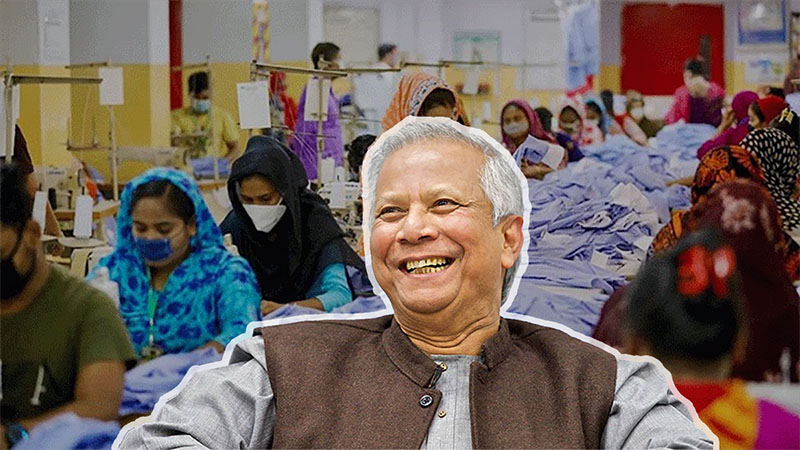
Dr. Mamunur Rashid
The dollar-based service organization of Yunus and the Talpi-bearers has published its/their success report for the past year, taking the year from August 5, 2024 to July 2025. I am trying to learn economics anew by reading the reports of some such service organizations. Let’s discuss a few points.
What they boldly call their successes:
1) Exports have increased by about 8%.
2) Foreign exchange reserves have increased to over $26 billion.
3) Inflation has decreased (point to point) on a basis (June last year to June this year).
4) Remittances have increased to over $30 billion.
5) Order has returned to the banking sector (merger plans are underway).
Now let’s come to my discussion of what actually happened. I will explain in detail what is going to happen in the next step.
[ 1 ] Export earnings:
There are many statistics in economics that are dynamic and change over time. For example, when calculating annual gross production, it is not possible to calculate 100% accurately from July last year to June this year, since some production has started but will end next month.
Similarly, a large portion of the exports being shown were ordered during Sheikh Hasina’s tenure. Note the timing as well – buyers have already placed orders for the new year on August 5, 2024.
But the thing to note here is, why did exports stop at $48 billion (from $47 billion) when they were supposed to be $52 billion?
The second question is, do you think it will be possible to export after resolving the problems described below in the past year?
1) Trouble with customs,
2) Port and supply constraints,
3) Increase in the price of raw materials: Due to NDA, cotton will have to be purchased at a higher price.
4) Domestic proposed tariff of 30%,
5) Obstacles in purchasing raw materials from India at low prices
6) Import letters of credit (LC) have decreased by 25% in the last one year,
7) Credit flow to the private sector has fallen to a 21-year low, and
8) Fuel prices have been increased by 30% in the industrial sector.
9) More than a thousand factories have closed, leaving millions of people (a total of 3 million new ones) unemployed and moving to the countryside.
Instead of solving so many problems, the government was busy wasting time figuring out how to save its own throats and selling the country to a superpower.
But has anyone asked this question, the country’s total production has decreased (from 6% to 3.97%). So how did exports increase? Our economic literacy is low, so they are saying whatever they want and we are forced to accept it.
[ 2 ] Foreign exchange reserves and remittances:
The term savings must be taken into account with great importance. Savings are the sum of a country’s total foreign exchange earnings minus its expenditure in a year.
Source of foreign exchange income:
1) Export earnings
2) Record of remittance in foreign currency (Remittance in)
3) Income from investments in foreign currencies
4) Aid received in foreign currency
5) Loans taken in foreign currency
6) Others
Expenditures in foreign currency:
1) Import costs
2) Repayment of loans taken in foreign currency
3) Transfer of income of foreigners residing in the country in foreign currency (remittance out)
4) Others
Now see how Yunus increased his foreign exchange reserves:
1) Imports decreased by 25%
2) Imports of industrial machinery have also decreased by 24-25%.
3) Remittances have increased.
4) Debt from abroad has increased.
5) Exports have increased.
The only place to take credit for these is the growth in remittances. Now let’s understand a little bit about how remittances increase?
1) Remittances are counter-cyclical – when the economy in a country is bad, remittances come in more.
2) The emotional value of remittances is very high – if there is a fear that the family will leave the country in a bad situation, more remittances will come.
3) There are remittances coming from some countries that have been used to settle payments to brokers in the country for July-August.
Now the question is about remittances, at the rate at which Bangladeshis are being denied visas, what will be the status of our remittances in 2025-26?
Bangladeshis are being deported from Malaysia and the Middle East every day. Yet we are busy with the news of increasing remittances. But again, no one wants to admit that today’s remittances are the result of Sheikh Hasina’s tireless efforts over the past 16 years.
The next question is about foreign exchange reserves. What did Yunus do to increase these reserves?
1) My private sector has been destroyed.
2) My farmers have been killed by importing consumer goods from abroad at low prices.
3) Millions of people have lost their jobs and are involved in various crimes.
4) My standard of living has decreased and expenses have increased due to loans taken from foreigners at high interest rates and under secret agreements.
[ 3 ] Inflation:
On a point-to-point basis, inflation has decreased by about 0.5%. For example, last year it was 8.5% at the end of June, which has now decreased to 8%. This does not mean that prices have decreased. The product that you bought for 100 taka last year, you have to buy for 108 taka this year at a rate of 8%.
On the other hand, average inflation has increased. The average inflation rate for the last 12 months is higher than the average for the previous 12 months. In fact, inflation has increased in the last two months – from May to July. So why this false propaganda?
But what needs to be seen is that by reducing inflation, I am killing farmers and making the country dependent on imports in the long run.
We have gone from being self-sufficient in food to the world’s fourth most food-starved country this year. Now we have to beg for food. Some people have reduced us to a pittance in the name of showing off our foreign exchange reserves.
[ 4 ] Discipline in the banking sector :
Sheikh Hasina’s sixteen years of campaigning have been going on in such a way that one bank was going bankrupt every day. But the truth is that in these sixteen years, Sheikh Hasina has increased the banking sector by eight to nine times from an estimated 2 trillion Bangladeshi taka in 2009 to 16-18 trillion Bangladeshi taka.
Sheikh Hasina was being blamed for the defaulted loans. If we take the total defaulted loans of the last 54 years to be 100 taka, then Sheikh Hasina had 25 taka at the end of June (2024), and the remaining 75 taka was added in this one year by the new NGO Governor Ahsan Mansur.
Why did she do it? Then she can tell everyone that Sheikh Hasina has destroyed the banking sector. There is no other way but to merge it now.
What is the problem with mergers?
Despite the abundant liquidity in the domestic banking sector (about 1.4 trillion taka as of October 2024), thousands of crores of taka have been given to the Islamic banks of the Jamaat by printing money three times. The people will not get any profit in return. The Jamaat is getting its banks back for free.
What is even more alarming is that the process of merging the remaining Islamic banks into Jamaati ownership is underway. Remember, one-third of the deposits and loans of the total banking sector in Bangladesh will then be in the hands of the Jamaatis.
This means that the reforms that are being implemented in the banking sector are actually part of the economic rehabilitation of the Jamaat.
But the economic “deterioration” that was not reported in any report or newspaper:
1) GDP has decreased by about $15 billion. It will decrease further next year.
2) About 3 million people have become unemployed in the private sector.
3) Demand for the product has decreased by 25%.
5) The country had to be sold to maintain exports next year.
6) Despite repeatedly promoting the free floating exchange rate policy, the government has purchased $45 million from the market.
7) The allowance for the 10% of people living at the bottom of the economic ladder has been stopped.
8) Millions of metric tons of rice have been looted from warehouses.
9) Budget allocation for infrastructure development has decreased.
10) The King’s Party has been provided security by spending crores of taka while leaving the people hungry.
11) Allocations to the health sector for marginalized communities have decreased. Necessary medicines are not available in community health clinics.
12) The lives and livelihoods of millions of people associated with them are being destroyed by detaining and abducting over four hundred thousand people of opposing views without trial.
13) Relations with the outside world, including neighboring countries, have been damaged due to revenge.
14) Foreign companies are secretly closing down their businesses.
15) Many foreign companies have faced their first financial losses in the last 60-70 years due to government-backed mobs and policies.
16) The amount of money borrowed from the banking sector in one year is 70 times more than during Sheikh Hasina’s time. Due to which the interest rate on loans has increased to about 16-17%, which was 8-9% earlier.
17) Investors in the stock market have become destitute. The number of small investors has decreased.
We will have to wait a few more months to understand the true state of the country’s economy. Much of the success of the past year has come because of the policies adopted by the previous government. The next few months will be crucial in determining the extent of the destruction and the impact it is having or will have.
In my opinion:
1) Bangladesh has long since entered a period of formal economic recession, decline, and structural famine, although not institutional.
2) It will take at least five years for this dire situation to improve, even with competent leadership, in the future.
If the political situation and police killings are not brought to justice, it may not be possible to restore Bangladesh to its old form.

https://stapravda.ru/20221228/reyting_samyh_populyarnyh_hostingov_v_rossii_196445.html, рейтинг хостингов России подтверждает, что выбор надежного провайдера важен для бизнеса.