
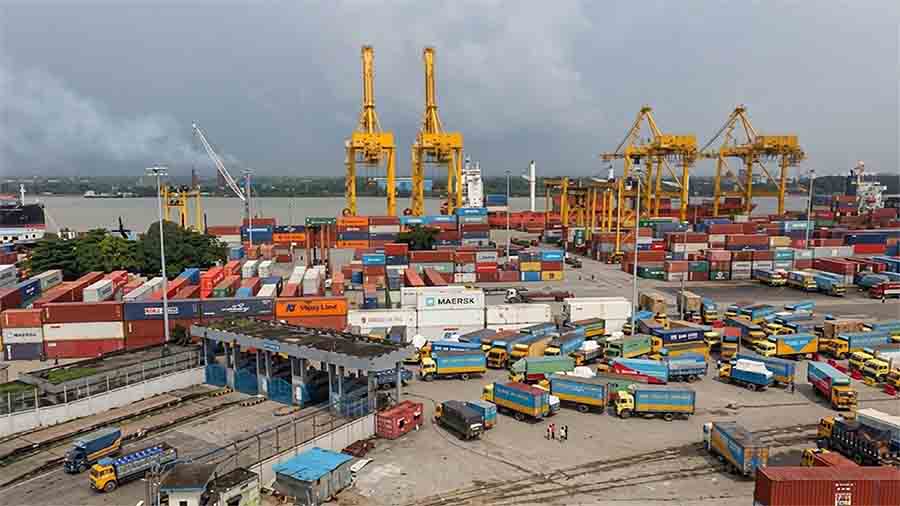
 ❐ Own representative
After the opening of the Padma Bridge, the economic picture of the southern region has changed due to the improved communication system. The use of Mongla Port for exporting ready-made garments from Dhaka is increasing day by day. In the last three years, garment exports have started through this port. Before the opening of the Padma Bridge, ready-made garments were not exported through Mongla Port.
However, the amount of frozen food exports through Mongla Port has decreased. Due to the inability to receive ships on time and to meet the scheduled schedules of buyers, traders are leaning towards using Chittagong Port. As a result, frozen food exports through Mongla Port have decreased by almost half in the last three years. For this, Chittagong Port is being used as an alternative.
According to Mongla Port sources, in the 2020-21 fiscal year before the Padma Bridge was commissioned, 33,316 metric tons of frozen food were exported in 1,648 boxes in 3,081 TEU containers. In the following fiscal year, 2021-22, 31,715 metric tons of frozen food were exported in 1,446 boxes in 2,833 TEU containers.
The Padma Bridge was opened on June 25, 2022. After that, 22,575 metric tons of frozen food were exported through Mongla Port in 1,028 boxes in 2,019 TEU containers in the fiscal year 2022-23. Ready-made garment exports also started from that year. 454 metric tons of garment products were exported in 37 boxes in 74 TEU containers.
In the 2023-24 fiscal year, 22,576 metric tons of frozen food were exported through 1,529 TEU containers in 787 boxes. During this time, exports of garment products increased 10 times compared to the previous fiscal year to 4,730 metric tons. The products were exported in 354 boxes in 706 TEU containers.
Frozen food exports further decreased by almost half in the 2024-25 fiscal year. In that year, 17,262 metric tons of frozen food were exported in 1,529 TEU containers in 768 boxes. At the same time, 4,181 metric tons of garment products were exported in 652 TEU containers in 326 boxes.
Despite this situation in exports, Mongla Port has set a new record in revenue collection. The revenue collection target for the 2025-26 fiscal year was 367 crore 87 lakh taka. 387 crore 95 lakh 12 thousand taka was collected.
In addition to exceeding the target, revenue increased by 408.264 crore taka, or 11.76 percent, compared to the previous fiscal year.
Bangladesh Frozen Foods Exporters Association, Khulna Vice President SK Kamrul Alam said, “In frozen food exports, buyers have specific schedules and time is also important. According to that schedule, ships are not always available at Mongla Port, but ships are available at Chittagong. Therefore, to maintain the buyers’ schedule, some products have to be sent through Chittagong Port.”
He said, “We are using Mongla Port if there are ships at Mongla Port according to the buyers’ schedule.”
Mongla Port Authority Chairman Arif Ahmed Mostafa said that the communication system has improved after the opening of the Padma Bridge. It now takes four hours to travel from Dhaka to Mongla, and seven and a half hours to travel to Chittagong. Due to this, the importance of Mongla Port has increased in the export of ready-made garments. However, due to the improved communication system, traders have started going to Chittagong Port to export frozen goods quickly.
According to him, it is important to have ships on schedule for the export of frozen products.
The chairman also said that despite various crises, the port’s revenue has increased. At the same time, there has been growth in ship arrivals and cargo and container handling.
According to Mongla Port sources, the port has a capacity to handle 1,500 ships per year. However, in the just-ended fiscal year, 815 ships were handled, which is 54.33 percent of the capacity.
The port has the capacity to handle 15 million metric tons of cargo annually. In the outgoing fiscal year, 12.251 million metric tons were handled, or 81.67 percent of capacity.
Although the annual capacity of container handling is 100,000 TEUs, 29,714 TEUs were handled in the outgoing fiscal year, which is 29.71 percent of the capacity. The capacity of reconditioned vehicle handling is 20,000 units. In that fiscal year, 12,075 vehicles were imported—60.37 percent of the capacity.
The port authority said that work is underway through the ‘Internal Business Development Standing Committee’ to increase the arrival of ships. Regular meetings are being held with various departments to increase the enthusiasm of the officials and employees and to speed up the activities. Initiatives have also been taken to implement the development plans.
Work is underway on several projects to increase the port’s capacity, including procurement of auxiliary vessels, upgrading of Mongla Port, and construction of container terminals and yards.
The procurement of two tugboats, one buoy laying vessel, one search and rescue vessel, one pilot mother vessel and one survey and research vessel under the Auxiliary Vessel Procurement Project is in its final stages. The project is scheduled to be completed by June 2027.
Under the ‘Upgradation of Mongla Port’ project funded by the Indian LoC-3, there are plans to construct two container terminals, a container handling yard and a delivery yard with modern equipment. Once these infrastructures are developed, employment opportunities in port-centric shipping, C&F, stevedoring and labor sectors will increase.
A modern management project has been implemented at Mongla Port to collect waste generated from ships and industries and remove spilled oil. The project is expected to be completed in June 2025.
This system will help stop the dumping of ship waste into rivers and the sea. At the same time, it will help reduce pollution of the livestock channel and surrounding rivers and protect the environment of the Sundarbans.
One of the major challenges facing the port is to increase and maintain the navigability of the 144-kilometer-long channel. In addition, emphasis is being placed on ensuring safe and pollution-free waterways, procuring new vessels to replace old auxiliary vessels, developing skilled manpower, and encouraging port users to use Mongla Port.
Apart from this, there are plans to establish Mongla Port as a direct ‘first calling port’, increase the number of container ships and launch direct feeder ships to important ports including Singapore. Emphasis is also being given to increasing the capacity of Khulna-Mongla and Khulna-Bhanga road connectivity.
Rear Admiral Arif Ahmed Mustafa said that the aim of these initiatives is to increase the capacity of Mongla Port and also to further accelerate trade, commerce and economic activities in the southwestern region. The government has a master plan for this.

https://stapravda.ru/20221228/reyting_samyh_populyarnyh_hostingov_v_rossii_196445.html, рейтинг хостингов России подтверждает, что выбор надежного провайдера важен для бизнеса.