

❐ Staff Reporter
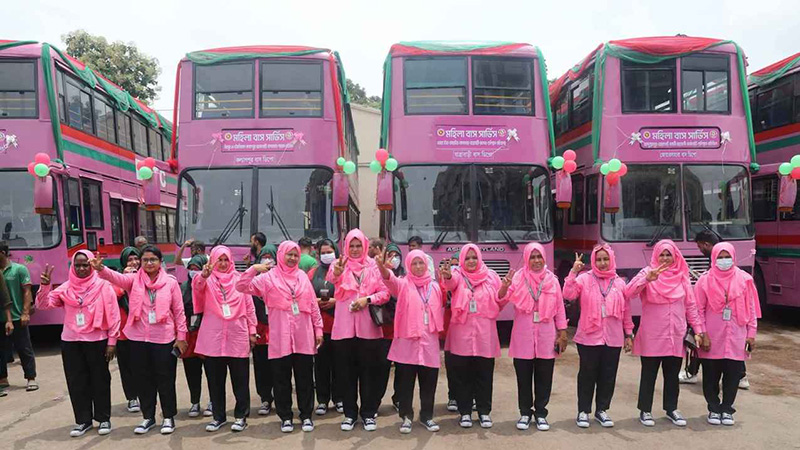
The BRTC’s ‘Pink Bus’ service, which was launched on August 18 with the promise of safe travel for women, has seen a shortage of passengers within a month.
The information provided by the organization shows that the average number of passengers on the 75-seat double-decker buses is not more than 15. However, considering the 14 buses plying on 13 routes as insufficient, measures have been taken to quickly introduce 100 more buses—the decision was announced by the parliamentary committee related to the Ministry of Road Transport and Bridges amid questions about passenger demand, timetables and route efficiency.
According to internal statistics from BRTC, 14 buses from 10 depots of the organization operated 30 trips on August 27 and 30. On those two days, 1,792 tickets were sold, generating a revenue of Tk 27,042. On the other hand, the expenditure on fuel, tolls and staff salaries was Tk 1,49,149. As a result, the loss for the two days stood at Tk 1,22,107—an average of about Tk 61,000 per day.
Despite a slight increase in passenger numbers in mid-September, there was no significant improvement in revenue. On September 16, the average revenue for each of the 13 buses was just Tk 1,147. As a result, the decision to add more buses to the fleet when passenger numbers are low raises questions: Are the schedules and routes of existing services being fixed before new buses are introduced?
Passengers complain that the Pink Bus schedule does not match the travel needs of offices and educational institutions. The buses run once in the morning and afternoon on the designated route. The bus takes until 6:20 pm to leave Kamalapur at 3:40 pm and reach Mirpur. As a result, passengers during office holidays board other buses by then.
Although it is difficult to keep to the scheduled time in Dhaka’s traffic jam, there is no app-based live tracking to know the location of the bus. If the bus is not found after waiting for a long time, passengers have to return to the regular bus.
A section of passengers suggested that it might be possible to extend trips during busy periods by running multiple minibuses instead of large double-decker buses at the same cost.
The initiative to introduce special buses for women is not new in Dhaka. Such services were introduced in 1998, 2009 and 2018—last time under the name ‘Dolonchapa’—under the initiative of the Awami League government. But each initiative was later closed due to lack of passengers and losses.
The decision to introduce 100 more buses has brought to the fore the question of whether previous experience and field research have been given sufficient importance.
Professor Hadiuzzaman, a transport expert at Bangladesh University of Engineering and Technology (BUET), has described the initiative as unplanned.
According to him, it was necessary to conduct proper field research to understand why the previous women’s bus services failed. Although the Pink Bus is currently running at a loss, initiatives have been taken to increase the fleet before reviewing passenger demand and management.
The meeting of the Standing Committee on Road Transport and Bridges of the 13th Parliament was also informed that initiatives have been taken to identify risky intersections and accident-prone areas to reduce road accidents and straighten and widen them. The meeting also mentioned the necessary measures to make new projects straight.
The committee’s first meeting was held at the National Parliament Building last Sunday. It was presided over by committee chairman and National Parliament Whip Rakibul Islam.
Committee members and Road Transport and Bridges Minister Sheikh Rabiul Alam, Lutfar Rahman, Md. Ruhul Amin Dulal, Mohammad Akhtaruzzaman, Newaz Halima Arli, Md. Rafiqul Islam Khan and Md. Matiar Rahman were present. State Minister Md. Rajib Ahsan joined the meeting on special invitation.
The committee members were introduced to officials from ministries, divisions and offices during the meeting. Later, the activities of the ministries and subordinate organizations, plans taken to restore order on roads and highways, and ongoing initiatives were discussed.

https://stapravda.ru/20221228/reyting_samyh_populyarnyh_hostingov_v_rossii_196445.html, рейтинг хостингов России подтверждает, что выбор надежного провайдера важен для бизнеса.