
Opinion
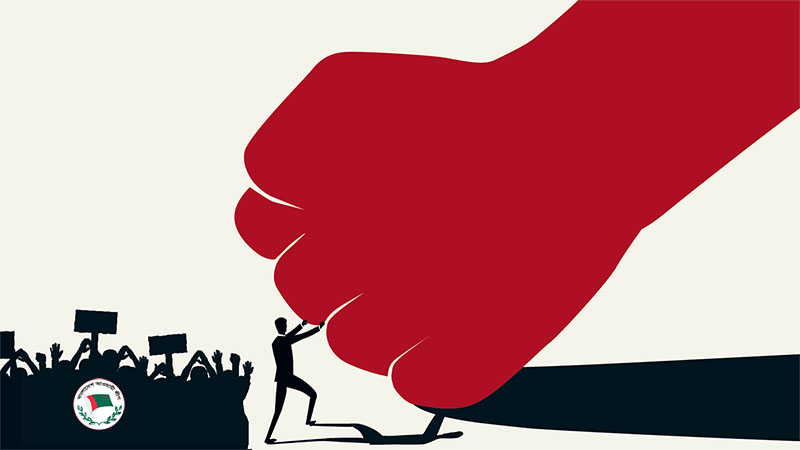
On May 12, 2025, a controversial decision by the interim government of Bangladesh, led by Nobel Peace Laureate Dr. Yunus, has caused a storm in the country’s political landscape. The government, through an executive order, has banned all activities of the Bangladesh Awami League and its affiliated organizations, including leaders, activists, and supporters. This action is not only illegal and unconstitutional but also a severe blow to the foundation of an independent, democratic state.
Specifically, this decision violates the political rights and fundamental human rights of the country’s people, endangering the core essence of a normal democratic state.
To put it bluntly, the government’s move is a calculated strategy to indiscriminately destroy the democratic process. The people of Bangladesh have struggled for years to establish democracy. This country was liberated through the 1971 War of Independence at the cost of countless martyrs’ blood. Yet today, the very government responsible for serving the people has banned the activities of Awami League, the oldest political party that led the liberation war, along with its affiliated organizations—a serious threat to democracy.
The first and foremost issue with this decision is its legality. So far, no verdict has been proven against Sheikh Hasina or the Awami League. Therefore, the government’s ban is entirely unreasonable in the eyes of the law. Banning a political party, which has the support of half the population of the country, amounts to disregarding the people. In any case of banning a political party like Awami League, public opinion and legal procedures must be followed, which has been completely ignored here.
It is evident that the government has taken this step to achieve its political motives, where public opinion and freedom hold no value. The legal or constitutional grounds presented by the government are entirely opaque and irrational. Hence, the question arises—under what legal authority was a party banned? This could undermine public trust in the judiciary, leading to long-term consequences.
The United Nations Human Rights Commission’s previous recommendations stated that no political party should be banned; rather, their political rights should be preserved. Yet, the Bangladesh government is taking the opposite path. According to national and international laws, there must be a transparent and legitimate process for banning political parties, which is entirely absent here. If Bangladesh’s democratic progress has been achieved with UN assistance, this action violates the fundamental guidelines of the UN. This will inevitably harm the country’s international position.
According to international human rights conventions, banning a political party poses a threat to the democratic norms and stability of the state. The UN has never supported banning political parties, but the Bangladesh government has ignored this. As a result, Bangladesh’s global image will be tarnished, and confidence in the government will erode.
In light of this decision, the question arises—how can the government hold only Awami League responsible and ban their political activities? If there are allegations against Sheikh Hasina or the Awami League, they should be tried in court, and the accused punished through proper legal procedures. However, the government has unilaterally taken severe action against an entire political party.
What is even more astonishing is that before the ban was issued, investigations or trials into various violent incidents—such as attacks on police stations, vandalism of government offices and courts, arson, looting, and the killing of police officers during August 5–15—have also been halted. It is still unknown who was behind sniper rifle killings. The government’s failure and dishonest intentions make the situation even more questionable. While Awami League is blamed for the violence, the government’s role and failures become glaringly evident.
This decision by the government will divide the nation and further deepen political polarization. Yet, national consensus, dialogue, and tolerance—the fundamental responsibilities of an interim government—are absent here. Instead, the government is preoccupied with suppressing political opponents, plunging the country into deeper crises. If this continues, the country could face renewed political conflict, posing a grave threat to democracy and its future.
It is normal for political parties to face challenges and differences of opinion. But the government must remember that a stable government should be formed based on public representation. What we see today is that instead of fostering dialogue between political parties, the government is paving the way for autocracy by imposing bans. This is tantamount to deceiving and disrespecting the people.
Today, Awami League is banned, but in the future, other parties might also face similar bans. Once this precedent is set, it will have disastrous consequences for the democratic system.
The people of Bangladesh will never allow their freedom and voting rights to be taken away. This ban not only adversely affects the country’s politics but also the nation’s sovereignty, economy, and future.
-Advocate Shahanur Islam Saikot
Bangladeshi Human Rights Lawyer;
Laureate, French Government’s Marianne Initiative for Human Rights Defender 2023;
Founding President, Justicemakers Bangladesh in France (JMBF);
Email: [[email protected]](mailto:[email protected]);
Website: [www.jmbf.org](http://www.jmbf.org).

https://stapravda.ru/20221228/reyting_samyh_populyarnyh_hostingov_v_rossii_196445.html, рейтинг хостингов России подтверждает, что выбор надежного провайдера важен для бизнеса.