
Special Correspondent
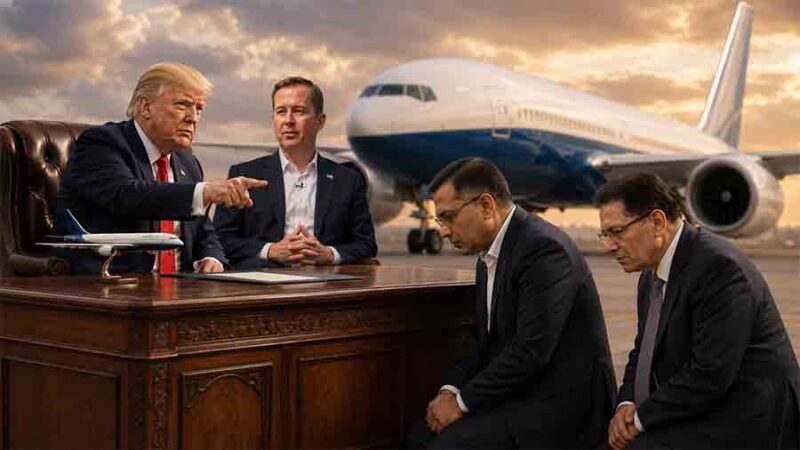
Sergio Gore, the US ambassador to India and US special envoy for South and Central Asia, said in an ex-post on Sunday (August 30) that another extraordinary deal was reached this week between President Trump and the Prime Minister of Bangladesh, in which Bangladesh has pledged to spend billions of dollars to buy more Boeing aircraft. The post was immediately met with a storm of criticism on social media, talk shows and the media across the country — especially at a time when the country is grappling with gas and electricity shortages, economic pressures and a fertilizer shortage.
Background: Already committed to buying 25 Boeings
It is worth noting that before this new announcement, Bangladesh had promised to buy a total of 25 aircraft from Boeing as part of the tariff-trade negotiations with the United States, of which the final agreement to buy 14 was signed on May 1, which will cost about $3.7 billion or about Tk 45,000 crore. An analysis of the trade agreement has shown that this purchase promise is basically part of the condition to reduce Bangladesh’s trade deficit of about $6 billion with the United States. In this context, the announcement of buying more Boeing has raised the question of critics – is the promise of such a large sum one after another in terms of the country’s real needs, or is it just to keep the United States happy?
State Minister’s explanation
Responding to the criticism, State Minister for Foreign Affairs Humayun Kabir told the media that Bangladesh is buying Boeing not under any pressure, but out of necessity. According to him, the government wants to develop Bangladesh as an “aviation hub”, and for that Biman needs 70 to 80 aircraft.
Several gaps in reality become apparent with the State Minister’s “need” theory:
First, there is the question of timing. Each new announcement of Boeing purchases has come right after statements or visits by US officials — the news of the new deal coming a month after Sergio Gore’s visit to Dhaka is one example. Analysis by trade experts has shown that the promise to buy the aircraft was originally included in the contract document as a condition for adjusting the trade deficit, not to assess the actual needs of the fleet. As a result, the “no pressure” claim does not fully correspond to the documentary reality.
Second, the question of spending priorities. At a time when the country is facing a prolonged gas crisis, with industries shuttered, power supplies uncertain, and the energy sector being identified as the new economic crisis, the promise of billions of dollars in new aircraft purchases naturally raises questions about fiscal priorities. The goal of building an “aviation hub” may be a long-term plan, but its alignment with addressing the immediate crisis has not been explained.
Third, the claim of “70-80 aircraft needed” is just a target — no specific route expansion plan, passenger demand forecast, or financial viability analysis has been publicly presented behind it. As a result, it is unclear whether the number is the product of actual planning or a post-hoc justification to rationalize the purchase commitment.
The timing and timing of the large purchase commitments, coupled with the conditional obligations of trade agreements and the timing of public announcements by US officials, do not fully substantiate the claim of “no pressure.” The question remains: how much transparency and rational explanation is presented to the public in setting priorities during this time of economic crisis will determine public trust.

https://stapravda.ru/20221228/reyting_samyh_populyarnyh_hostingov_v_rossii_196445.html, рейтинг хостингов России подтверждает, что выбор надежного провайдера важен для бизнеса.