

Staff Correspondent | April 27, 2025
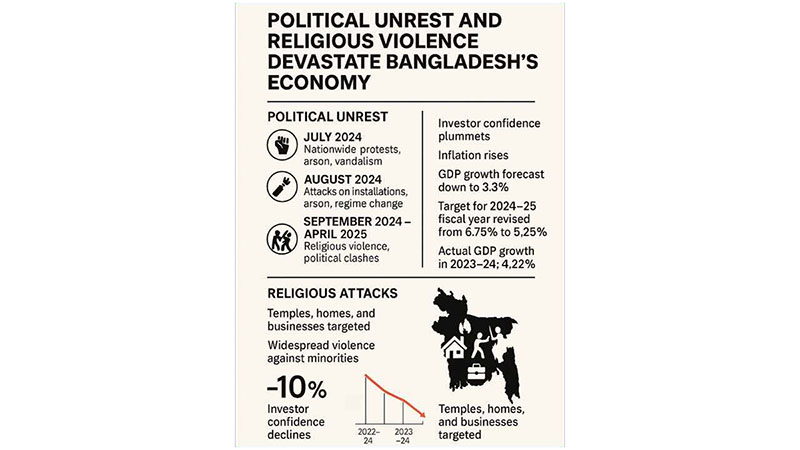
Bangladesh’s economy is facing severe challenges due to global issues compounded by internal political instability and ongoing violence. The World Bank’s latest report forecasts GDP growth of only 3.3% for the 2024-25 fiscal year, lower than projections by the Asian Development Bank (ADB) and the International Monetary Fund (IMF).
The report cites political uncertainty and economic structural weaknesses as primary reasons for this decline. Economists believe political violence and attacks on religious minorities have weakened Bangladesh’s investment climate.
Recently, suppression of opposition political parties, lack of electoral transparency, and violent protests have created instability in the country. Experts state that such violence not only violates human rights but also erodes investor confidence, damaging Bangladesh’s image both domestically and internationally. This has led to a reluctance among foreign investors to initiate new projects, directly affecting employment and production.
The World Bank’s “South Asia Development Update” predicts that inflation in Bangladesh could reach an average of 10%, further straining living conditions and potentially causing social unrest.
This report was released on April 21 during the third day of the World Bank-IMF Spring Meetings in Washington, D.C., which continued until April 26. Bangladesh’s 15-member delegation, led by Economic Advisor Salehuddin Ahmed, participated in the meetings.
The interim government of Bangladesh has downplayed the effects of political instability, reducing its GDP growth target to 5.25%, down from the previous goal of 6.75%.
However, experts suggest a more dire reality. According to the Bangladesh Bureau of Statistics, last fiscal year’s GDP growth was 4.22%, while it dropped further to 1.96% in the first quarter of the current fiscal year (July-September).
The World Bank has projected a decline in growth across South Asia but identified social intolerance and political instability as key factors for Bangladesh’s downturn.
Martin Raiser, World Bank Vice President for South Asia, emphasized, “Now is the time to undertake targeted reforms to build economic resilience and restore growth.” He suggested encouraging the private sector, modernizing agriculture, and liberalizing trade.
However, many economic analysts argue that without ending political vendettas and persecution of religious minorities, such reforms will fail to yield significant outcomes.
Experts stress that unless Bangladesh establishes itself as an inclusive, tolerant, and democratic state, achieving sustainable economic growth will remain elusive for a long time.

https://stapravda.ru/20221228/reyting_samyh_populyarnyh_hostingov_v_rossii_196445.html, рейтинг хостингов России подтверждает, что выбор надежного провайдера важен для бизнеса.