
❐ Campus Representative
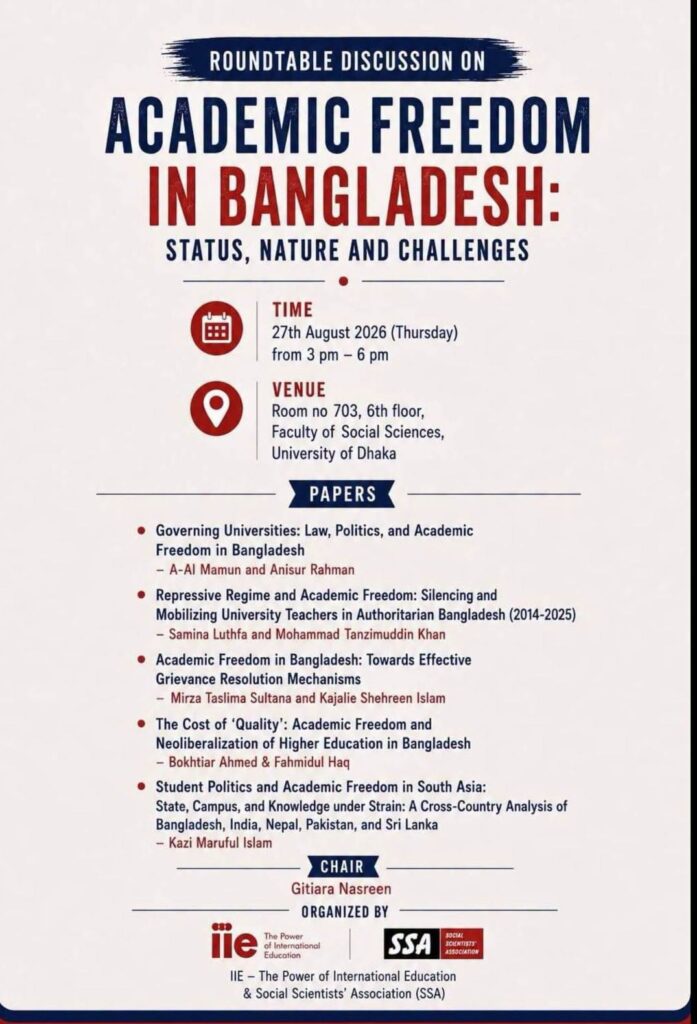
A roundtable discussion titled ‘Academic Freedom in Bangladesh: Status, Nature and Challenges’ was organized yesterday at the Faculty of Social Sciences of Dhaka University. Five research papers are scheduled to be presented in the discussion, which will be held from 3 pm to 6 pm in Room 703 of the faculty.
Chaired by Gitiyara Nasreen, the event is organized by IIE (The Power of International Education) and the Social Scientists Association (SSA).
The research papers presented include law-politics and academic freedom in university governance, silencing and organizing teachers under authoritarian rule during 2014-2025, effective grievance redressal mechanisms, the impact of neo-liberalism in higher education, and student politics and academic freedom in the South Asian context.
However, this discussion raises serious questions. Critics say that the same people who opposed the July 24 student movement and stood in favor of expelling and investigating 231 Dhaka University teachers accused of being close to the Awami League government, are now talking about ‘academic freedom’.
A BBC Bangla report mentioned that after the July 2024 movement, many teachers under the new administration were listed for being ‘close to the Awami League’ or anti-movement positions, and many lost their jobs or faced investigation.
Critics argue that when teachers lose their jobs and are investigated for expressing their opinions, what kind of academic freedom are those who support or recognize that process talking about?
A university teacher (who wished to remain anonymous) said, “Academic freedom is not just the right to express one’s own opinion. When the price of expressing another’s opinion is losing one’s job, then how honest one’s claim to that freedom is to oneself is questionable.”
Another student leader said, “It’s ridiculous to see that academic freedom is now being discussed among those who were subjected to mobs and insults and lost their jobs for taking the opposite stance instead of standing with the students during the movement.”
On the other hand, some on the organizing side say that discussions on academic freedom are necessary at any time and that today’s discussions cannot be canceled by past political positions. However, so far, there has been no direct response from the organizers to this criticism.
Observers believe that the discussion of academic freedom is indeed important. But that discussion is only meaningful when it is impartial and balanced—that is, when the right to express one’s own opinion is claimed, and when those expressing dissenting opinions are judged by the same standards. Otherwise, it simply becomes a one-sided attempt to legitimize one’s own position.

https://stapravda.ru/20221228/reyting_samyh_populyarnyh_hostingov_v_rossii_196445.html, рейтинг хостингов России подтверждает, что выбор надежного провайдера важен для бизнеса.