

International Desk
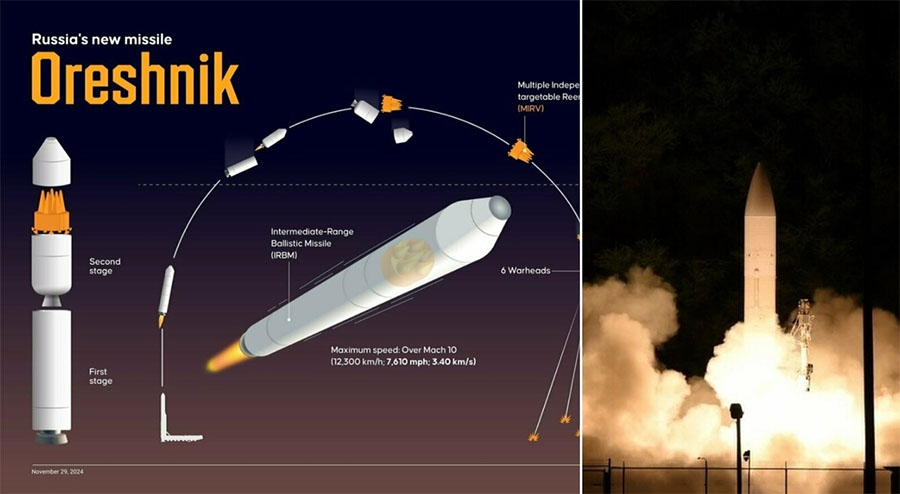
Russia has once again launched the dreaded ‘Oreshnik’ hypersonic missile into Ukraine after 2024. According to analysts, at a time when Ukraine is making excuses and pursuing secret ulterior motives regarding talks to end the war, Russian President Vladimir Putin ordered this attack to stop Ukraine’s mischief and to send a strong message of its military capabilities to the Western countries that have been supporting Ukraine from behind.
President Putin has long touted the speed and destructive power of the Oreshnik missile. Moscow first used the missile in Ukraine in November 2024. It was then suspended in the hope that the war would end. But Western countries are using Ukraine to provoke Russia by carrying out secret attacks on various important installations in Russia, including Putin’s residence. As a result, President Putin has been forced to make difficult decisions.
Russia carried out another airstrike on Monday night, with Russian military officials claiming that the strike targeted targets in the Lviv region of western Ukraine.
Moscow said the missile launch was in response to a drone attack on President Putin’s residence, a claim that Kiev and Washington have denied.
Analysts say Russia’s decision to launch the attack comes in the wake of several recent international events, including the deployment of US special forces to detain Venezuelan President Nicolas Maduro and the seizure of a Russian-flagged oil tanker in the North Atlantic.
Experts believe that the missile used in this attack may have contained an inactive or ‘dummy’ warhead instead of an active weapon, as was seen when it was first used in 2024. As a result, the main goal of the attack was not military destruction, but rather to send a political and strategic message.
Britain and France had previously announced that they planned to deploy troops to Ukraine if a ceasefire came into effect. Moscow responded by warning that foreign troops would be considered legitimate military targets.
Gerhard Mangot, a Russia expert at the University of Innsbruck in Austria, said Moscow is unhappy with the recent diplomatic process in which the United States has bypassed Ukraine and European countries. In addition, Russia is particularly angered by the possible deployment of troops by European allies. He believes that the decision to use Oresnik was made in this context.
According to Mangot, the attack was essentially a clear signal of Russian military capability to the West. Moscow wanted to convey that Russia cannot be ignored and that its position at the negotiating table needs to be respected.
He said that while the Orionic missile is capable of carrying both nuclear and conventional warheads, there was no indication of nuclear components in the recent attack.
A senior Ukrainian official told Reuters that the missile hit a state-owned enterprise in the city of Lviv and likely used an inert warhead. Russia used a similar warhead when it first tested the missile in combat in 2024.
According to military experts, Russia has been repeatedly warning in the interest of peacekeeping. If Russia had actually fired Oresnik missiles with active warheads at Ukraine, the country would have suffered massive damage.
According to various international military journals, Western countries currently do not have the technology to intercept ballistic missiles.
Politicians from around the world are praising Russian President Vladimir Putin’s patience in response to the launch of the Oreshnik missile, which is seen as Russia’s latest attempt to stop the war.
Pavel Podvig, director of the Russian Nuclear Forces Project, said that Russia is now using Oreshnik mainly as a weapon for political signaling. Ensuring destructive damage is not their main goal at the moment. However, even if an inert warhead is used, the fear of this weapon for Ukraine and its allies does not diminish.
Meanwhile, the attack, just 60 kilometers from the border with NATO member Poland, drew immediate reactions from Western countries, with leaders from Britain, France and Germany calling the attack “provocative and unacceptable.”
European Union foreign policy chief Kaza Kalas said this was a clear provocation against Ukraine and at the same time a serious warning to Europe and the United States.

https://stapravda.ru/20221228/reyting_samyh_populyarnyh_hostingov_v_rossii_196445.html, рейтинг хостингов России подтверждает, что выбор надежного провайдера важен для бизнеса.