
Staff Reporter
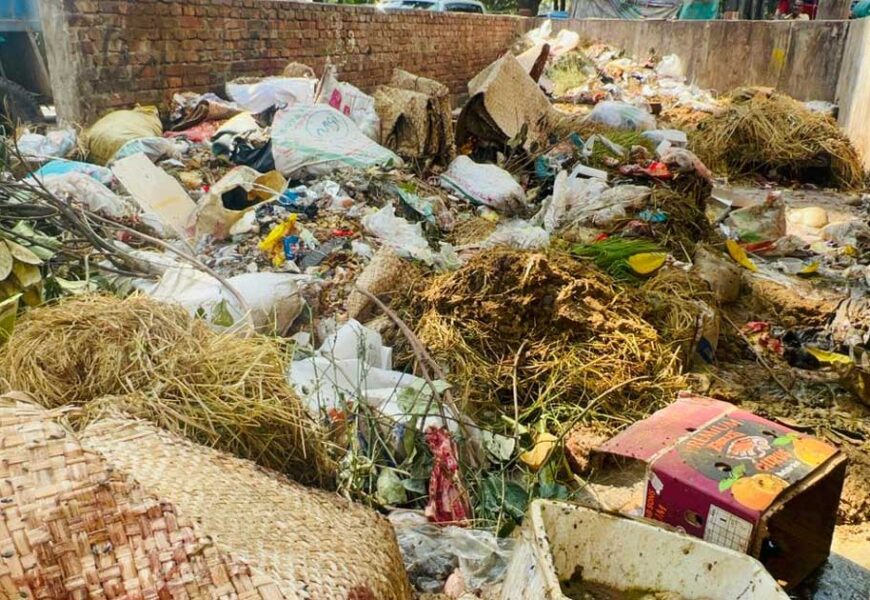
Two days after Eid-ul-Azha, Dhaka’s roads, alleys, and intersections remain strewn with leftover waste, mats, bones, and rotting meat pieces. The stench has made life unbearable for city dwellers. Yet, the city corporations claim all waste was cleared overnight.
Around 3 PM on Sunday, sacrificial waste was still visible on roads in Mohammadpur’s Tikka Para, Tajmahal Road, beside the Ring Road, and in front of Kishaloy High School. In some areas, sanitation workers were present; in others, they were absent.
Field-level sanitation workers say while waste was collected from homes, garbage at intersections and open spaces remains untouched, with no certainty when it will be removed.
The same scene prevails in Old Dhaka’s Nazira Bazar, Bakshibazar, and Lalbagh areas. Animal heads, legs, mats, and plastic bags filled with waste lie piled at alley entrances, emitting unbearable odors.
Dhaka South and North City Corporations had earlier promised to clear all waste within 12 hours. But even after 36 hours, that commitment remains unfulfilled.
Government Claim: 100% Cleared!
Local Government Adviser Asif Mahmud Sajib Bhuiyan wrote on Facebook Sunday afternoon: “All waste in 487 wards across 12 city corporations was 100% cleared by 10 PM!” He called it a “victory of hard work and commitment.”
Meanwhile, Dhaka North City Corporation (DNCC) Administrator Mohammad Ejaz told reporters on Eid evening: “85% of the waste has been removed.”
Later on Sunday, the city corporations claimed in a statement that 13,174 tons of waste had been cleared.
Reality on the Ground Tells a Different Story
Nargis, a sanitation worker in Mohammadpur, said: “We’ll still have to clean tomorrow.”
Shafiqul Islam, a worker on Tajmahal Road, said: “Garbage at the intersections is still there. Big trucks will come to take them, but we don’t know when.”
Near Tikka Para on Ring Road, the stench of waste lingered, yet no workers were present.
The same situation prevails in South City areas. In Old Dhaka’s Hussaini Dalal Road, Lalbagh, and Posta, fresh sacrificial waste has piled up for the second day.
Residents say the city corporations did not provide a list of designated slaughtering spots this year, leading many to sacrifice animals right outside their homes—on roads, parking spaces, and alley entrances.
In areas with poor drainage, blood and waste have mixed into stagnant, foul-smelling pools.
Citizens’ Frustration
Meherin Afrin, a Mohammadpur resident, said: “It’s disgusting to step outside with children. The streets are still dirty.”
Sakib Hasan from Dhanmondi’s Shankar area said: “Blood and meat are piled at alley corners. The city corporations claim everything is clean, but nothing has been done in our area.”
Asif Ahmed from Chawkbazar said: “Flies and insects swarm over garbage piles. Clothes get ruined by mud and blood when walking outside. I don’t even know where to complain.”
Plan vs. Reality
Every Eid-ul-Azha, Dhaka generates nearly 50,000 tons of waste. Previously, it took three days to clear; then the deadline was reduced to 24 hours. This year, the target was 12 hours.
To meet this, the two city corporations deployed 20,267 sanitation workers, distributed nearly 1.4 million waste bags, and launched hotlines.
Yet, the reality shows these measures were not effectively implemented. Waste remains in some places, while in others, people ignored slaughtering rules.
Now, Dhaka residents question the gap between the government’s “statistical victory” and their “real-life suffering.”

https://stapravda.ru/20221228/reyting_samyh_populyarnyh_hostingov_v_rossii_196445.html, рейтинг хостингов России подтверждает, что выбор надежного провайдера важен для бизнеса.