

Sayeedi Samachar | The Rise of a Religious Trader | Asif Nazrul | Weekly Bichitra | 10 February 1989
Asif Nazrul,
former advisor to the interim government, teacher at Dhaka University
The recent mass protests against Maulana Delwar Hossain Sayedee have once again proven the unacceptability of Maududism and the politics of religious business in this country. After Sayedee’s inclusion in the Jamaat Majlis-e-Shura on December 18 last year, people from all walks of life, including the country’s clerical community, became aware of Sayedee. In Sylhet, Dhaka and Chittagong, including various places in the country, a spontaneous public opinion developed against Sayedee, the stage leader of Jamaat. In the face of opposition from all quarters, regardless of party affiliation, Sayedee was expelled from Sylhet, and permission for his mahfils was withdrawn in various places in the country. The indomitable Sayedee still secretly entered some places in the dark of night. He delivered his speech under strict police guard and in the presence of armed cadres of Jamaat. The character and weakness of these mahfils made Sayedee’s religious business character more public and open. In the midst of criticism, protests, and strikes, Sayeedi suddenly rose to the level of a popular figure like Ghulam Azam.
The rise of Sayeedi
Sayeedi’s acquaintance with the capital Dhaka began around 1975. At that time, he gave a Tafsir at a gathering in Armanitola in old Dhaka. According to information provided by Maulana Qari Obaidullah, the Khatib of Chawkbazar Shahi Mosque and one of the initiators of that gathering, a Tafsirul Quran gathering was organized every year at Armanitola ground at that time. At the stage of organizing such a gathering in 1975 or 1976, some Muslims (Maulana Obaidullah said later that I heard that they were associated with Jamaat-e-Islam) proposed to invite Sayeedi. Although Sayeedi was fairly well-known in Khulna at that time, no one in Dhaka knew him that way.
After being invited to the Armanitola Mahfil, Sayeedi got the opportunity to give Tafsir for the first time in Dhaka. The Mahfil committee made arrangements for Sayeedi, who came to the Mahfil in very religious attire and plain clothes, to stay and eat. After Armanitola, Sayeedi gave Tafsir in two more Mahfils in Lalbagh and Chawkbazar. In these Mahfils, he first started giving Tafsir of the Quran to the tune of songs. Local scholars criticized it as un-Islamic, and later the Mahfil committee refrained from inviting the controversial Sayeedi ever again.
The controversy in the life of this Maulana from Pirojpur began even earlier. While he was a fifth-grade student at Sharshina Madrasa, he was expelled from the madrasa on suspicion of being involved in Jamaat politics, said his one-time colleague Maulana Ishaq Obaidy. After Sharshina Madrasa, he enrolled in Khulna’s Alia Madrasa. There is a lot of doubt in the country’s scholarly community about whether he actually obtained a Kamel (Dawra-e-Hadith) degree from that madrasa. Although hundreds of scholars of the country have challenged Sayedee several times to prove the truth of this matter, Sayedee has never accepted the challenge. Although there are questions about the perfection of Sayedee’s Islamic education, his vocal agility and ability to attract an audience have always been recognized without a doubt. According to various sources, before the War of Independence, Sayeedi used to make a living by singing and selling perfumes, tasbeehs and religious books at the Garer Haat in Pirojpur, using his vocal talent. During the War of Independence, there are allegations of looting and robbery against him.
In this context, the July ’87 issue of the monthly Nipun Patrika quoted the Muktijoddha Sangsad’s Parerhat Union as saying… ‘Sayeedi was directly involved in the Pak occupation forces during the War of Independence. He looted the houses of the Hindu community in Parerhat port as booty in the name of religion. And he broke into the shop of a Hindu businessman named Madan and took it to his own house. After the War of Liberation, Sayeedi fled for a long time and returned to his village after ten years.’
A local cleric said that Sayeedi was first seen in public in Chittagong after independence. At that time, he used to collect donations while walking around with a microphone for a mosque under construction. His melodious voice and style of speech attracted the Jamaat-affiliated non-political organization, the Islamic Social Welfare Council. After the war of independence, all the activities of Jamaat were conducted in great secrecy. Under the guise of the Social Welfare Council, Jamaat limited their activities to organizing Tafsir Mahfils. The Social Welfare Council started using Sayeedi to achieve their goals in exchange for financial benefits. And thus, Sayeedi, as the mouthpiece of Jamaat, at one point became involved in Jamaat-e-Sayyid.
Saeedi hid his identity
One of the stages of Jamaat-e-Islam’s organizational structure is inclusion in the Majlis-e-Sura. According to the constitution, one can become a member of the Majlis only after passing the associate member-worker-Rokan stage. In that case, Sayeedi’s inclusion in the Majlis-e-Sura proves his long-standing relationship with Jamaat politics.
Two days ago, a central leader of Jamaat publicly admitted that Sayeedi had been involved in Jamaat politics for a long time. Khilgaon Islamic Library President Abul Kashem said, “Yes, he had been involved in Jamaat for 10 years.”
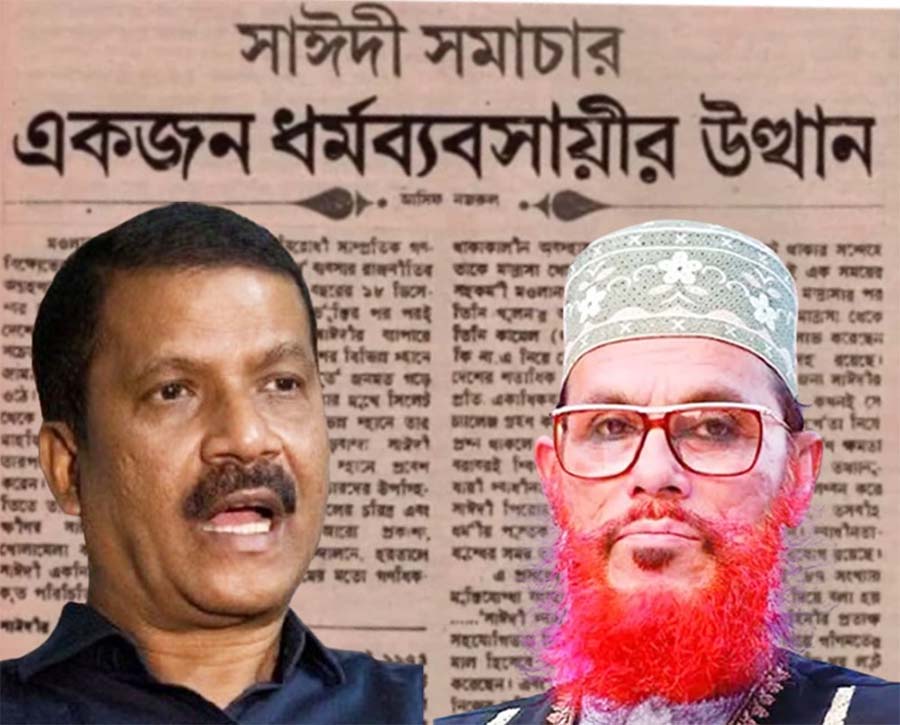
However, Sayedee’s statement in this regard is indicative of a blatant lie. In an interview given in the 4th issue of the fortnightly Tarakalok, Sayedee clearly said, ‘I am not affiliated with any political party. I would request those who make this allegation to listen to my statement more carefully.’
This lie of Sayedee was also seen during the formation of a religious organization called ‘Ittehadul Ummah’. In late 1981, a secret meeting was held at the Khanka of the Pir Saheb of Baitush Sharaf to plan the formation of the organization. The meeting was attended by the Pir of Baitush Sharaf, the Mejhujur of Sharshina, Khwaja Sayedee Pir of Jessore, Maulana Delwar Hossain Sayedee, and Golam Azam of Jamaat.
Sayeedi never admitted this. A source in the Khilafat Movement described a conversation he had with Maulana Hafezzi Huzur, the head of the Bangladesh Khilafat Movement at that time:
Saeedi: There is a vacant chair for you in Ittehadul Ummah, sir.
Hafezji: This saying is not in the Holy Quran. You should repent from all this politics.
Sayeedi: Sir, I don’t do these things, why should I repent?
Realizing that Ittehadul Ummah was a pseudo-organization of Jamaat, Hafizji Huzoor refrained from joining it. Through this organization, Jamaat tried to recruit the country’s prominent religious scholars. Once this secret desire of Jamaat became clear, the breakup of Ittehadul Ummah became inevitable. As the disillusioned Maulanas withdrew, Ittehadul Ummah became an inactive organization at one point.
The separated Maulanas later came together and formed an organization called the Islamic Shasantantrik Movement in 1986.
This group of Pir Baitush Sharaf of Charmonai and Maulana Abdur Rahim also included the rebel faction led by Maulana Azizul Haque of the Khilafat and the Bachchu group of the youth camp that broke away from Jamaat from the beginning.
Interestingly, Sayeedi himself was also involved in the initial stages of the formation of this party. Jamaat’s relations with Maulana Sayeedi and Kamaluddin Jafri deteriorated during this period when Abbas Ali Khan led a Jamaat conference at Manik Mia Avenue. The Sayeedi did not easily accept the leadership of a non-Muslim in the presence of scholars. Also, during various incidents, the Sayeedi realized that the issue of politics was more important than religion in the Jamaat leadership. A scholar associated with the Islamic Shasantantrik movement said that for these reasons, Sayeedi probably tried to withdraw from the circle of Jamaat activities. Sayeedi repeatedly denied any relationship with Jamaat to the leaders of the Islamic Shasantantrik movement at this time.
Some scholars were again confused by Sayedee’s lies. Sayedee became involved with the Islamic Shasantantra movement. In the initial stage of the movement, Sayedee’s signature was on the collection coupon along with Maulana Fazlul, Maulana Madani, and Maulana Abdul Jabbar. Sayedee’s name was also on the convening committee of the first conference of the Islamic Shasantantra movement. But a few days before the conference began, Sayedee suddenly disappeared. According to various sources, due to Sayedee’s betrayal, the state Jamaat started pressuring Sayedee to sever ties with the Shasantantra movement. At one point, a source said that Sayedee was even imprisoned in an unknown place for some time.
Finally, just before the conference began, Sayeedi was sent to Saudi Arabia under the pretext of performing Umrah Hajj. After returning from Saudi Arabia, Sayeedi denied any connection with the Shasantantra movement by issuing a statement in the newspaper. The leaders of the Shasantantra movement were shocked by Sayeedi’s unexpected betrayal and lies. Even the scholars outside the movement could not accept Sayeedi’s role. Regarding this, Maulana Zafrullah Khan of the Khilafat movement said, “The incident of a part of the Khilafat breaking away and joining the Islamic Shasantantra movement was a blow to Hafezji. Even then, we do not consider Sayeedi’s behavior acceptable or commendable in any way. It was nothing more than a heinous betrayal or betrayal.”
Sayeedi’s religious business
This little-known chapter of lies and betrayal began to fade away with Sayeedi’s well-developed strategy of religious business. Through the twisting of words, arbitrary interpretation of the Quran and Hadith, and fascinating presentations, Sayeedi tried to establish himself as the true bearer of Islam in the Tafsir Mahfil. Along with this, his wealth began to swell with the money he received in exchange for Tafsir. The Sayeedi, who was first seen by Qari Obaidullah in Dhaka around 76, helpless and in the guise of a religious person, became the owner of a palace-like building in a span of a century. The rental income from Sayeedi’s four-story house at 914 Shahid Bagh, which is well-equipped with all kinds of modern systems, is currently around 20 thousand taka.
In this regard, Maulana Jalalabadi, Maulana Ishaq Obaidi, Maulana Zafrullah Khan, Maulana Obaidullah all say – ‘Taking money in exchange for interpreting the Quran is in no way Islamic. People of tafsir can spontaneously help a scholar in dire need with food, accommodation or travel expenses. But interpreting the Quran in exchange for money through commercial negotiations is completely prohibited. This is nothing more than a kind of haram trade.’
000
‘Whatever is given for my expenses is in accordance with Sharia’ — Maulana Saeedi
Maulana Sayedee refused to give a direct interview to the representative of the weekly Bichitra and demanded written questions. The answers to the written questions are given below:-
Question: When did you become involved in Jamaat-e-Islami politics? Were you ever an associate member of Jamaat, at the activist or Rokon level? If not, how did you suddenly become a member of the Maslis-e-Shura?
Answer: I became a member of the Shura based on the constitution of Jamaat-e-Islami. If necessary, you can study the constitution.
Question: What did you do during the 1971 war of independence? What is your assessment of Jamaat politics at that time? Do you support it?
Answer: That time was a period of extensive research and study as food for our thirsty minds. In addition to the Quran, Hadith, Tafsir and Aqeed, I was busy with comparative review and research of many religious texts of other religions and various ideologies and doctrines of the world. Due to which, my actual participation in the activities of any party or faction was no longer mine. However, I was always against the exploitation that was going on in Bangladesh. Jamaat-e-Islami has already published its explanation of the activities of Jamaat-e-Islami at that time in various press conferences and booklets. I do not think it is unreasonable.
Question: A freedom fighter from Pirojpur had accused you in the monthly Nipun Patrika of looting the property of some Hindu families in 1971. If that allegation was false, why didn’t you send a protest letter to the newspaper?
Answer: All those allegations are completely false. I have given my answer to them at that time and later in various gatherings.
Question: Various scholars of the subcontinent have called Maulana Maududi’s interpretation of Islam distorted and unacceptable. Jamaat’s politics have progressed by embracing this Maududiism. In this context, what is your opinion about the acceptability of Maududiism and Jamaat?
Answer: Although some scholars consider some parts of Maulana Maududi unacceptable, most of the world’s prominent and Haqqani scholars accept his interpretation as correct. I found his opinion correct from the point of view of Islam. The politics of Jamaat-e-Islami is based on the Quran and Sunnah. This party conducts politics in Bangladesh according to the country’s constitution. It is worth noting that there is no doctrine called Maududiism. Maulana Maududi was one of the greatest Islamic thinkers and servants of this century.
Question: In what year did you receive your Kamel degree from which madrasa? Tell us about your professional life. What is your current source of income?
Answer: I graduated from Sharshina Madrasa in 1962, but I do not consider any degree to be the pinnacle of knowledge. I still spend a significant part of my time studying and learning. I consider whatever knowledge Allah has given me to be the result of my diligent study.
My profession can be considered as the profession of knowledge and literary practice. So far, many of my books have been published. And the profit from the sale of those books is my source of income.
Question: How long did it take you to build your current house in Shahid Bagh? What was the source of the money?
Answer: The house in question is my own. It was built with my lifetime savings and loans from prominent friends. The construction work was accelerated by the payment of some money towards the advance rent of the ground floor of the house by the Islami Bank. I still have these loans.
000
It is worth mentioning that in an interview given to a newspaper a couple of years ago, Sayeedi himself said, “I hate commercial pirs.” Of course, Sayeedi did not say anything about his commercial practice in Islam. However, Sayeedi got himself entangled in his own web in the very condition of his financial agreement with the organizers of the tafsir before the tafsir. Although there is no written evidence of this process of accepting money, the matter is no longer a secret in direct discussions with the organizers of the tafsir. In this regard, Md. Nur Hossain, one of the organizers of the tafsir mahfil at the ground of Mofidiyam High School in Mirpur in 1986, said, “After initial discussions with Huzoor, Huzoor agreed to come to the jalsa for 4 thousand taka. But when he left after only an hour of speaking at the jalsa, there was a commotion in the mahfil. Many people kept saying that he was brought for so much money, why did Huzoor leave so soon!”
Maulana Faizur Rahman, the Nayeb-e-Ameer of the Khilafat Movement, went to a gathering in Yamansingh as the president. Sayedee was also brought to interpret the Quran in that gathering. Faizur Rahman said, ‘In that gathering, I heard that Sayedee was paid 10,001 taka for giving sermons.’ Maulana Habibur Rahman, Secretary General of Ahl-e-Sunnat Wali Jamaat, said… Before Sayedee’s sermon gathering, donation coupons were printed under the pseudonyms of various organizations and money from various sectors including zakat was collected as donations. People’s question: What is the need for a person to spend a lot of money for a sermon? Sayedee Sahib gets the lion’s share of that money.
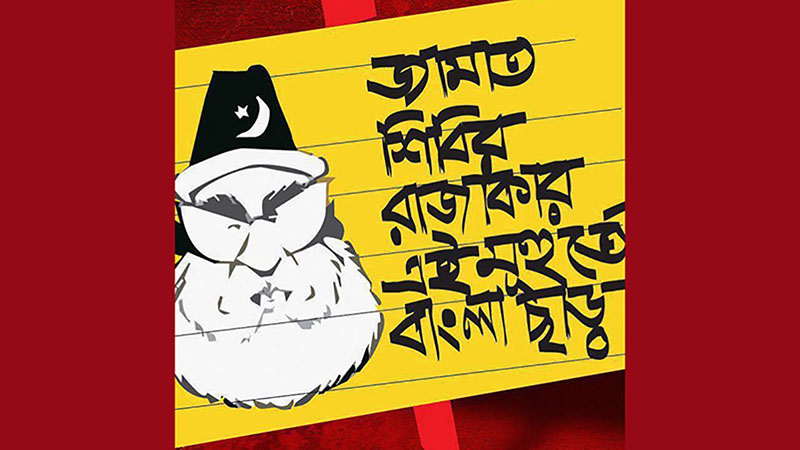
Sayeedi’s acceptance of money in exchange for sermons is known even from sources in the Islamic Chhatra Shibir. On the afternoon of February 2, this reporter spoke to Sheikh Belaluddin, a member of the Shibir’s central committee, at the Jamaat-e-Islami’s metropolitan office. At one point in this conversation recorded on a cassette player, Belaluddin said… ‘If someone serves a purpose and is happy to give money, it is not against Sharia law to accept it. You have to do it without bargaining.’ In response to the question of whether Sayeedi will go to sermons if he does not give any money, the Shibir leader said… ‘He will go anyway… but the timing has to be right. If you want to do a program next year, you have to sign a contract this year.’ When asked how much money Sayeedi charges for each sermon, Belaluddin said, ‘He gave a sermon once in Khulna and forgot to take the money. Later, when the money was given to him, he did not even count it. The promoters told me that three thousand taka was given. “Rural areas are not given much money….When there is a mahfil in Dhaka City, there are grand arrangements – the collection is high…that’s why more is given.”
Another example of Sayedee’s greed for money is the incident of embezzling bank money. In this regard, a report published in the weekly ‘Ekta’ newspaper on January 1, 88, under the title ‘A feat of Delwar Hossain Sayedee’ states that ‘Maulana Delwar Hossain Sayedee, known nationwide as an Islamic speech-maker, is also joining the ranks of the wealthy group that has been robbing banks without repaying their loans. In the language of the bank, he has been identified as a bad debtor. According to the accounts till June 1987, the amount owed to him by the bank was 16 lakh taka. The yarn business company owned by him, Hezbollah Trading Syndicate, took a loan of 15 lakh taka from the Narayanganj branch of Islami Bank in November 1985. Although the money was supposed to be repaid by November 1986, no money was repaid (until January 1988). The name of the other owner of Hezbollah Trading Syndicate is Alhaj Mujibur Rahman. After investigation, it was found that the institution does not have any assets that the bank would seize to recover the loan.
Sayeedi later protested the report, describing himself as a sleeping partner of the Hezbollah trading syndicate. He did not deny the incident of not returning the bank money. Rather, he expressed anger at being lumped in with the rich group that looted him for ‘just 1.6 million’ taka.
0000
Question: I would like to draw your attention to a report published in the weekly Ekta regarding the non-payment of bank money against Hezbollah Trading Corporation. Has that money been paid at all to date?
Answer: I currently have no relationship with Hezbollah Trading Corporation. Hezbollah Trading Corporation and Islami Bank will decide the mutual matters. I have never caused any financial loss to Islami Bank.
Question: You accept money in exchange for interpreting the Quran. To what extent is this acceptable in Islam?
Answer: Whatever is given to me and my companions for their expenses is in accordance with Sharia.
Question: Recently, you have faced severe obstacles in various parts of the country while giving Tafseer. However, before becoming a member of Jamaat’s Maslis-e-Sura, you did not face any obstacles in this regard. In other words, it can be said that Jamaat’s unacceptability has also damaged your image. Do you have any disagreements about this?
Answer: It is not true that I have not faced obstacles before. However, recently its intensity has increased a hundredfold. Some circles are creating such a situation because of the growth of the work of Islam in Bangladesh. Those who fight for the establishment and establishment of the religion will be conspired against by the established self-interested circles. Therefore, I was ready for this and will be, God willing.
I think that by joining a revolutionary movement with an international reputation like Jamaat-e-Islami, my image has increased by the grace of God.
Question: There are allegations that you have been attacking leftist university students, teachers, cultural activists, and Pir Auliyas in various ways in various sermons. What is your statement in this regard?
Answer: These allegations are completely false. If you listen to the cassettes of my speeches in full, you will find proof of this.
Question: Various scholars of the country have criticized your sermons. They have also invited you to participate in debates. Will you accept this invitation?
Answer: I do not think that the motives of those who have criticized are noble. I do not think that their call for debate is also well-intentioned. Because if they had good intentions, they could have directly sat down with me in an interview and discussed it. Instead of doing so, by issuing statements in the press, it is needless to say whose minds they are trying to please. The presence of thousands of distinguished Haqqani scholars from all over the world among my listeners is enough proof of this.
Question: Why are you so controversial? What is your own assessment?
Answer: I have explained the answer to question number 9.
Question: What is your assessment of Ershad, Hasina and Khaleda Zia?
Answer: It is the responsibility of the people to evaluate the rulers and political leaders. I do not want to comment on this.
0000
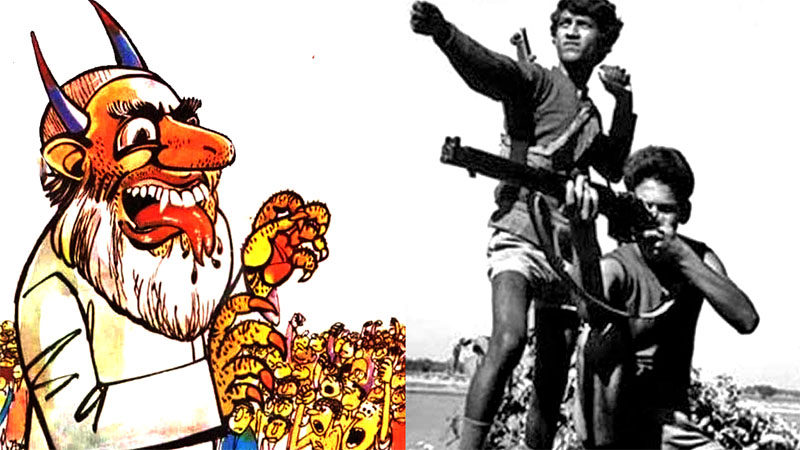
Sayeedi’s interpretation is not Islamic.
The majority of Sayeedi’s statements in Quranic commentary consist of advocacy for Jamaat politics, obscene and sarcastic comments against leftists and progressives. Even before becoming a member of the Maslis-e-Shura, Sayeedi used to campaign for Jamaat-Shibir in his various mahfils.
Before the 1986 parliamentary elections, Sayeedi said at an Islamic rally, “Like any other political party, the front of the Islamic Party is also formed. Huzoors seek votes in the name of Islam. As a result, various people ask me which Islamic party they will support…. We should support that party whose workforce and organizational activities are spread from the capital to the remote areas of the country.” At this stage, Sayeedi loudly asked the crowd present whether he still had to reveal the name of the party himself? In response, he himself said, “I believe that the activities of the party’s student organization extend to the remote areas of the country. Therefore, we should support this party.”
An example of how far Sayeedi has given a self-conceived interpretation of Islam to protect the interests of the patron group and his own personal interests can be found in the Khulna Platinum Jute Mills Employees Union elections held on November 23 last year. In this election, special initiatives were taken by the owners and the administrative circles to religiously resist the workers. The owners organized a prayer meeting with Sayeedi. In that meeting, Sayeedi unhesitatingly called the workers communists and prayed… Oh God, may the communists not win… Sayeedi’s prayer in this grand prayer festival of one and a half lakh taka could not prevent the defeat of the owners. All the ‘communist leaders’ whom Sayeedi prayed against won with the votes cast by 90 percent of the Muslims in the mill.
In his religious discourse, Sayeedi calls socialism as hexadecimalism, communism as communalism, and progressives as the victims. According to Sayeedi, socialists and philosophers like Marx, Engels, Lenin, Darwin, Rousseau, Voltaire could not give any new ideology for the progress of humanity. Regarding university teachers and students, Sayeedi said, “All these teachers educated in Moscow, Pentagon and Shanti Niketan are the disgrace of this country. They are misleading the students of university colleges. Under the direct supervision of these teachers, the golden boys of this country are all becoming communists.”
Regarding the progressive women’s movement, Sayeedi said: ‘The communists say religion is nothing, in the name of religion, in the name of veil, you (girls) have been imprisoned in your homes. Come out and soak up the light and air of Bengal, refresh your body.’ Regarding the leftists, he said, will you give freedom? Your philosophers have exploited women… They hire girls from garment factories and bring them to meetings and processions. But the truth is that without girls, they do not get the enthusiasm in the processions.
This false, satirical and hateful statement of Sayeedi about people from different strata of society in the name of interpretation of the Holy Quran is clearly against the teachings of the Quran. The Quran says, ‘Let not one group of people mock another group of people, for they may be better than them.’ Imam Bayhaqi says, ‘The Prophet (PBUH) said, “Those who talk a lot, mock and are arrogant towards people are bad in character.”
This religious businessman must be stopped.
The country’s ulema have ruled that Sayeedi has deceived millions of devout Muslims by hiding his identity, defending the elite Jamaat politics based on Maududiism in the name of religion, and by giving arbitrary interpretations of Islam.
There are also clear allegations against Sayedee of incomplete Islamic education, distorted interpretation and recitation of the Quran. Maulana Zafrullah Khan said that the extent of Sayedee’s knowledge can be understood by listening to his incorrect recitation of Hadith. Maulana Habibur Rahman said that just by listening to Sayedee’s recitation, it is understood that he is not a certified scholar. There are enough mistakes and errors in his recitation which are not befitting for a Maulana. Maulana A.N.M. Zakir Hossain, Imam of Shaheed Park Central Jama Masjid, said, I am announcing a challenge to Sayedee that Maulvi Delwar Hossain Sayedee does not have the minimum qualifications to translate the Quran into Bengali, let alone interpret it.
In addition, at various times, hundreds of prominent scholars of the country have challenged Sayedee to a face-to-face debate, calling him a misinterpreter of the Quran and Hadith. These scholars also demanded that Sayedee, who is a misinterpreter of Islam, be banned from giving his interpretations.
Interestingly, Sayeedi could not think of anything other than communists and devils as his opponents in this case either. Sayeedi’s speech at this year’s mahfil at the Chittagong Parade Ground was that ‘the devilish power was there during the time of the Prophet Muhammad and is there now. This satanic circle is against him. On January 4, at a rally at Khilgaon intersection in Dhaka, Sayeedi said, ‘The communists of this country will not allow the message of the Quran to be preached. Therefore, a deep conspiracy is going on to stop the interpretation of the Quran in the country. But this conspiracy will not be tolerated by the monotheistic people.’
Although the country’s scholars, students, and political activists are able to discover all the opponents as conspirators to stop the interpretation of the Quran, the religious people of this country are no longer confused by this discovery of Sayeedi. Incidentally, a statement by the Quran Propagation Organization can be mentioned, this statement by the Quran Propagation Organization at 4 Khilgaon Chowdhurypara says – ‘The Quran Propagation Organization has been holding Tafsir Mahfils of the Holy Quran in cities, ports, and even in remote areas of the country for a long time. This organization believes that the people of all walks of life, including the Muslim Sont Muktijoddha Sangsad, the Muslim Sont Chhatra Sangram Parishad and 5 and 8 parties, can never speak against the interpretation of the Holy Quran. Many such Tafsirs have been held in this country before which they have never spoken against. From this, we clearly understand that the Freedom Fighters’ Association, the Chhatra Sangram Parishad, 8 parties, and 5 parties are not opposing the Holy Quran or its true interpretation, which is related to the lives of 90 percent of the country’s Muslims, but are only opposing Sayedee, who is misinterpreting the Holy Quran and underestimating the Islamic perspective in the name of interpretation.

https://stapravda.ru/20221228/reyting_samyh_populyarnyh_hostingov_v_rossii_196445.html, рейтинг хостингов России подтверждает, что выбор надежного провайдера важен для бизнеса.