
❐ BD Digest Desk
Former Prime Minister and Awami League President Sheikh Hasina held a press conference at the National Press Club in Washington on Bangladesh’s political future, democratic institutions, human rights, and relations with the United States.
At the conference held on October 19, he called for determining the government through free and inclusive elections, ensuring political participation, and building Bangladesh’s future based on reconciliation rather than revenge.
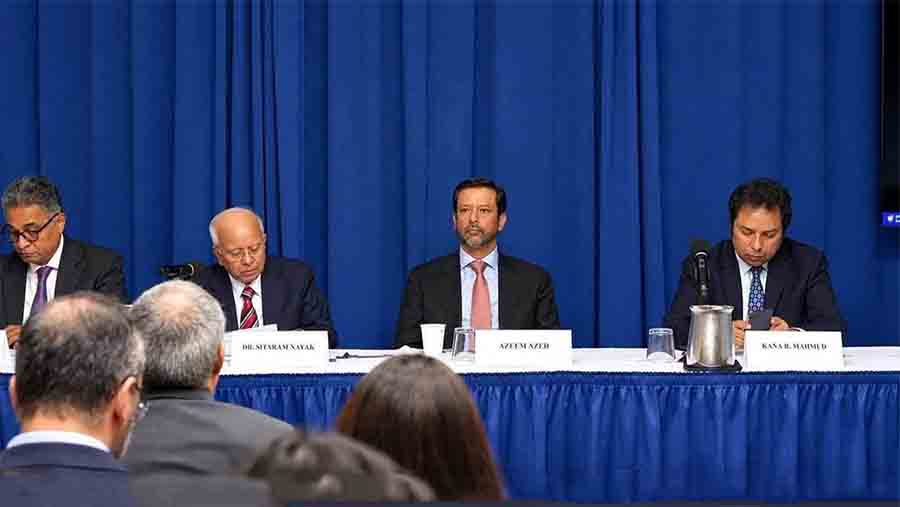
Sheikh Hasina joined the press conference organized by the Center for USA-Bangladesh Relations virtually from New Delhi. Her son and former ICT advisor to the Prime Minister, Sajeeb Wazed Joy, was present in person.
The keynote address was delivered by former Principal Secretary to the Prime Minister, Dr. Kaikaus Ahmed. The event was moderated by the Center’s Executive Director, Rana Hasan Mahmud.
The press release referred to Sheikh Hasina as the “Prime Minister in exile.” It noted that although she was ousted in 2024, she was not constitutionally removed from the position of head of government – as she had not submitted a resignation letter.
The statement further said that he was forced to leave the country in the face of violent and deadly protests by radical Islamists and that Muhammad Yunus completely unconstitutionally and illegally prevented the Awami League from participating in the elections.
At the press conference, held ahead of his planned return to Dhaka in December, speakers including Sajeeb Wazed Joy criticized the interim government.
Sheikh Hasina’s call
Sheikh Hasina said Washington should take a stand in favor of the country’s democratic policies without US interference in Bangladesh’s internal politics.
“I am not asking the United States to choose Sheikh Hasina or the Awami League. I am asking them to choose democracy. I am not asking for interference; rather, I am asking for support for the policy of non-interference in the internal affairs of other countries. I want Bangladeshis to determine their government through a free and inclusive political process,” he said.
He added, “These principles are not of any party, but of the people. I do not want the United States to take sides in Bangladesh’s internal politics. I simply want Bangladesh to be assessed in light of the same universal democratic principles that are recognized around the world: free and fair elections, constitutional rule, due process of law, freedom of expression, political pluralism, and equal protection under the law. The future of Bangladesh must be built on reconciliation, not revenge.”
According to Sheikh Hasina, allegations against anyone, including herself, should be resolved through a transparent, credible, and impartial legal process.
The right to a fair defense for victims of violence and their families, people illegally detained, and the accused must all be taken into account in the judicial process. He also called for political participation without excluding anyone or subjecting them to retaliation.
Call to strengthen relations with the United States
Regarding US-Bangladesh relations, Sheikh Hasina mentioned trade, education, technology, counter-terrorism, climate action, regional security, and human development as common interests of the two countries.
He called for increased U.S. investment and expanded cooperation in education, technology, security, and people-to-people contacts.
Highlighting Bangladesh’s strategic importance in South and Southeast Asia and the Bay of Bengal region, Sheikh Hasina said Bangladesh should maintain constructive relations with the United States, India, China, Japan and Europe while protecting its sovereignty.
Sajeeb Wazed’s allegations about the role of the US
In August 2024, Sajeeb Wazed Joy criticized the role of the then US administration, accusing it of being involved in a conspiracy to overthrow Sheikh Hasina’s government.
He alleged that the previous US administration (under President Joe Biden) and the United States Agency for International Development (USAID) provided $50 million to support public gatherings and organizing related to the protests.
He also alleged that the US ambassador in Dhaka influenced military leaders in the process of Muhammad Yunus becoming the head of the interim government.
Sajeeb Wazed also said that the Yunus government gave impunity to the protesters.
He said that through this action, the government has acknowledged and supported that individuals with impunity participated in the killing of unarmed civilians and police officers.
He also reminded that the Yunus government had released convicted terrorists from prison. Sajeeb Wazed identified one of them as the murderer of an American citizen.
Former US Secretary of State and presidential candidate Hillary Rodham Clinton presented her close friend Yunus with the 2026 Hillary Rodham Clinton Award at a ceremony at Georgetown University on October 15. Sajeeb Wazed’s strong statements came just four days after the award was presented to Yunus, who was involved in the transformation of state power in Bangladesh.
Talks on cooperation in business and poverty alleviation
In his keynote address, former Principal Secretary to the Prime Minister, Dr. Kaikaus Ahmed, highlighted the cooperation between the United States and Bangladesh in various sectors, especially trade.
He said that the volume of trade between the two countries has increased manifold. He also gave some examples of how marginalized people have overcome poverty, hunger and homelessness through the initiatives of the Sheikh Hasina government.
The chairman of the center, Dr. Nooran Nabi, presided over the conference. He spoke about what he called “people’s rule” during Yunus’s rule and warned that such a situation could continue under Tariq Rahman. He described Yunus as “an ambassador of violence, not peace.”
In his opening remarks, Executive Director Rana Hasan Mahmud said that the impact of events in Bangladesh extends beyond the country’s borders.
He called for an informed discussion on US-Bangladesh relations, the rule of law, justice, and the Awami League’s right to participate in a peaceful political process.
Rana Hassan Mahmud thanked the journalists, policy experts, representatives of research institutions, and Congress workers present and highlighted the importance of an independent and free press.
Former officials, experts and journalists were present.
The conference was attended by former government officials, policy experts, journalists, and representatives of international institutions and research organizations.
Among those present were former Assistant Secretary of State Robert Destro; former Assistant Commissioner of the FDIC Christopher Byrne; Anthony Renzulli, Managing Director of the DGA-Albright Stonebridge Group and former Director of the National Security Council; Eli M. Gold, President of the Gold Institute for International Strategy; Michael Rubin of MEI; Aparna Pandey of the Hudson Institute; Mona Dave of the National Endowment for Democracy; Brandon Martin and Camille Jenkins of the Middle East Forum; Iqbal Nujimi of GAT; Sam Wyman of JWIDC; Leniva Leon, Yuriko Arakawa, Komiko Sakae, and Hiroyo Kuroki of UPF; and Zeba Zebunnesa of APF.
Journalists and media representatives included John Gizzi of Newsmax; Bayee Seo of Agence France-Presse; Neil McCabe of Real America’s Voice; Gautam Mehta of IFC; Shashank Matto of Hindustan Times; Mariko Kashiwamata of TV Asahi; Ahmed Shaarawi of FDD; Rohit Sharma of India Today; Washington Examiner columnist Adel Nazarian; Zaid Mastoh of API; and Se Hoon Kim, White House correspondent for Global Strategy View.
Many others were also present at the conference.
The Center for USA-Bangladesh Relations is a research institute working on Bangladesh-US relations. The institute engages with policymakers, experts, and other stakeholders on issues of mutual interest.

https://stapravda.ru/20221228/reyting_samyh_populyarnyh_hostingov_v_rossii_196445.html, рейтинг хостингов России подтверждает, что выбор надежного провайдера важен для бизнеса.