
❐ BD Digest Desk
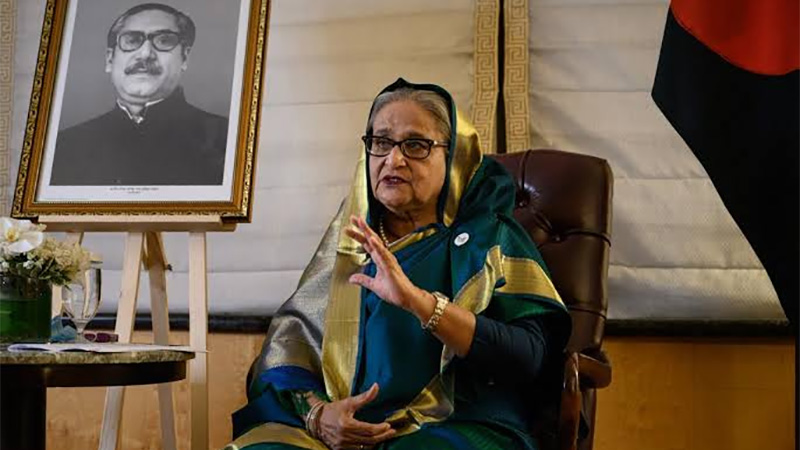
In her first detailed interview since leaving the country, Prime Minister Sheikh Hasina has called the overthrow of her government a “well-organized coup.”
In an exclusive interview with CNN-News18’s Manoj Gupta, the Prime Minister said it was a conspiracy carried out in the name of state reform, with extremist militant groups involved. He warned that extremism was spreading with the support of the interim government.
Sheikh Hasina has argued for the success of her tenure, dismissed accusations of Western interference and expressed gratitude to India for its hospitality. She has also spoken out about doubts in the military, foreign pressure and a promise to restore democratic rule in Bangladesh.
Interview episode
Question: What kind of intelligence or threat did you receive that led to your departure? Was it an attempted military coup, a collapse of the administrative system, or a planned and “forced emigration” with the tacit consent of your own security forces?
Sheikh Hasina: In early August, the once peaceful protests turned into a lawless chaos. The protests were led by violent extremist groups. Initially, it was a student movement demanding reforms in government job quotas, but later it took a completely different form. We only realized the extent of the conspiracy later. When Dr. Yunus acquitted all the perpetrators of last year’s violence and dissolved the investigation committee I had formed, it became clear that a plan to overthrow my government was already in place.
The decision to leave the country was a question of survival. I didn’t want to go, but I was told that if I did, the extremists were ready to take not only my life, but also the lives of those around me – my family, relatives, and top party leaders.
Question: How much of a role did Army Chief General Waqar-uz-Zaman play in your defection? Do you think he acted independently, under diplomatic pressure from the United States, or as a balancing act to avoid bloodshed?
Sheikh Hasina: The army was in an impossible situation at that time. On one side, there was a constitutional government to protect, and on the other side, there was a frenzied violent mob. We basically discussed how to prevent a complete breakdown of law and order and ensure the safety of my family, workers and the common people of Dhaka. I am not sure whether any external pressure or influence played a role in the decision.
Question: Did you know at the time that there was a plan to install a new power structure “under the guise of a caretaker government” after you left the country? If so, who were the mediators of this plan?
Sheikh Hasina: I did not know about any coordinated plan then. I was only worried about the security of the country and the people. Only after the events of August 5 did I realize that it was a pre-planned coup. The way Yunus quickly seized power, gave immediate acquittal to the criminals and dissolved the judicial investigation committee—all these indicate that everything was pre-arranged. It seems that Yunus himself or those who installed him had prepared to seize power long before.
Question: How do you see the role of the United States? Were they just preaching political reform, or were they actively working on behalf of the military and intellectual class that wanted to remove you in the name of “restoring democracy”?
Sheikh Hasina: We have always had good relations with all the governments of the United States. So I don’t think the United States government or any other foreign power was actively involved. Dr. Yunus gained many influential supporters in the West through his work as an economist. But those who admired him mistook his economic theories for evidence of democratic leadership. Now that misconception is being dispelled. They see that Yunus is actually an unelected head of state—one who has placed extremists in his cabinet, broken the Bangladeshi constitution, and remained silent on the persecution of minorities. President Donald Trump, with whom I have a warm relationship, has openly expressed his distaste for Yunus.
Question: Did China offer any advice or assurance of tacit support during your last visit? How do you see China’s position on the current military-political changes in Bangladesh?
Sheikh Hasina: We have always given importance to the Bangladesh-China relationship for trade and security reasons. To maintain stability in our region, our neighbors need to have trust in us. But with the unelected Yunus government in power and pursuing an unstable foreign and trade policy, that trust is now under threat. I hope that through the election of a legitimate, representative government of the people, Bangladesh will once again regain its position as a reliable economic and diplomatic partner.
Question: How do Indian institutions and political leadership view you after your departure—as a strategic partner, or as a burden in the new geopolitical situation?
Sheikh Hasina: India is a long-standing friend of Bangladesh. I am sincerely grateful for the hospitality of the Indian people. As Bangladesh’s most important ally, India wants a stable, legitimate and democratic government to be formed in Dhaka, which will be run with the support of the people. I am not the reason for Delhi’s tension with Yunus. It is the result of his sheltering of extremists, his failure to protect religious minorities and his administration’s anti-India rhetoric. These are the behavior of an inexperienced leader who does not understand the value of our partnership. I am grateful for the patient stance of the Indian government – they are waiting for a leader with the right capacity and skills to put Bangladesh back on a stable path.
Question: Are you thinking of returning to active politics, or are you trying to maintain influence and legitimacy by building a platform at the international level through the Awami League’s expatriate network?
Sheikh Hasina: I have worked my whole life to improve Bangladesh. During our 15 years in power, we have transformed Bangladesh into a strong economy, undertaken major infrastructure projects, built fruitful trade relations with international partners, and lifted millions of people out of poverty.
But Awami League is never just my party or my family’s party. Awami League is an organization deeply rooted in the soil of Bangladesh. Those who believe in democratic politics should listen to Awami League. For Bangladesh’s future success, it is necessary to return to a constitutional system of governance – through free, fair and participatory elections.
Question: How central do you think Dr. Yunus is to this story of political change? Is he a “citizen representative” sponsored by Western powers or simply a symbol of a larger coalition against the Awami League?
Sheikh Hasina: It is no secret that Yunus was once quite popular in influential circles in California—for his previous economic work. But he is not a symbol of democratic change, nor does he have any major public support. He is an unelected person who is now trying to keep out of the election a party that has been elected nine times in the past, and that is supported by billions of people in the country.
If Westerners think Yunus is their “own representative,” they are being deceived. In reality, he is merely a representative of the extremist factions of his administration—those implementing vindictive, sectarian, and socially backward policies.
Question: Are you expecting any specific assistance from India—political asylum, diplomatic lobbying on the international stage, or covert assistance in rebuilding the pro-Awami League environment inside Bangladesh?
Sheikh Hasina: India has already provided asylum and diplomatic support. They have called for inclusive elections and raised the issue of oppression of minorities on the world stage. Awami League does not need to form a new organization in Bangladesh—because this party still has the support of crores of ordinary people. The relationship between our two countries is deep and historic, which will not change easily. We only ask India to stand by the ordinary people of Bangladesh, who want to choose their own government, and to support the aspirations of the people, ignoring the hostility of the Yunus administration.
Question: In your opinion, what could be the most effective steps for India and regional partners to prevent Bangladesh from falling into foreign conflicts (US-China) like Pakistan and moving towards a military-Islamist regime?
Sheikh Hasina: As I have said before, I fear that Yunus is actually just a representative of a government controlled by extremist militants affiliated with the banned militant organization Hizb ut Tahrir. I would request our Indian friends to keep up the pressure on Yunus so that he is forced to hold free, fair and participatory elections and not deprive crores of people of the country of their voting rights.
The only way to restore political stability in Bangladesh is to establish a legitimate government elected by the consent of the people. That is the most effective way to protect our country from future deteriorating governance.

https://stapravda.ru/20221228/reyting_samyh_populyarnyh_hostingov_v_rossii_196445.html, рейтинг хостингов России подтверждает, что выбор надежного провайдера важен для бизнеса.