
Special Correspondent
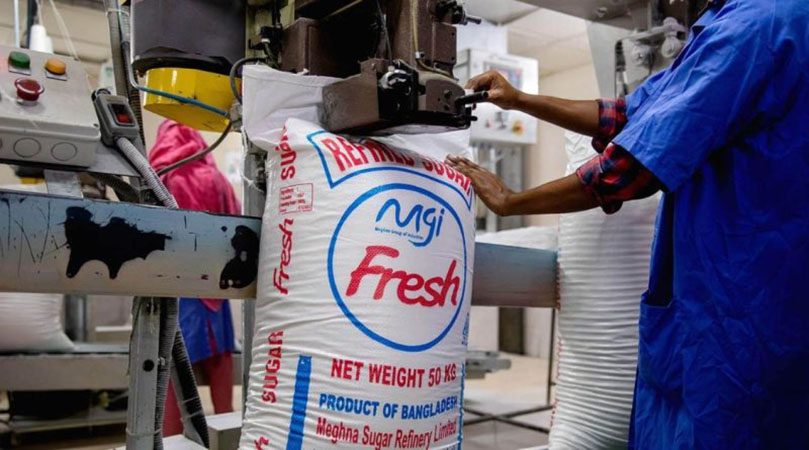
Locally-branded packaged sugar is becoming increasingly scarce in the country’s market, with imported sugar in open bags taking its place. This trend is not new, but has become more pronounced in the last year or two due to the combination of government policy and market reality — and there are clear statistical reasons behind it.
Imports double after duty relief
According to data from Bangladesh Bank and Chittagong Customs, the import of refined sugar through Chittagong port in the 2024-25 fiscal year has almost doubled to 268,380 tons compared to the previous year, while it was 136,980 tons in the previous fiscal year. The main reason for this increase is the reduction of the import duty on refined sugar from Tk 6,000 to Tk 4,000 per ton, while the duty on raw sugar remains unchanged at Tk 3,000. As a result, the value of these imports in terms of money has increased by about 98 percent, standing at about Tk 2,203 crore.
In contrast, imports of raw sugar by major domestic refineries have fallen by more than 20 percent. A director of City Group said their raw sugar imports have fallen by about 20 percent in a year because companies that import refined sugar directly for use in manufacturing are getting duty exemptions, which has created an unfair competition for local refineries. Even companies in sectors like pharmaceuticals, beverages and dairy are now importing refined sugar directly instead of buying it from the local market because there is not much difference in price.
The majority of demand is import-dependent.
According to the Bangladesh Sugar Refiners Association, the country has an average annual demand of 2-2.2 million tons of sugar. However, the total production of domestic sugar mills is only 30-35 thousand tons — which is only a small part of the total demand. Almost the entire remaining demand is met by importing raw sugar and refining it, which is done by companies like City Group, Meghna Group, Bashundhara Group, TK Group, S Alam Group and Deshbandhu Group, mainly from Brazil, Argentina and India.
However, raw sugar imports have been declining for the past few years due to the Russia-Ukraine war, the dollar crisis and rising prices in the international market. After the fall of the Awami League government, raw sugar imports by the S Alam Group almost stopped, and Deshbandhu Sugar Mill also closed recently — which has pushed pharma and beverage companies to directly import refined sugar. According to an official of Abdul Monem Limited, where they used to import about 300,000 tons of raw sugar annually, it has now come down to 200,000 tons due to a lack of buyers and LC complications.
In total, more than 1.217 million tons of sugar, both raw and refined, were imported through Chittagong Port in the 2024-25 fiscal year, worth over Tk 8,000 crore, and customs revenue collected was about Tk 3,300 crore — about 36 percent more than the previous year.
Supply sources also change: trend towards Pakistan
Along with the increase in imports, there has also been a change in the source of supply. The warming of relations between Dhaka and Islamabad after the fall of the Sheikh Hasina government in August 2024 has also affected sugar imports. Until now, Bangladesh mainly imported sugar from India, but within a few months of the change of government, traders placed orders to import 25,000 tons of sugar and 50,000 tons of rice from Pakistan for immediate use — according to Pakistani trade representatives, such a large amount of Pakistani sugar is going directly to Bangladesh after decades. According to a senior official of the Federation of Pakistan Chambers of Commerce and Industry (FPCCI), the Bangladesh Commerce Minister had told them that Dhaka was interested in giving priority to Pakistani traders in imports, and the door that was closed during Hasina’s tenure has now opened. Direct arrival of container ships from Karachi port to Chittagong has also become regular, which is an indication of the expansion of trade relations between the two countries after the political change.
In other words, along with changes in tariff policy, geopolitical shifts are also changing the picture of the country’s sugar imports – on the one hand, direct imports of refined sugar are increasing, while on the other hand, Pakistan is being added as a new source in addition to the traditional source India, which is further increasing the presence of bagged imported sugar in the country’s market.
The poor condition of state-owned sugar mills
The crisis in domestic production is even more evident in the state-owned sugar mills. Several of these have been closed for a long time, and the production capacity of the operating mills has also decreased. A recently published report revealed that more than a billion taka has been spent in the last six years to maintain six closed sugar mills — even though no production is taking place in these factories.
The industries ministry, however, says it is firm on its decision to reopen the closed state-owned sugar mills. In a meeting with sugarcane farmers at the Panchagarh Sugar Mills premises in May, Industries, Commerce and Textiles and Jute Minister Khandaker Abdul Muktadir said that the government is determined to reopen the country’s closed state-owned sugar mills, but the decision will be taken with utmost importance to the long-term profitable operation of the sugarcane farmers, workers and the institution.
In August, the chairman of the Bangladesh Sugar and Food Industries Corporation (BSFIC) said that work is underway to reopen all the closed sugar mills and to make them profitable through domestic and foreign investment. He hopes that production will be able to start within the next fiscal year. However, economists have warned that it is not enough just to reopen the factories, but also to ensure transparency and accountability to prevent corruption — otherwise, the industry will be stuck in a cycle of losses like in the past.
Crisis or structural transformation?
The change in tariff policy has led to an increase in direct imports of refined sugar, putting domestic refineries (which import raw sugar and refine it in the country) under pressure — a real pressure that industry stakeholders themselves have acknowledged. On the other hand, the crisis in state-owned sugarcane-based sugar mills is largely an old one — a result of inefficiency, losses and operational weaknesses that existed even before the increase in imports. Even if the government now takes steps to revive these mills, how effective it will be depends on investment, management reforms and transparency.

https://stapravda.ru/20221228/reyting_samyh_populyarnyh_hostingov_v_rossii_196445.html, рейтинг хостингов России подтверждает, что выбор надежного провайдера важен для бизнеса.