
❐ Aynal Karigor
The Bangladesh-US Agreement on Reciprocal Trade (ART), signed by the interim government just three days before the national elections, has been controversial from the start. The criticism did not stop even after the BNP government came to power, but recently, it has come under renewed criticism after it was revealed that the agreement had only six conditions for the US, compared to 131 conditions for Bangladesh.
But at the center of this debate is not just the terms of the agreement — but also the question of when which party spoke, when it didn’t, and why it didn’t, which is the most discussed question in the political arena.
The Trump administration announced an additional 37 percent tariff on Bangladeshi goods in April last year. After lengthy negotiations, the tariff was reduced to 20 percent from August 1. However, since Bangladeshi goods already had a 15 percent tariff, the total tariff burden stood at 35 percent.
After nine months of negotiations, the two countries signed a Reciprocal Trade Agreement (ART). Under the agreement, the Trump administration reduced tariffs from 20 percent to just 19 percent.
But the whole thing turned into a big joke — because the Trump administration was ultimately unable to implement the additional tariffs due to a Supreme Court order. As a result, questions have arisen in political circles about why Bangladesh tied itself up with a web of 131 conditions to reduce tariffs that were never imposed.
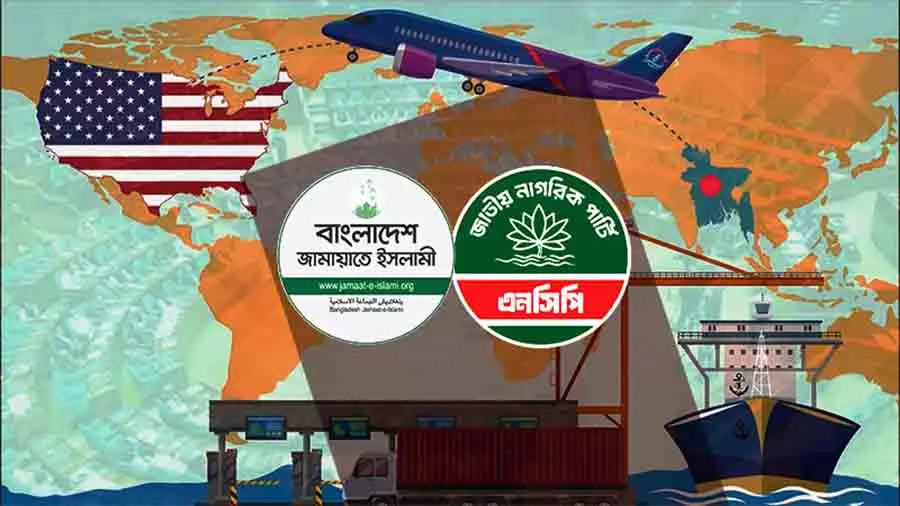
Jamaat-NCP’s silence: Loud on ‘nation-selling’ accusations, but silent on this agreement
The issue has become more complicated due to the stance of the two parties. Jamaat-e-Islami and the National Citizens Party (NCP), which have been vocal for a long time claiming that the Sheikh Hasina government has made ‘anti-national’ and ‘nation-selling’ agreements with various foreign parties, including India, have not yet made any public statements about the agreements with the United States that are against Bangladesh’s interests.
Even after talking to the central leaders of the two parties, there was no sign of strong protest. The two top leaders of Jamaat and NCP admitted that they do not want any agreement against the country’s interests. But at the same time, they also made it clear that they are not “openly opposing” the trade agreement with the United States.
Jamaat Assistant Secretary General Ehsanul Mahbub Zubair said the agreement was signed three days before the elections. He said, “The interim government did not say anything when the agreement was signed. The current government also did not say anything about it in the beginning. Now we know about its nature.”
Stating that the party’s top leaders have discussed the issue, he added, “It is not possible to make an official comment right now. The party’s Ameer is on a foreign trip, and a formal statement will be made after discussions after his return.”
NCP’s position: ‘Not completely opposed, some conditions should be reviewed’
The NCP’s position is more complex and contradictory. Alauddin Mohammad, secretary of the party’s diplomacy cell, said that considering the terms of the agreement, they saw some parts of it as positive for the country in the long term.
“There are many issues here that we are not in a position to wholeheartedly oppose,” he said. “The areas that seem to interfere with our freedom should definitely be reviewed. I see no reason to reject the terms of the agreement that are helpful to our economy.”
However, the NCP leader is reluctant to accept the agreement as a complete ‘sell-out’. In his words, ‘The way everyone is saying that this agreement has sold Bangladesh out, that is not true. It did not happen like that.’
At the same time, he also questioned the agreement process. He said, “We never consider this agreement process to be appropriate.”
He said they expressed their concerns in meetings with the current US trade delegation and also with US Secretary of State James Stewart.
Explaining the reason for not taking a public stand in or outside Parliament, Alauddin Mohammad said, “In the post-July reality, it was our national responsibility to take Bangladesh out of India’s sphere of influence. As part of this responsibility, diversifying this space was also an important matter for us.”
However, the party’s position is clear on the question of whether the NCP had ‘agreed’ with the agreement. Alauddin Mohammad said, ‘NCP was not aligned with this agreement. But as far as we know, both BNP and Jamaat were aligned.’
NCP senior joint convener Ariful Islam Adib said that the issue has been discussed at the party level and further discussions will be held.
The Islamic Movement of Bangladesh has expressed concern over the overall situation.
The party’s Joint Secretary General Gazi Ataur Rahman said on May 5, “If the government and the opposition agree to sacrifice the country’s interests, it becomes difficult to protect the country’s interests.” His comment has attracted special attention in political circles.
Controversy over whether to give consent: Jamaat rejects Foreign Minister’s claim
Khalilur Rahman, the interim government’s national security adviser who played a key role in negotiating the agreement for Bangladesh, is currently serving as the foreign minister of the BNP government.
He recently claimed that ‘BNP and Jamaat had given their consent’ before signing the trade agreement.
However, opposition leader and Jamaat Ameer Shafiqur Rahman has directly denied this claim. He said that the interim government has signed several agreements with various countries, but none of them have been discussed with Jamaat.
Although various political circles have termed Jamaat’s claim as a ‘scam’, top leaders of various parties including Dr. Muhammad Yunus, Jamaat Ameer Shafiqur Rahman, BNP Secretary General Mirza Fakhrul Islam Alamgir have held continuous discussions on the issue of the agreement with the United States and have even visited the United States to discuss the matter.
So even ordinary people don’t want to accept that something has happened ‘unbeknownst’ to them.
The Left’s sudden awakening and mild objection: Dramatic Akhya
Left-wing politicians have faced the most questions in this entire debate.
Although the process of the agreement with the United States was almost completed since the beginning of the interim Yunus government, economist Professor Anu Muhammad, who had been silent, suddenly woke up after the departure of the Yunus government. On April 17, he held a rally in Shahbagh demanding the cancellation of this agreement. There, he commented that it was a ‘subordination agreement’. He also demanded that the interim government be prosecuted for signing the agreement. Although Anu Muhammad was not heard to say a single word about it during the Yunus government.
Similarly, former Communist Party of Bangladesh (CPB) president Mujahidul Islam Selim has also suddenly ‘awakened’. He has declared that this ‘slavery deal of selling the country’ cannot be allowed to happen.
Political analysts have raised the question, why are the left parties, which during the Yunus government spoke in the same tone with Dr. Yunus and his ’employer’ anti-discrimination group on all issues including the July Charter and reforms, suddenly singing in the opposite tone? Many have commented that this ‘digbaazi’ is merely a ‘drama’ and an attempt to present themselves in a ‘pure’ face to the people.
Demand to raise in Parliament: Rumin Farhana’s question
On April 29, independent member of parliament Rumeen Farhana demanded that the agreement be brought to parliament. She said that when the agreement was signed three days before the election, the country’s civil society and think tank circles said that an unelected government cannot sign such an agreement.
Moreover, the agreement contains many clauses that are against the interests of Bangladesh. But unfortunately, the interim government did not listen to that and signed the agreement on February 9th.
Rumin Farhana also said that the government can cancel the agreement within 60 days if it wants. Therefore, she demanded that the agreement be presented in parliament.
Commerce Minister assures there is nothing to worry about: Reality is different
In the face of criticism, Commerce Minister Khandaker Abdul Muktadir said there is nothing to worry about.
Responding to questions from reporters after a meeting with the US Trade Representative at the Secretariat on May 5, he said that if any clause of the agreement is against Bangladesh’s interests, there is scope for amendment within the agreement.
The overall picture that emerges is worrying. The ruling BNP government has taken a stand in favor of the agreement. The main opposition Jamaat is delaying its formal stance. The NCP is in the middle. Its credibility is questionable as the Left’s protest ‘did not come in time’. Although there is a demand for the agreement to be presented in parliament, it is uncertain whether it will be implemented.
According to economists, the agreement with the United States is extreme.
The biggest question now is how seriously political parties will take this gap of 131 vs. 6 conditions and how effective a role it will play in protecting the interests of the people.

https://stapravda.ru/20221228/reyting_samyh_populyarnyh_hostingov_v_rossii_196445.html, рейтинг хостингов России подтверждает, что выбор надежного провайдера важен для бизнеса.