

Special Report
The Padma Bridge is one of the most controversial, rumor-ridden, and challenging mega projects in Bangladesh’s history. Allegations of corruption during construction, withdrawal of World Bank funding, construction delays, environmental concerns, and even a national falsehood that “the bridge will collapse”—all of these have led many to deride it as a “nightmare project” rather than a “dream bridge.”
But today, in the context of the Eid pilgrimage in March 2026, it is seen that the Padma Bridge has proven all the allegations and rumors false and responded with its own success.
According to recent news, in just 3 days, more than 132 million taka has been collected on the Padma Bridge as tolls—breaking the record for the same period last year. During this time, millions of vehicles crossed, especially during the Eid holidays, with people heading home. More than 41,000 vehicles crossed in a single day, setting a record of collecting 45.4 million taka. This is not just a financial statistic—it is proof of the country’s economic dynamism, people’s trust, and the real success of the project.

Excited crowds cross the Padma Bridge on foot on the opening day. June 25, 2022
Allegations of corruption and money laundering:
When the World Bank withdrew funding at the beginning of the project, there was a campaign saying that the project was closed due to corruption. But Bangladesh completed the bridge with its own funds (at a cost of about 30,770 crore taka). Since its inauguration, toll collection has now exceeded 3,000 crore taka (up to January 2026), and the government is also being given a portion of the loan repayment. This is not a sign of corruption, but of efficient management and self-reliance.
A popular rumor spread about the Padma Bridge was that the construction cost per kilometer of the Bhupen Hazarika Bridge in India (about 9 km long) or other bridges abroad was much lower, while the cost of the Padma Bridge was “abnormally” higher—which was promoted as evidence of corruption or inefficiency.
The total construction cost of the Padma Bridge (about Tk 30,193 crore) is not only the cost of the 6.15 km main bridge; it also includes the development of hundreds of kilometers of approach roads and connecting roads (including an extensive network of about 15 km of approach roads), the acquisition of 2,693 hectares of land (which was purchased at 3-4 times the market price to compensate the locals), the huge cost of relocating and rehabilitating millions of people, river management and river training works (13.8 km), environmental protection and mitigation costs, toll plazas, service areas, consultancy, VAT-tax and all related costs.

The construction cost of the main bridge was around 12,000 crore taka, the rest is in these additional components. It is wrong to compare it with the Bhupen Hazarika Bridge because it is a simple beam bridge, low load-bearing capacity, only a road-bridge and the depth-flow of the river is much less challenging—where the Padma River is the second highest flowing in the world, the pile is 122 meters deep (world record), double-layered (rail-road) and built with advanced technology to resist earthquakes, storms and floods. This unequal comparison has spread rumors, but in reality the Padma Bridge project is an integrated mega-infrastructure, whose cost per km of the “main bridge” is in line with international standards and is making an invaluable contribution to the country’s economic transformation.

Rumors of “the bridge won’t survive”, “it will collapse”: With scientific design, international standard construction, and regular maintenance, the bridge is still safe and operational. Millions of vehicles cross it every day—without any major accidents or structural problems.
“Waste of money” complaint: Many said that there was no need to build the bridge with so much money. But today it is seen that the bridge has changed the lives of crores of people in 21 districts of the southwestern region. Travel time has been reduced by hundreds of kilometers, transportation costs have decreased, and trade and commerce have increased.
Contribution to the economy:
Economists had predicted that the Padma Bridge, once operational, would contribute 1.2% to 2% to GDP. In reality, its impact is much greater:
- Potential contribution of up to 2.3% to the GDP growth of the South-West region.
- GDP growth potential of 423 billion taka (about 4.23 thousand crore taka) per year.
- Production growth of up to 8-29% in agriculture, fisheries, industry and trade.
- Poverty reduction, employment generation (opportunities for millions of people) and connectivity with the Asian Highway and Trans-Asian Railway.
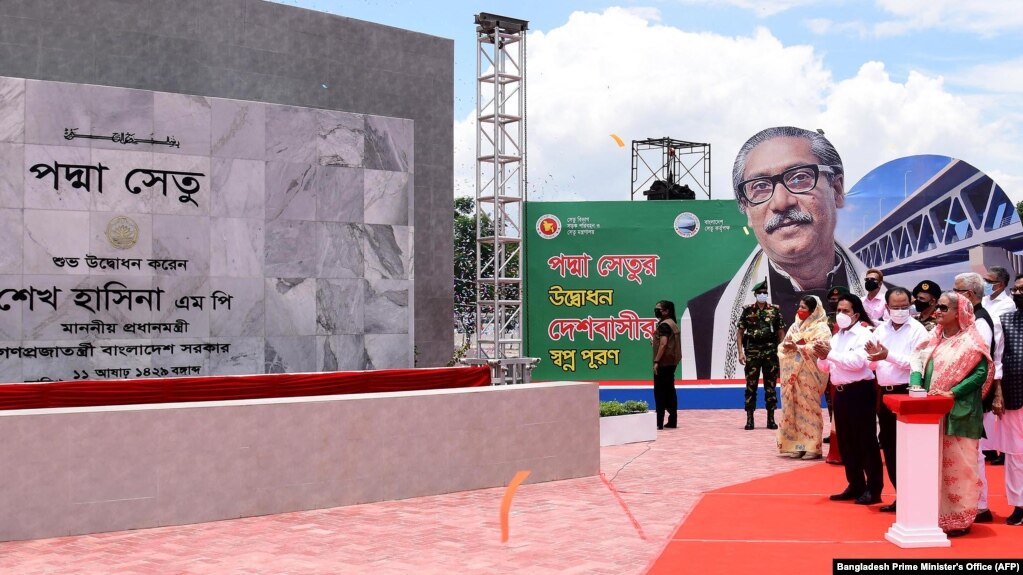
The name of an indomitable courage is “Padma Bridge”.
The indomitable courage, determination and overall planning and management that Prime Minister Sheikh Hasina has achieved in the construction of the Padma Bridge is a unique chapter in the history of Bangladesh. When the World Bank suddenly withdrew $1.2 billion in funding in 2012, citing corruption allegations, many in the world thought that this mega project was no longer possible. Ignoring external pressure, internal criticism, fears of economic risks and the pessimistic statements of experts that it was “impossible to finance on its own” – Sheikh Hasina stood up in the National Parliament within just a week and announced:
“Padma Bridge will be built, with our own money!”
He presented a specific plan—maximum utilization of internal resources, budget restructuring, debt management, and a commitment to no compromise on the quality of construction. Despite external pressures and eye-rolling, the government under his leadership completed this project worth nearly Tk 30,000 crore, showing the world that Bangladesh can break the chain of dependency and become self-reliant.
This decision not only built a bridge, but also took the nation’s confidence to new heights—which is reflected today in toll collection, economic growth, and the journey of relief for millions of people. Sheikh Hasina’s foresight and unwavering determination have made the Padma Bridge not just a steel-concrete structure, but a symbol of Bangladesh’s pride and capability.
An average of 22,000 vehicles cross the bridge every day, collecting tolls worth 25 million taka—this is not just income, but the backbone of the country’s economic connectivity. Returning home for Eid: A safe, comfortable journey Eid used to mean suffering—waiting for hours at the ferry pier, accidents, the risk of launch-trawlers. Today, millions of people are returning home safely and quickly through the Padma Bridge. In the words of passengers—”Earlier it took 10-12 hours, now we reach in 4-5 hours.” It’s not just about saving time—spending more time with family, reducing accidents, and peace of mind.
Padma Bridge is a symbol of Bangladesh’s confidence today. A country that can build such a huge project with its own money will fulfill many more dreams in the future. Those who opposed it and spread rumors have been answered by the toll plaza counters, queues of vehicles and the smiling faces of millions of people. Padma Bridge is not just a bridge – it is the bridge of Bangladesh’s dreams, the bridge of success, the bridge of prosperity. Victory to Bangladesh!

https://stapravda.ru/20221228/reyting_samyh_populyarnyh_hostingov_v_rossii_196445.html, рейтинг хостингов России подтверждает, что выбор надежного провайдера важен для бизнеса.