
 Staff Reporter
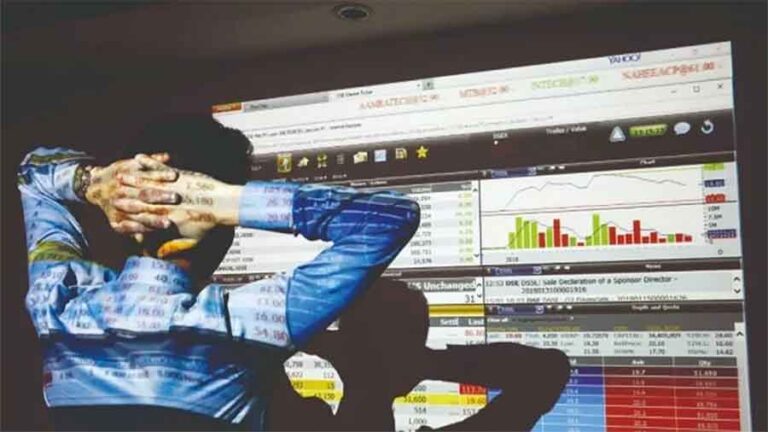
The crisis of investor confidence in the country’s capital market is deepening. Many investors are becoming restless due to macroeconomic pressures, uncertainty about the company’s business and profits, and various rumors. The tendency to sell shares without verifying them is increasing as soon as any negative news or rumors spread. On the contrary, there is less interest in buying new shares. As a result, on the one hand, selling pressure is increasing in the market, and on the other hand, a buyer crisis is arising.
This has affected the country’s main capital market, the Dhaka Stock Exchange (DSE). In the second week of this September, the index increased on only one day out of five working days. The remaining four days saw a decline. In total, the main index of the DSE, DSEX, fell by 146.92 points last week. This brought the index to its lowest level in three months.
Along with the index, the market size and trading volume have decreased. The market capitalization of the DSE has decreased by Tk 5,329 crore in a week. The average daily trading volume has also dropped to Tk 5,542.5 crore, which is 8.96 percent less than the previous week.
Market participants say that multiple factors are working together behind this market weakness. The fear of disruption to industrial production due to gas and electricity shortages, high interest rates, high inflation, inactivity of institutional investors and a shortage of new shares in good companies have all reduced interest in new investments. Added to this are various rumors. As a result, a section of investors are now making decisions based more on market talk than on the fundamentals of the company.
Capital market analyst Professor Al-Amin said, “In this situation, it is not enough to just prevent price declines, but it is also important to remove investors’ fears and confusion. When confidence returns, buyers will return, and when buyers return, transactions and market vitality can gradually increase.”
The weakness of the market is also reflected in the share prices of various sectors. Last week, the share prices of 45 out of 58 companies in the textile sector fell. The prices of 37 out of 42 in the engineering sector and 38 out of 43 in the general insurance sector fell.
The fear of disruption in production of industrial companies and the possibility of a decline in profits in upcoming financial reports is also increasing investor concerns. There is a fear in the market that if production is disrupted due to gas and electricity shortages, it could affect the income and profits of companies.
However, the market is not only worried about the business situation of companies. There are also various discussions and rumors about market regulations and various companies. In some cases, this information is influencing investors’ decisions even before the truth is verified.
DSE Brokers Association of Bangladesh (DBA) President Saiful Islam said that DBA and DSE have taken the matter seriously and are discussing it with the regulatory body. However, the Bangladesh Securities and Exchange Commission (BSEC) said that no suspicious transactions have been detected so far in their surveillance.
As a result, investment decisions in the market have become largely based on ‘hearsay’. When negative news spreads about a company, there is pressure to sell shares. On the other hand, when positive rumors spread, some people are interested in buying shares without verification. In this, rumors are also affecting the fluctuations in share prices instead of the normal demand and supply of the market.
This one-sided trend in the market is also evident in Breadth data. That is, the number of companies whose prices have decreased is more than five times that of companies whose prices have increased. This indicates widespread selling pressure and weak buyer presence in the market.
Along with the price decline, the pressure on brokerage houses has also increased due to the decrease in transactions. This is also affecting the business of these institutions as the commission income that depends on transactions has decreased.
A brokerage house owner, speaking on condition of anonymity, said that a bigger problem than the price drop is the crisis of confidence. If investors sit with their money, even good companies’ shares will lose buyers. This will not only reduce transactions, but also reduce brokers’ income.
Recent market dynamics suggest that the problem is not limited to the decline in the index. If investors do not bring new money into the market and existing investors continue to pressure to sell, trading and market depth may further decrease. Therefore, the big challenge now is to stabilize the market, as well as reach reliable information to investors and rebuild trust.
Capital market analyst Abu Ahmed said, “It is important to release quick and reliable information to stop rumors. Visible measures need to be taken if there is an attempt to intentionally spread rumors to influence share prices.”

https://stapravda.ru/20221228/reyting_samyh_populyarnyh_hostingov_v_rossii_196445.html, рейтинг хостингов России подтверждает, что выбор надежного провайдера важен для бизнеса.