
-Tasin Mahdi
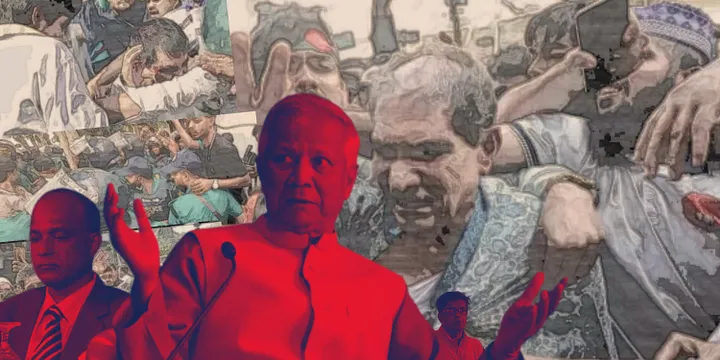
Since July 2024, Bangladesh has entered a period of escalating authoritarianism under an unelected interim government that initially promised to oversee a democratic transition. While the previous Awami League government was far from perfect, marked by mismanagement of protests like the quota reform movement and a poor record on dissent, at no point did the population experience the widespread fear, silencing, and state-sponsored intimidation now being reported across the country.
At the same time, the interim regime has moved to erase secular principles from the constitution, empowered extremist religious groups, and intensified repression of journalists, writers, and civil society. This article outlines the alarming trajectory of Bangladesh’s political collapse, highlighting how a flawed democracy has given way to a dangerous authoritarianism far worse than what preceded it.
Over the past several months, the interim government has engaged in an unprecedented campaign of political repression, targeting opposition parties, civil society, and independent media. The alarming escalation of arbitrary arrests, the banning of the Awami League, the country’s largest political party, and widespread suppression of dissent represent a fundamental assault on democracy and the rule of law.
The scope and nature of the abuses are alarming. In April 2025, the government banned the Awami League, declaring that it “officially banned all activities of the Awami League and its affiliated bodies on allegations of killings, crimes against humanity.” (en.wikipedia.org) This was followed by the suspension of the party’s registration with the Election Commission, effectively outlawing its participation in national politics (reuters.com). Although the party had its problems, the current campaign to eliminate it from public life represents a fundamental breakdown of democratic norms.
The repercussions were swift and brutal. One month saw “over 48,400 arrested in one month” on politically motivated grounds. During February’s “Operation Devil Hunt,” launched on February 8 to “restore law and order,” joint forces arrested 1,308 people on the first day, and by month’s end the number had swelled to 11,313 (thedailystar.net). As the crackdown continued, 12,700 more people, predominantly Awami League members or activists, were detained in an eight-day sweep. An early May surge saw another 1,673 arrests in 24 hours, bringing the total to over 23,450 in just 17 days.
These are not statistics; they represent thousands of families torn apart. Under the banner of law enforcement, political opposition is being systematically dismantled.
Furthermore, the term “Operation Devil Hunt” itself evokes chilling intent. As Home Affairs Adviser Lt Gen (Retd) Jahangir Alam Chowdhury bluntly stated, the operation would continue until “all devils are rooted out.” (thedailystar.net). This language suggests not a mission to enforce the law, but a campaign to eliminate dissent.
What started as a crackdown on unrest has evolved into outright political repression. A major political party has been effectively banned, and its members arrested en masse, undermining both national and international standards for free and fair political participation.
Human Rights Watch documented that the government “prohibited all activities, including any kind of publication, media, online and social media, any kind of campaign, procession, meeting, gathering, conference, etc. by Bangladesh Awami League,” effectively silencing not only political expression but also civic association. (hrw.org) The Election Commission went further by stripping the Awami League of registration on May 12, banning meetings, publications, and online speech supporting the party under a “draconian amendment to the Anti‑Terrorism Act.” (thedailystar.net) HRW warned that the interim government’s “arbitrary targeting of former ruling party (Awami League) supporters fails accountability” and cautioned that these repressive tactics “risk undermining fundamental freedoms.” (m.economictimes.com)
Press freedoms have been especially hard hit. According to the Rights and Risks Analysis Group, at least 640 journalists were targeted in the first eight months (Aug 2024-Mar 2025), including 182 criminal cases, 206 violent attacks, 167 accreditation denials, and 85 inquiries by financial, anti‑terror, and anti‑money‑laundering units. (rightsrisks.org) One independent study noted a chilling statistic: “There have been more than 354 journalists harassed, 74 cases of violence reported, 113 criminal charges filed, and press credentials revoked for 167 journalists…” (en.wikipedia.org) Outlets report the abrupt firing of staff for asking difficult questions and the suspension of an entire news division following critical reporting at a government press event. (borderlens.com) Furthermore, media infrastructure has come under siege; journalist associations, press club offices, and TV channels have been ransacked or occupied by mobs, sometimes with official tolerance. (en.wikipedia.org)
Legal harassment is rife. Under the Cyber Security Act, which essentially retained the Digital Security Act’s repressive powers, the interim government has pursued arrests for “hurting religious sentiment,” targeting poets, writers, activists, and peaceful dissenters. (article19.org) Amnesty and ARTICLE 19 have condemned repeated patterns of violence, intimidation, arrests, and physical assaults against journalists, human rights defenders, and public intellectuals. (amnesty.org) Violence against bookstall vendors accused of selling controversial literature and crackdowns on poets such as Sohel Galib, detained under vague charges, highlight the draconian use of these laws. (article19.org)
Also, a deeply alarming development under the interim administration is its concerted effort to undermine secularism, one of Bangladesh’s founding principles. The Attorney General and the Constitutional Reform Commission have explicitly proposed removing “secularism” (along with “socialism” and “nationalism”) from the Constitution, replacing these core pillars with vague ideals like equality, pluralism, and social justice. (ndtv.com, business-standard.com) Critics have warned that this marks a deliberate ideological shift toward an Islamically framed state, effectively dismantling secularism as a constitutional safeguard.
Bangladesh is increasingly falling under the influence of Islamic extremism, as banned and radical groups resurface and operate with growing confidence under the interim government. Hizb ut-Tahrir, outlawed since 2009 for its links to global jihadist networks, has returned to the streets with public “March for Khilafat” processions in Dhaka, some requiring police intervention and the use of tear gas to disperse crowds. (Reuters, 2025) The interim government in Bangladesh has initiated a troubling rehabilitation of extremist forces. According to The Economic Times, the current authorities are “pushing to re-register the pro‑Pakistan Jamaat‑e‑Islami (JeI) as a legitimate political party and exonerat[e] it of its alleged role in the 1971 war crimes,” reversing hard‑won bans. (reuters.com, moneycontrol.com) This move risks empowering ideologies that once abetted genocide and crimes against humanity. Analysts report a concerning normalization of extremism, with previously banned organizations like Jamaat-e-Islami and Ansarullah Bangla Team re-entering public discourse and allegedly being accommodated by parts of the interim administration.
According to a detailed report by Nikkey Asia, Islamist forces are now asserting control over public and private life, targeting women, minorities, and secular traditions. Incidents include attempts to restrict women’s participation in sports, public harassment of women who do not wear hijab, and attacks on Ahmadiyya and Sufi religious sites. (Nikkey Asia, 2025) Speaking at the UN Human Rights Council, expert Fazal ur Rehman Afridi warned that Bangladesh is facing a “meteoric rise” in Islamist influence, adding that security structures are “under siege” as extremist ideologies move into positions of power. With law enforcement weakened and the political void deepening, the resurgence of Islamist militancy is no longer limited to the fringes; it is becoming entrenched in mainstream politics and governance.
In response to these mounting concerns, the interim government has done little beyond dismissing the allegations as false or exaggerated. Rather than addressing the documented abuses, it has consistently denied responsibility, deflected criticism, and refused to engage in meaningful dialogue or investigation.
In summary, while the interim government professed support for democratic renewal, its actions have mirrored the authoritarian methods, through bans on political parties, sweeping restrictions on media and civic freedoms, targeted criminal prosecutions, and unchecked violence against dissent. This constellation of measures not only suffocates political pluralism but also sets a dangerous precedent for systemic suppression under the guise of transitional governance.
[Tasin Mahdi, a devoted knowledge seeker based in Dhaka, Bangladesh, exhibits a profound commitment to the betterment of his home nation and a keen interest in international policy.]

https://stapravda.ru/20221228/reyting_samyh_populyarnyh_hostingov_v_rossii_196445.html, рейтинг хостингов России подтверждает, что выбор надежного провайдера важен для бизнеса.