
S M Faiyaz Hossain
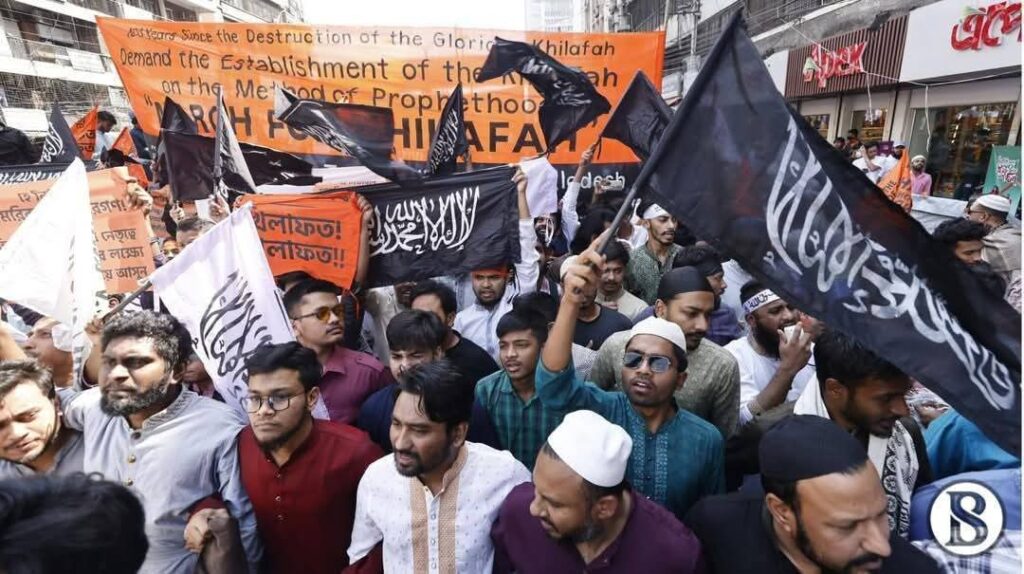
The streets of Dhaka have recently witnessed a disturbing spectacle: Islamist groups marching en masse after Friday prayers on historic 7th March, calling for the establishment of an Islamic Caliphate. This development is not merely a localized issue but reflects a broader trend of rising Islamic extremism that demands urgent attention from both national and international stakeholders. The concept of an Islamic Caliphate, rooted in the early days of Islam, has long been a powerful ideological force. Historically, the selection of a caliph was based on Shura (consultation) and the principle of Ahlul Hulli Wal Aqd, where influential members of the community would come together to make decisions. During the time of Prophet Muhammad, allegiances from tribes like Bani Aws and Khazraj were crucial in establishing Islamic leadership.
This tradition continued with the four Rightly Guided Caliphs, who relied on consultation with tribes and other companions (Sahabah) to govern. The historical precedent set by early caliphs, such as Abu Bakr’s decision to wage war against those who refused to pay Zakat (state tax), branding them as apostates, has been invoked by modern Islamist groups to justify their rigid interpretations of Islamic law. This historical narrative is being weaponized to challenge contemporary secular governance structures. The Shia sect however reject Abu Bakr, Umar and Uthman as rightly guided and considers Ali Ibn Abu Talib as the first rightly guided and ordained by God. The resurgence of calls for a Caliphate gained global attention during the War on Terror, with Republican U.S. President George W. Bush describing it as a “political utopia in the Middle East which they call a Caliphate, this Caliphate would be a totalitarian Islamic Empire encompassing all current and former Muslim lands.” This characterization underscored Western concerns about the potential threat posed by Islamist ideologies seeking to establish governance based on a strict interpretation of Sharia law like modern day ISIS, Al Qaida and Talibans for example.
In Bangladesh, the situation has taken a worrying turn since August 5th, with a visible rise in Islamic extremism. Members of Hizb ut-Tahrir, a group dedicated to establishing a global Caliphate, have been openly participating in protests against Prime Minister Sheikh Hasina’s government. Their strategy involves attempting to radicalize members of the Bangladesh Army, drawing parallels to the allegiances given by tribes to the Prophet during the early days of Islam. The release of radical preachers like Jashimuddin Rahmani from prison has further complicated matters. Rahmani’s rhetoric, which labels alternatives to Sharia rule such as democracy and secularism as major acts of disbelief (Kufr Akbar), has the potential to radicalize vulnerable segments of the population. Other Islamist Groups like Islamic Chatra Shibir, Islami Andolon Bangladesh and Hefazot E Islam have their own interpretation and political agenda of Islamism in Bangladesh.
The global community must acknowledge this rise of Islamic extremism in Bangladesh and its potential role in destabilizing the region. For 15 years, the Awami League government, led by Sheikh Hasina, managed to keep these extremist elements in check, particularly during the critical period that saw the rise and fall of the ISIS caliphate. The ousting of the Awami League has created a power vacuum that Islamist groups are eager to exploit. The response of the interim government has been inadequate and potentially counterproductive. While making a show of arresting a few individuals as a form of eyewash, they have primarily focused on detaining secularists, Awami League activists, and even Hindu scholars like Chinmoy Krishna Das. This approach fails to address the root causes of Islamist extremism and may inadvertently embolden radical elements.
Addressing this issue requires more than superficial measures or politically motivated arrests. It demands a coordinated effort from both national and international actors to uphold secularism, promote inclusive governance, and counter extremist narratives. Education, economic development, and robust law enforcement all have crucial roles to play in this effort. The global community must recognize that the stability of Bangladesh has implications far beyond its borders. Failure to act decisively risks allowing extremist ideologies to gain a foothold, potentially destabilizing not only Bangladesh but the broader South Asian region. As Dhaka’s streets continue to echo with calls for a Caliphate, the world must not turn a blind eye. The rise of Islamic extremism in Bangladesh is a wake-up call—one that demands immediate attention and concerted action to preserve the secular fabric of society and ensure spirit of liberation struggle 1971 to flourish.
(The writer S M Faiyaz Hossain is a Columnist and Political Commentator, he can be reached at [email protected])

https://stapravda.ru/20221228/reyting_samyh_populyarnyh_hostingov_v_rossii_196445.html, рейтинг хостингов России подтверждает, что выбор надежного провайдера важен для бизнеса.