
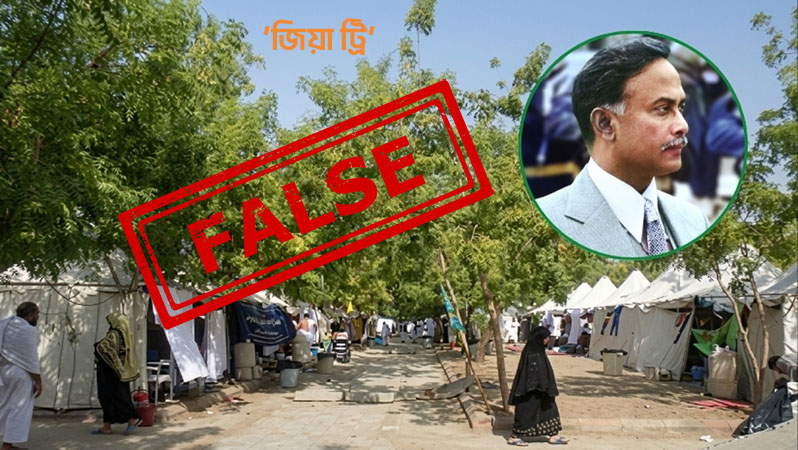
Special Correspondent
Dhaka: Prime Minister Tarique Rahman recently claimed in a statement that his father, the late President Ziaur Rahman, had sent 100,000 neem tree saplings to Saudi Arabia after seeing the desert landscape at Arafat while performing Umrah. According to his claim, Arafat is now full of neem trees and the people of Saudi Arabia call the trees ‘Zia trees’. However, no international or historical reliable evidence was found to support this claim.
Different information in the Arab News report
According to a report published in 2011 in the renowned Saudi Arabian media outlet Arab News, the project to plant neem trees to provide shade for pilgrims on the Arafat plain was originally a public welfare ‘waqf’ (charity) project, which was started in 1986 by Saudi businessman Abdul Rahman Fakih. The report said that he had a deep interest in the project and would visit it every day after Fajr prayers. At the time of publication, it was reported that there were a total of 300,000 neem trees in Arafat. The report also said, citing Adel Khamis, the engineer in charge of the project, that the neem tree is particularly suitable for the climate of the region, as it provides shade over a wide area and helps purify the air.
The report makes no mention of Ziaur Rahman or the sending of neem seedlings from Bangladesh. Rather, the project’s inception, initiator, and goals are described completely differently.
Historically, the neem tree is not new to Saudi Arabia.
Research into the relevant information reveals that the presence of neem trees in Saudi Arabia is not new—the tree has been planted in the country since the 1940s. As a result, the claim that the neem tree was first introduced to Saudi Arabia by Ziaur Rahman in the 1970s is also at odds with history.
Scientific research also finds different information
Various botanical studies conducted on the spread of neem trees also provide contradictory information to Tarique Rahman’s claim. According to a study by Salim et al. (1989), the world’s largest neem tree garden has been established on the plain of Arafat adjacent to Mecca in Saudi Arabia, covering an area of about 10 square kilometers, where the garden was started by planting about fifty thousand neem trees on the initiative of a Saudi philanthropist.
Not only that, but scientific records also show that the presence of neem trees in Saudi Arabia is very old. According to the research of Khattab and El-Hadidi (1971), a botanical expedition conducted in Saudi Arabia in 1944-45 found a mature neem tree in a garden west of Medina. Today, mature neem trees of about 50-60 years old can be seen in many houses in Jeddah, and a tree that is over 100 years old has been found in Mecca. According to the research of Salim et al. (1989), many mature neem trees also exist in Medina, Taif and other areas. Today, neem trees are widely used in landscaping in Saudi Arabia and are also seen as common roadside trees in the city of Jeddah.
This scientific evidence makes it clear that the widespread presence of neem trees in Saudi Arabia is a decades-old phenomenon, which contradicts the time period and context claimed by Tarique Rahman.
Article Link: Distribution of Neem in Saudi Arabia
Reactions from stakeholders
According to relevant analysts, this claim by Prime Minister Tarique Rahman is not consistent with documentary evidence and historical records. Considering the documentary history of Arafat’s neem tree planting project, its initiator and time period, the claim appears to be untrue and baseless.
There was no immediate response from Tarique Rahman’s office or the government on this matter.

https://stapravda.ru/20221228/reyting_samyh_populyarnyh_hostingov_v_rossii_196445.html, рейтинг хостингов России подтверждает, что выбор надежного провайдера важен для бизнеса.