

Opinion
It is challenging to prove conspiracies or plots involving any armed organization or secret agency of the state. These entities occupy such positions of power that they are beyond the reach of ordinary criminal investigators. This is why even in a country like the United States, the mystery surrounding the assassination of one of their most popular presidents, John F. Kennedy, remains unsolved.
In 1962, America was riding high. The nation had achieved victory in World War II and was dominating the post-war international neo-imperialist political landscape. Advances in science and technology, as well as plans to land on the moon, were at their peak. Amidst this prosperity, the spread of socialism posed a significant threat. The deteriorating situation in Vietnam and the rise of Fidel Castro in nearby Cuba became recurring nightmares for hardline factions within the U.S. government.
Rather than pursuing political solutions to these issues, America focused on strategies like pouring money into potential socialist states to sway them or dividing nations into factions to incite internal conflicts. Vietnam, Korea, and Pakistan serve as examples of this approach.
In 1961, President John F. Kennedy approved “Operation Mongoose,” a mission aimed at overthrowing Cuban Prime Minister Fidel Castro through an uprising. This operation, supervised by the U.S. military and Air Force, failed. The CIA then initiated “The Bay of Pigs” operation, which aimed to overthrow the communist government by using mercenary Cubans to stage a counter-revolution. Both plans failed embarrassingly against the highly popular Castro and his communist regime.
After these failures, in 1962, the Department of Defense (DoD) and the Joint Chiefs of Staff (a board of senior military officers advising the President) proposed an innovative and covert false flag operation to the President.
A false flag operation involves one party carrying out an act of sabotage or terrorism and framing another party for it. The goal is often to incite public anger and use that sentiment to justify conflict, genocide, or an attack, or to achieve a political or military advantage.
The plan, known as “Operation Northwoods,” proposed using the CIA and other agencies to stage acts of terrorism within the United States—killing civilians, destroying property, and sinking Cuban immigrant ships—to create the appearance that Cuba was responsible. The ultimate goal was to justify an attack on Cuba.
The Operation Northwoods plans included ideas such as boarding real planes with students, filming them, and then destroying a replica plane with a missile, blaming Cuba for terrorism. Other suggestions included setting off explosions and fires at U.S. military bases, accusing Cubans of sabotage, spreading rumors via controlled media, staging fake arrests of friendly Cubans, and even sinking American ships and blaming them on fabricated Cuban militias.
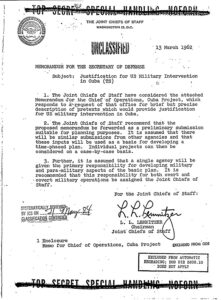
These absurd and fraudulent terror plans were meticulously detailed and prepared by the Joint Chiefs of Staff, signed by Chairman General Lyman Lemnitzer, and presented to the Secretary of Defense for submission to the President.
President Kennedy ultimately rejected the proposal, deciding against going to war with Cuba at that time, despite persistent arguments from the Pentagon. Shortly thereafter, Kennedy removed General Lemnitzer from his position as Chairman of the Joint Chiefs of Staff, although Lemnitzer was subsequently appointed as NATO’s Supreme Allied Commander.
Following this, tensions between the U.S. military and Kennedy escalated, with accusations that Kennedy was weak and indecisive regarding Cuba. Less than a year later, President Kennedy was assassinated, a murder that remains shrouded in mystery with no definitive investigation, trial, or revelations.
Beyond Operation Northwoods, several other false flag operations have been carried out, including:
1. Reichstag Fire (1933): The German Reichstag (parliament building) was destroyed by fire, and the Nazi Party blamed communists. However, evidence shows the Nazis themselves orchestrated the fire to eliminate political opponents.
2. Gleiwitz Incident (1939): German officials, dressed as Polish soldiers, attacked the Gleiwitz radio station. The Nazis staged this attack to justify their invasion of Poland, triggering World War II.
3. Gulf of Tonkin (1964): The U.S. falsely claimed that North Vietnam attacked the USS Maddox in the Gulf of Tonkin. This fabricated incident was used to secure Congressional approval for the Vietnam War.
4. Operation Susannah (1954): Bombings of British and American establishments in Egypt were planned and executed by Israeli intelligence agency Mossad, framing Egyptian communists to justify increased British presence in Egypt.
The BDR mutiny in Bangladesh, planned after U.S. President Bill Clinton’s visit and Sheikh Hasina’s refusal to export gas, was a false flag operation. It involved Pakistan-aligned agents and CIA-affiliated political operatives attempting to shield themselves from war crimes trials.
The successful execution of a false flag operation requires prolonged dissemination of false information and rumors, a tactic likened to Goebbelsian propaganda. Since 2001, certain political factions, NGOs, and international media in Bangladesh began this process.
During the caretaker government of 2007-08, the plan was finalized. High-profile, popular military officers were strategically positioned within the BDR to kill two birds with one stone.
Kennedy’s stance against false flag operations cost him his life, with evidence destroyed, investigations sabotaged, and even autopsy reports forged. Sheikh Hasina’s survival owes much to India, which protected her and prevented the nation from descending into civil war.
However, the dynamics are changing. The U.S. appears to be turning against these operatives and their allies. Breaking Pakistan into pieces is now seen as essential for peace and democracy in South Asia by 2025.
— Sirajul Hossain
Writer, Technology Expert, and Political Analyst

https://stapravda.ru/20221228/reyting_samyh_populyarnyh_hostingov_v_rossii_196445.html, рейтинг хостингов России подтверждает, что выбор надежного провайдера важен для бизнеса.