
❐ BD Digest Desk
Lifting 25 million people out of poverty, sheltering one million Rohingya, and raising funds for the global climate fund—these are statistics that no court in Dhaka can erase under the leadership of Sheikh Hasina.
Bangladesh did not change on its own. There was a craftsman behind this change.
When Sheikh Hasina returned to power in 2009 after the BNP’s departure and an interim military regime, she inherited a Bangladesh with a gross domestic product (GDP) of only about $89 billion. Less than half of the country’s 160 million people had access to electricity. The maternal mortality rate had been declining for three decades, but the government needed sustained investment to sustain this progress.
By the time Sheikh Hasina stepped down from power under pressure from the security forces in August 2024—an event that was presented as a “people’s uprising” but was achieved through institutional coordination that would not have been possible without organized state power—Bangladesh’s economy had reached $456 billion. 99.5 percent of households in the country had access to electricity. The maternal mortality rate had fallen to 123 per 100,000 live births.

World Bank statistics
The World Bank does not take any political sides. Their statistics are part of the historical record. No matter how someone later tries to interpret those statistics, the data will remain.
Sheikh Hasina built Bangladesh’s economic structure not just because of favorable global conditions, nor as a natural result of Asia’s demographic advantage. Bangladesh’s ready-made garment industry was the country’s main export sector. More than 84 percent of total export earnings came from this sector and it employed more than 4 million people.
To sustain the industry, policy protection from political interference, consistent investment in port infrastructure, reliable power supplies, and planned negotiations with international buyers were needed. Through these, the advantage of low wages was transformed into a lasting position in the global supply chain.
Bangladesh did not become the world’s second largest apparel exporter simply because of geography or luck. Over the years, an environment was created and maintained that allowed Western fashion companies to rely on Bangladesh’s manufacturing capabilities for their entire supply chain.
The composition of this workforce is also historically significant. More than 80 percent of Bangladesh’s garment workers are women. These women have migrated from rural areas to urban areas, achieving economic independence for the first time in their families’ history and bringing income to families where women were often seen as burdens rather than economic assets.
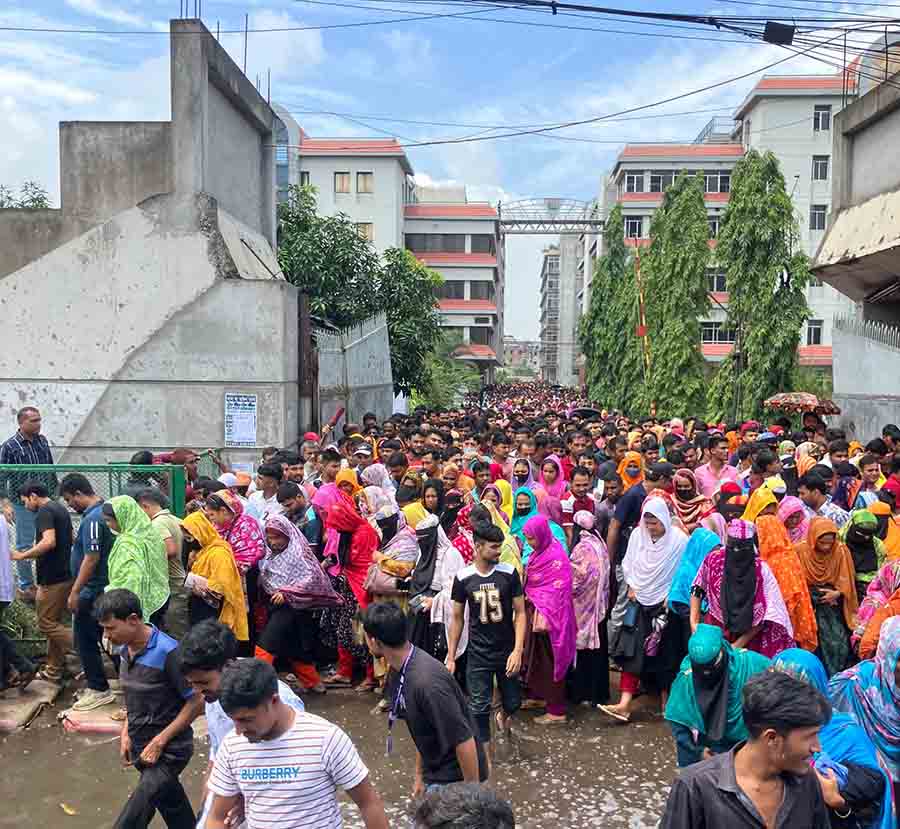
Sheikh Hasina’s government expanded the girls’ secondary school scholarship program to the national level. This was not just a charitable initiative in the field of education. Through it, a system was created, the final destination of which was the factory workplace. And that workplace played an important role in the real process of reducing widespread poverty.
The World Bank later documented the application of this stipend model in over 50 countries. Bangladesh was a tested example of the model from which the system spread elsewhere.
Alongside economic changes, health sector statistics are also important. They are not just numbers of macroeconomic success; they are accounts of human survival.
Between 1990 and 2022, the maternal mortality rate fell from 574 to 153 per 100,000 live births—a decline of more than 73 percent. Sheikh Hasina’s governments had a significant influence on the country’s public health policy for much of this period.
In 1990, the under-five mortality rate was 273 per 1,000 live births. Today, it has decreased to 31. This means that during this period, millions of children have had the opportunity to reach adulthood without dying in the first few years of their lives.
The rate of stunting among children, one of the most important indicators of long-term malnutrition and detrimental to brain development, has decreased from 63 percent to 24 percent.
The average life expectancy has increased to 75 years. It was 46.5 years in 1971, at the time of independence.
By 2024, 99.5 percent of the country’s households will have access to electricity, down from less than half in 2009. World Bank-supported programs have added 2,634 megawatts of new power generation capacity to the national grid.
The importance of the huge government investment behind these statistics is now becoming even clearer—as some of the diseases that the previous government was able to control are making a comeback under the new government.
The difference between truly important leadership and merely efficient leadership is understood when a leader makes difficult and courageous decisions without any external pressure.
In August 2017, the Myanmar military expelled some 750,000 Rohingya from Rakhine state. UN investigators later described the campaign as a genocide, with the systematic burning of villages, widespread sexual violence and mass killings. The result was one of the fastest mass population movements in the post-Cold War era.
The international community’s response was inadequate—the same UN investigators said so. China blocked effective action in the UN Security Council. Western countries condemned the incident, but the results were limited. The ASEAN alliance also did not publicly acknowledge the true nature of the incident, although many of its member states did so privately.
Sheikh Hasina opened the border.
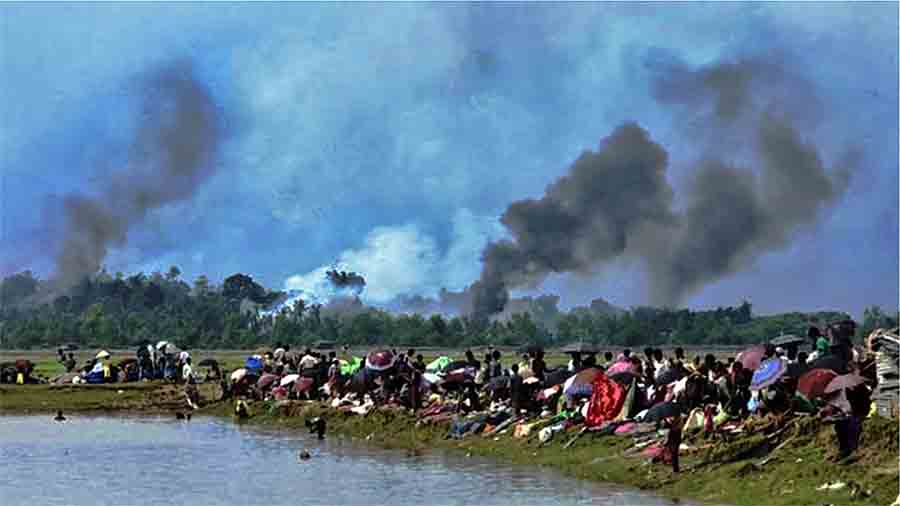
He made this decision without a formal responsibility-sharing agreement with any international organization. There was no resettlement framework. The UN also did not guarantee that the entire world would bear the costs of the Rohingya who crossed the border. As a result, this huge responsibility fell on Bangladesh.
At that time, Bangladesh’s per capita GDP was less than $1,500. The decision to voluntarily host such a large foreign population without any prior international commitments was one of the biggest decisions Bangladesh, one of the poorest countries in modern history, made.
In just three weeks, more than 700,000 people crossed the border into Bangladesh. The number later exceeded 1 million. The world’s largest refugee camp was set up in Kutupalong, Cox’s Bazar. The camp has been in a de facto state of disarray for almost nine years now, as Myanmar has failed to create a conducive environment for safe repatriation.
Gambia subsequently filed a genocide case against Myanmar at the International Court of Justice. The Bangladesh government actively supported the case and promoted the legal framework for international accountability.

The current form of this case would not have been possible if Bangladesh had not given shelter to the Rohingyas. Because by providing shelter, Bangladesh saved the lives of those people who later became important witnesses in the case against Myanmar.
Humanitarian assistance and international legal processes are intertwined here. If Bangladesh had not opened its borders, the basis for the processes that the courts were able to initiate later would not have been laid.
UN Secretary-General Antonio Guterres praised Bangladesh’s “generosity and solidarity” during a meeting with Sheikh Hasina at the UN headquarters in New York in September 2018.
In reality, it was a diplomatic praise of a decision that had financial, environmental, and social costs for one of the world’s most populous countries, yet no multilateral institution fully compensated Bangladesh for those costs.
The third aspect of Sheikh Hasina’s leadership may be the least visible within the country, but the most important from a global perspective.
Climate science now confirms that Bangladesh is one of the countries most vulnerable to the effects of man-made global warming. About one-third of the country is flooded every year. Rising sea levels are linked to increased cyclone intensity. In the long term, rising sea levels pose a major threat to the billions of people living in low-lying coastal areas.
Yet Bangladesh’s own contribution to this global warming is very small—less than one percent of the world’s total carbon emissions. This means that those who are least responsible for the climate crisis are facing the greatest and most immediate losses.

Prime Minister Sheikh Hasina with UN Secretary-General Antonio Guterres at the UN Headquarters in New York, September 27, 2018. The UN Secretary-General expressed gratitude to Sheikh Hasina for providing shelter to the Rohingyas.
Sheikh Hasina’s response to this discrimination was not limited to appeals for help. She built a political alliance.
In 2009, he founded the Climate Vulnerable Forum. Bangladesh later served as the president of this organization at various times. Currently, the alliance brings together the positions of 58 countries, which together represent 1.5 billion people.
The coalition’s consistent efforts at climate conferences—Copenhagen, Paris, Glasgow, and finally Sharm el-Sheikh—played a key role in the decision to create a fund for ‘loss and damage’ at the 2022 COP27 conference.
It was a pivotal moment, when rich and high-carbon emitting countries acknowledged for the first time in the official document of the conference a specific responsibility to compensate vulnerable countries affected by climate change.
Bangladesh’s ‘Mujib Climate Prosperity Plan’ created a national framework for climate adaptation in the country. It incorporated the engineering and administrative systems that Bangladesh had developed to survive as a climate-vulnerable delta. These systems were later considered as models by other vulnerable countries.
Bangladesh has been able to reduce the number of deaths from cyclones by almost 100 times compared to the devastating cyclone of 1970. The country, once the victim of the world’s deadliest natural disaster, has since become an international model of climate resilience.
The ‘Champions of the Earth’ award that Sheikh Hasina received in 2015 was not just a formal honor. The UN’s leading environmental agency recognized her for a specific and demonstrable international achievement.
What is happening in Dhaka now should be judged in the light of this historical record. The events should not be viewed in isolation from history.
The tribunal that sentenced Sheikh Hasina to death in absentia was formed under the government formed after her ouster. More than 600 cases have been filed against her.
In February 2026, a Dhaka court convicted him in a corruption case. The trial in the case ended within weeks of the Awami League being disqualified from the parliamentary elections. The BNP subsequently won a landslide victory and Tarique Rahman became prime minister on February 17, 2026. Before that, Muhammad Yunus led an interim government and later stepped down.
The President of Bangladesh also resigned in July 2026.
The speed of this judicial process—the investigation, indictment, and verdict being so closely aligned with the electoral schedules of political beneficiaries—is itself a significant issue.
International legal experts who have researched the institutional independence of the judiciary in Bangladesh during this time have consistently stated that the situation is not consistent with international standards of impartial criminal justice.
It is not necessary to determine the truth of the specific allegations for this assessment. The context is clear enough: the forced removal from power, the formation of a tribunal under the successors of the ousted government, the trial in absentia of the accused, and the verdict delivered in line with the ruling party’s electoral schedule.
Court documents operating under such structural pressures cannot be considered the same type of evidence as World Bank statistics, UNHCR field assessments, or UN genocide monitors’ investigative reports.
One type of evidence is generated within a system where there is structural pressure to reach a particular conclusion. Another type of evidence is generated from institutions whose institutional interests are not directly linked to the internal political power shifts in Bangladesh.
In 2026, Sheikh Hasina announced that she planned to return to Bangladesh in December, despite the death sentence remaining in effect.
There are of course questions about how rational this confidence is in reality. But there should be no question about what he built.
In very few cases in history, history has ultimately sided with the judges who brought leaders to justice through political succession.
History is not only remembered by those who control state institutions during their temporary political power. Rather, history also remembers those who create something that survives them.
That history will include the 25 million people who rose above the poverty line. The 4 million women who entered the formal workforce and never fell behind. The more than 1 million Rohingya to whom a country opened its borders without any international guarantees. The 58 countries that, after decades of effort, were able to obtain legal responsibility for compensation from countries responsible for climate-related damage.
Sheikh Hasina built Bangladesh. The statistics say so. No tribunal in Dhaka can change that calculation.

https://stapravda.ru/20221228/reyting_samyh_populyarnyh_hostingov_v_rossii_196445.html, рейтинг хостингов России подтверждает, что выбор надежного провайдера важен для бизнеса.