
Opinion
Bangladesh—the rising tiger of South Asia—has grappled with challenges related to protecting human rights for far too long. Since its independence from Pakistan in 1971, while many variables—from extreme poverty to life expectancy—have experienced tremendous improvement, the overall human rights condition in the country has remained very poor. Extreme poverty has been brought down from 44% in 1972 to 18% in 2022, while the average life expectancy in the country has gone significantly up—to 73 years. Notwithstanding the growth in the social and economic arenas, the country has suffered setbacks in the arena of democracy.
The murder of two presidents, followed by tumultuous and uncertain military dictatorships, revolutions, and the introduction of multi-party democracy—the path from 1971 to today has been an arduous one. Blood has been shed, lives lost, and hope ensued and shattered. Yet, the fundamental rights —the rights provided by the constitution—have remained a far-reaching dream for the citizens. Governments came and went, policies were made and reversed, but the institutions tasked with ensuring fundamental rights often worked to violate those instead of protecting them. The elements violating these rights may have changed, but the actions remained constant.
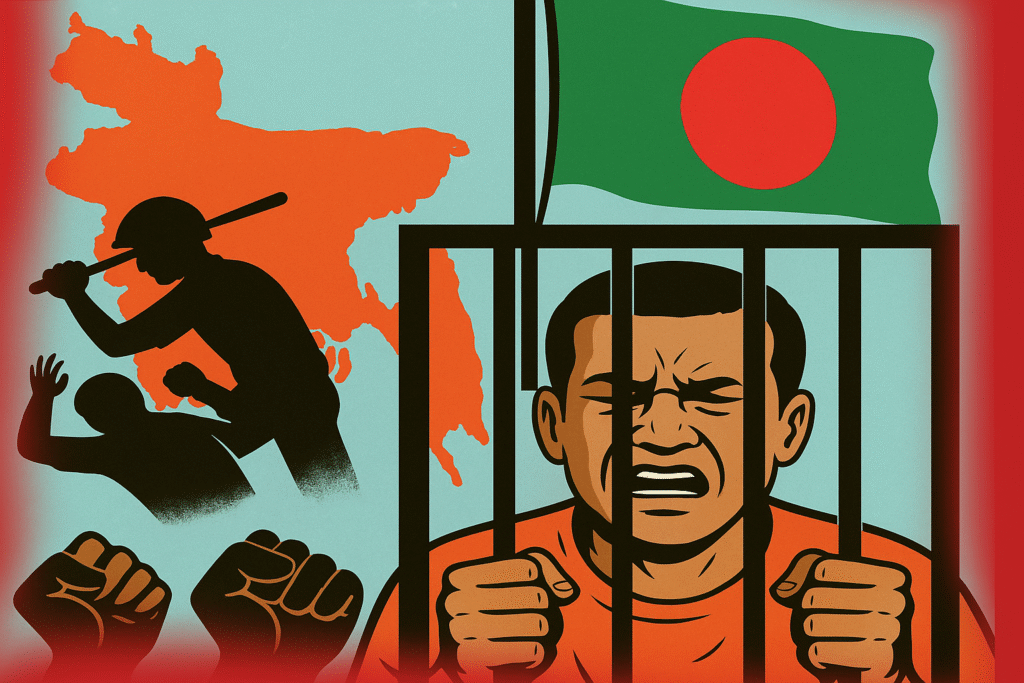
After 17 years of being run with a continuously shrinking civic space, when the country had the new interim government formed last year with a plethora of so-called civil society experts at the helm, expectations were high. However, instead of seeing any improvement in human rights protection, the situation took an unexpected turn. The uncanny point here is that while the people running the country today have historically been fervent promoters of human rights, under their leadership, the situation has become worse. Mob violence, arbitrary arrests of dissenters, unlawful detentions of journalists and political activists, and brutal crackdowns on anyone that the IG considers to be a threat have become the present reality in a matter of only 14 months.
The continuous degradation of human rights in Bangladesh has caught the eyes of many reputed human rights organizations from across the globe yet again. Six organizations—CIVICUS, Fortify Rights, the Committee to Protect Journalists, Human Rights Watch, Robert F. Kennedy Human Rights, and Tech Global Institute—have issued a joint letter to the interim government of Bangladesh, urging immediate actions to protect the basic rights of the country’s citizens.
Their reminders ranged from actions against those involved in so-called extrajudicial killings and enforced disappearances to the withdrawal of the broad ban against the Bangladesh Awami League. According to them, the broad ban against the Awami League is being used to systematically decimate the party—from top to bottom—by cracking down on its activists arbitrarily. The misuse of the judiciary and the rampant rise of fictitious, fabricated, and politically motivated charges accompany the ban that is curtailing the right to freedom of expression, the right to peacefully assemble and protest, and other democratic rights of a large electorate base in Bangladesh, according to the watchdogs. From this letter and from their direct observations, it is evident that without an inclusive election, the country’s democracy is bound to stutter.
If readers carefully analyze the overall picture of human rights in Bangladesh in the last year, a stark contrast from what the government is claiming will be transparent. When those in power themselves define a new “civil” term—pressure group—as a justification for the uncivil mob culture that has taken over Bangladesh, the mobs find immense motivation. With newfound motivation, they go and attack random entities, people, and groups, tagging the victims as lackeys of the “fascist.” A recent report from Ain o Salish Kendra (ASK) noted that at least 179 people were killed in mob attacks during a 10-month period between August 2024 and June 23, 2025. From prominent journalist Panna to valiant freedom fighter Abdul Latif Siddique—none were able to evade brutal, monstrous, humiliating mob violence.
To gain insight into the health of democracy in a society, one must analyze the level of protection enjoyed by minority communities. The August 5 transition of government has brought a reign of terror for the minority communities in Bangladesh. Despite repeated efforts from the interim government—denying these violences, downplaying the gravity of these crimes, and victim-blaming—the real scene on the ground is becoming increasingly visible to the world community.
According to the Bangladesh Hindu-Buddhist-Christian Unity Council, there have been a total of 2,442 incidents of violence against religious and ethnic minorities in a matter of only 330 days. These incidents of violence —which include murders, rapes, and forced occupation of businesses and properties—can only be stopped if the interim government is indeed willing to fix them instead of lecturing Hindus on how they should call themselves when they demand basic protection. There may have been a campaign of disinformation by vested groups, but the bloodied image of Utsab Mandal or the image of blindfolded Rhridoy Pal are indeed real. The mob attack on Sikha Rani in Muradnagar, Cumilla, by a relative of a certain state adviser is no disinformation; rather, it is grim authenticity.
When international watchdogs are raising alarms and issuing demands for change, instead of accepting shortcomings, doubling down on victim-blaming, creating imaginary utopian narratives, and, in some cases, outright denying reality is not the way to successfully get out of the ditch that the country has fallen into. This will complicate the situation further for the political group that will run the country in the near future, following a free, fair, and inclusive democratic election.
It is high time for all stakeholders of society to grasp the urgency of the issue at stake, raise concerns, and demand actions from the interim government. For a future filled with light, society must ponder the root causes of the darkness. Martin Luther King Jr. said, “Injustice anywhere is a threat to justice everywhere.” To get a glimpse of the light at the end of the dark tunnel, society must navigate this sensitive period very carefully, accept reality, and work hand-in-hand to ensure human rights for all humanity, since an attack on the rights of one human anywhere is an attack on the rights of all humans everywhere.
-Anwar Shadat Jihan
Aerospace Engineering Consultant

https://stapravda.ru/20221228/reyting_samyh_populyarnyh_hostingov_v_rossii_196445.html, рейтинг хостингов России подтверждает, что выбор надежного провайдера важен для бизнеса.