
BD Digest Report
Historical April 10th was a turning point in the history of Bangladesh’s liberation war. On this day in 1971, the first government of independent Bangladesh was formed, which later came to be known as the ‘Mujibnagar Government’. Not only was a government formed, this day was the day of establishing the state structure of a nation at war.
Earlier, the brutal attack by the Pakistani occupying forces on the night of March 25 practically made the path of Bengalis to independence inevitable. At around 12:30 am on March 26, the Father of the Nation Bangabandhu Sheikh Mujibur Rahman declared independence. The message sent from No. 32, Dhanmondi, clearly stated—“Bangladesh is independent from today.”
But soon after the announcement, Bangabandhu was arrested by Pakistani forces. Although there was a fear of a leadership vacuum, in reality the opposite happened as the political leadership quickly organized itself and gave the war a structured form.
In this context, the people’s representatives who won the elections on April 10, 1970, formally decided to establish the sovereign People’s Republic of Bangladesh. Bangabandhu Sheikh Mujibur Rahman was elected President and Syed Nazrul Islam was elected Vice President. In Bangabandhu’s absence, Syed Nazrul Islam assumed the duties of Acting President and appointed Tajuddin Ahmed as Prime Minister.
At the same time, with the ratification of the Declaration of Independence, the Liberation War gained a legal and constitutional basis. As a result, the war began to gain importance in the international arena as not just a rebellion, but a legitimate struggle to establish an independent state.
After the formation of the government, Tajuddin Ahmed’s speech from the Swadhin Bangla Betar Kendra on April 11 clarified the political and military outline of the liberation war. He portrayed the picture of a nationwide resistance war and called for an organized struggle. At the same time, the swearing-in date was set for April 17.
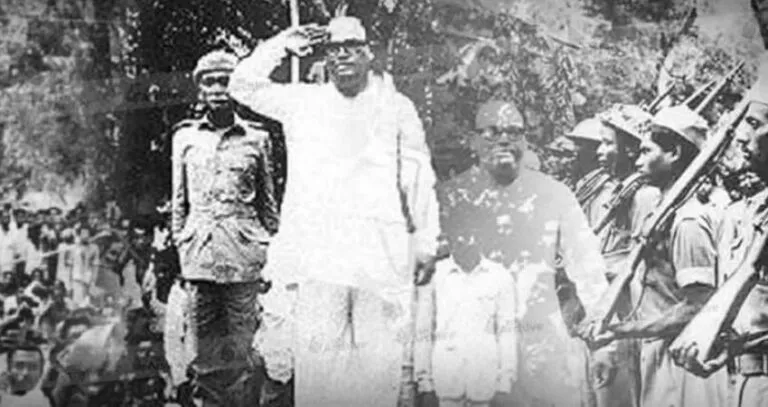
The oath-taking ceremony held at Baidyanathtala in Meherpur on April 17 was a symbolic and strategic step. After the oath-taking, Tajuddin Ahmed named the place ‘Mujibnagar’. Through this, a unified national identity was established, keeping in mind the leadership of the absent Bangabandhu.
The government began its work effectively by allocating portfolios at the first cabinet meeting on April 18. Other members of the cabinet were Khandaker Mushtaq Ahmed, M Mansur Ali and AHM Kamaruzzaman, who held important positions in administrative, diplomatic and wartime management.
The Mujibnagar government’s greatest achievement was to transform the isolated resistance into a unified liberation war. This government played a decisive role in organizing the liberation forces, conducting the war, dealing with the refugee crisis, and garnering international support.
As a result, after 9 months of armed struggle, Bangladesh achieved victory on December 16, 1971. The political foresight and leadership of the Mujibnagar government was one of the foundations behind that victory.
April 10th is not just a date, it proves that when a nation fights for its existence, it also acquires the ability to build a state in the midst of war.

https://stapravda.ru/20221228/reyting_samyh_populyarnyh_hostingov_v_rossii_196445.html, рейтинг хостингов России подтверждает, что выбор надежного провайдера важен для бизнеса.