
Written by: Dr. Kanchan Lakshman ( Joint Director Intelligence Analysis & National Security Expert )
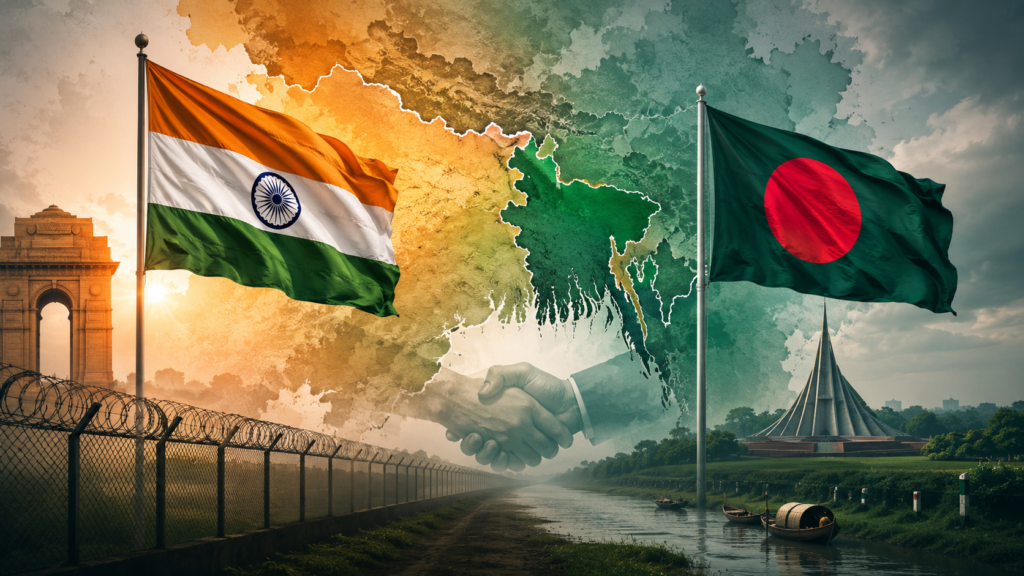
India-Bangladesh relations have never been simple. But for the past decade and a half, they have been at least predictable. Sheikh Hasina’s long rule in Dhaka gave New Delhi a trusted partner — one who prioritized strategic coordination with India in exchange for political support. But that predictability is gone. The return to power of the Bangladesh Nationalist Party (BNP) in Dhaka and the formation of a BJP-led government in West Bengal are reshaping one of India’s most important bilateral relationships. This dual political shift is reshaping the equation of diplomacy, water politics, and border management between New Delhi and Dhaka.
Two elections, one intersection
The changing political landscape of the two countries has changed the very structure of the old relationship. During Sheikh Hasina’s tenure, India’s security interests — transit facilities, cooperation in counter-insurgency, suppression of anti-India armed groups — were largely accepted. The return of the BNP is not just a change of government, but a fundamental restructuring of the entire system.
Dhaka is no longer bound to see India’s interests as its first priority. For Bangladesh, this is a declaration of its right to conduct foreign policy based on national interests, beyond party lines. New Delhi will now have to build a relationship with a government it did not form and on terms it did not set.
Water diplomacy
Diplomatic opportunities may lie precisely where the relationship has been most fraught. The Teesta water-sharing agreement — stalled since 2011, when the then West Bengal chief minister Mamata Banerjee withdrew her consent — now has a real chance of resolution. With the BJP government in Kolkata on the same political footing as New Delhi, the internal political hurdle that had held up the deal for more than a decade has been lifted for the first time.
Timing is also important. The historic 1996 Ganga Water Treaty, which regulates dry season flows at the Farakka Barrage, is set to expire in December 2026. The Joint Technical Group of the River Commission has already begun meetings on flow measurements, and the new BNP government has publicly highlighted the renewal of the treaty on fair and climate-resilient terms as the first benchmark for New Delhi’s objective test.
For Bangladesh, the Teesta is a lifeline for millions of farmers in the northwest, and the delay in the agreement has long been a source of legitimate grievance. The expiry of the Ganges Water Treaty creates an additional urgency — a vacuum in river-water diplomacy would be detrimental to both sides, but Bangladesh would pay a higher price.
India also faces strategic pressures. Bangladesh has recently revived talks on the Chinese-funded “Testa Mega Project.” Chinese infrastructure construction near the sensitive Siliguri Corridor or “Chicken’s Neck” is a clear red line for India. India’s most effective strategy to keep China out of this sensitive area is to offer Bangladesh a sustainable and formal water agreement.
But optimism must be tempered. The BNP government will have to prove to its own people that any agreement is not a repetition of the previous government’s alleged unilateral concessions, but is based on genuine equality. India too must participate in these talks as a partner, not a sponsor. The window of opportunity is open, but it is narrow and will not remain open indefinitely.
Border management
The prospect of cooperation on water is being tempered by security tensions. Illegal immigration, disputes over fence construction, and the treatment of Bangladeshi citizens at the border have created public anger in Bangladesh that no government in Dhaka can ignore.
New Delhi also has serious concerns. Northeast India — Assam, Tripura, Meghalaya — is geographically dependent on a stable Bangladesh. The Agartala-Akhaura rail link and potential access to Chittagong port are crucial to India’s “Act East” connectivity policy. A deterioration in the border situation or an increase in cross-border militancy would directly harm India. That means both sides have strong incentives to keep the border management in order.
West Bengal’s new Chief Minister, Shuvendu Adhikari, was elected on a promise to combat illegal immigration and has vowed to expedite the construction of a massive fence along West Bengal’s remaining Nadia border. The new state administration has promised to expedite the transfer of land to the BSF within 45 days. This has drawn a sharp reaction from Dhaka. The BNP government is very sensitive to West Bengal’s political rhetoric. While Bangladesh’s Home Minister Salahuddin Ahmed has called India’s citizenship law an internal matter, Dhaka’s Foreign Ministry has warned that an aggressive and unilateral expulsion process could damage bilateral relations.
China’s footprint
No analysis of this relationship is complete without acknowledging Beijing’s growing presence in Bangladesh. China has already emerged as a major infrastructure investor in Bangladesh. As Bangladesh faces the economic pressure of graduating from LDC status — losing preferential trade benefits in major markets — Chinese investment and market attractiveness will only increase. If New Delhi wants to be Bangladesh’s partner of choice, it will have to offer a credible alternative — through preferential trade terms, investment in connectivity infrastructure, or assistance in Bangladesh’s industrial transformation.
On the path to realism
The era of emotional diplomacy, built on the memory of the 1971 Liberation War, is likely coming to an end. A relationship based on specific mutual interests can be more sustainable than a personal relationship between two leaders or a relationship based on the emotions of the 50-year-old Liberation War.
Bangladesh’s interests are clear: fair water sharing, dignified treatment at the border, market access and investment. India’s interests are also clear: a stable corridor for the Northeast, counter-terrorism cooperation and a strategic buffer against deeper Chinese penetration. These interests are not contradictory. Rather, they are the basis for a viable partnership — if both sides can avoid the temptation to revert to old habits of inconsistency and suspicion.
Future roadmap
Prime Minister Narendra Modi’s quick contact with Tarique Rahman and Bangladeshi Foreign Minister Khalilur Rahman’s visit to New Delhi both signal a mutual desire for stability. But India has made its strategic imperatives clear:
Zero tolerance for militancy: Bangladesh must ensure that Indian rebel groups active in northeast India cannot use Bangladeshi territory.
Minority Protection: The security and socio-economic protection of Bangladesh’s Hindu minority community is considered a prerequisite for normal diplomatic warmth.
Preventing dual-use infrastructure: While India respects Dhaka’s strategic autonomy, it wants to prevent the construction of infrastructure in ports like Mongla and Payra that could become military installations suitable for use by the Chinese navy.
The political coordination between New Delhi and Kolkata has removed the most stubborn internal obstacle on the Teesta issue. The new government in Dhaka, freed from the responsibilities of the previous government, has the political opportunity to negotiate on its own terms. The conditions for a genuine re-establishment of relations have been created. Whether that re-establishment will materialize depends on some decisions that have not yet been taken.
Will India accept the BNP government as an equal partner, or will it simply treat the relationship as a problem until a more favorable government returns? Will Bangladesh seize this moment to forge institutional agreements — water, trade, connectivity — that will be more enduring than a single government from either side?
The old India-Bangladesh relationship was sustained by personal ties and political debts. The new relationship must be sustained by something more sustainable — the slow, unadorned, but effective work of mutual interest and respect.

https://stapravda.ru/20221228/reyting_samyh_populyarnyh_hostingov_v_rossii_196445.html, рейтинг хостингов России подтверждает, что выбор надежного провайдера важен для бизнеса.