

– Alam Masud
Author and Researcher
After the end of British rule in the Indian subcontinent in mid-August 1947, alongside India, a state named Pakistan was formed, comprising two Muslim-majority regions separated by a thousand miles. Our Bangladesh was initially known as East Bengal and later as East Pakistan, part of Pakistan based on the two-nation theory. We, the Bengali population, were the majority in Pakistan, and the majority of Pakistan’s export earnings came from East Pakistan. However, due to the conspiracies of the Urdu-speaking rulers of Pakistan, East Pakistan’s political power and economic benefits were not proportional to those of West Pakistan. Year after year, East Pakistan faced continuous regional discrimination—our culture, economy, and politics were all targeted by the rulers.
One of the most significant political events in Bengal’s 24-year liberation struggle was the Six-Point Movement. On February 5 and 6, 1966, at a conference of opposition political parties in Lahore, Pakistan, Sheikh Mujibur Rahman, on behalf of the Awami League, presented the ‘Six-Point Demand’ to establish autonomy for East Pakistan. On February 6, newspapers labeled Sheikh Mujib as a separatist. On February 21, 1966, the Awami League’s working committee meeting in Dhaka adopted the Six-Point proposal and planned a movement to realize the demands. Simultaneously, a pamphlet titled Six Points: Our Demand for Survival was published.
On March 23, 1966, when the ‘Six Points’ were presented to the public, the Bengalis embraced it as their charter of freedom and rallied in its support. That same year, on June 7, a massive nationwide movement began in favor of the Six-Point Demand. On this day, during a strike called by the Awami League, police and EPR (East Pakistan Rifles) firing in Tongi, Dhaka, and Narayanganj killed 11 Bengalis, including Manu Mia, Shafiq, Shamsul Haq, and Mujibul Haq. The first martyr of the Six-Point Movement was Manu Mia from Sylhet. In reality, the ‘Six Points’ were essentially a single demand for independence. The seed of independence was embedded within the Six Points, as proven five years later when it succeeded.
After the mass uprising of 1969, Sheikh Mujibur Rahman became ‘Bangabandhu’—the undisputed leader of the Bengali nation, the sole hope for Bengali liberation—and under his dynamic leadership, the realization of Bengali rights was imminent. At that time, cinema was a major medium of entertainment for the masses. The Bengali aspiration for liberation was also reflected on screen through films like Nawab Sirajuddaula (Khan Ataur Rahman, 1967), Shahid Titumir (Ibn Mizan, 1968), Jibon Theke Neya (Zahir Raihan, 1970), and Kothay Jeno Dekhechi (Nizamul Haq, 1970). Zahir Raihan was also working on his unfinished film Let There Be Light.
During this time, with the consent of senior Awami League leaders, Sheikh Fazlul Haque Mani (1939–1975) took the initiative to make a film on the Six Points to spread the spirit of Bengali nationalism and the Six-Point Movement among the people. The film, titled Joy Bangla, was produced by Abul Khair (elected MNA from Gopalganj in the 1970 election), directed by Fakhrul Alam, and conceived by Sheikh Mani.
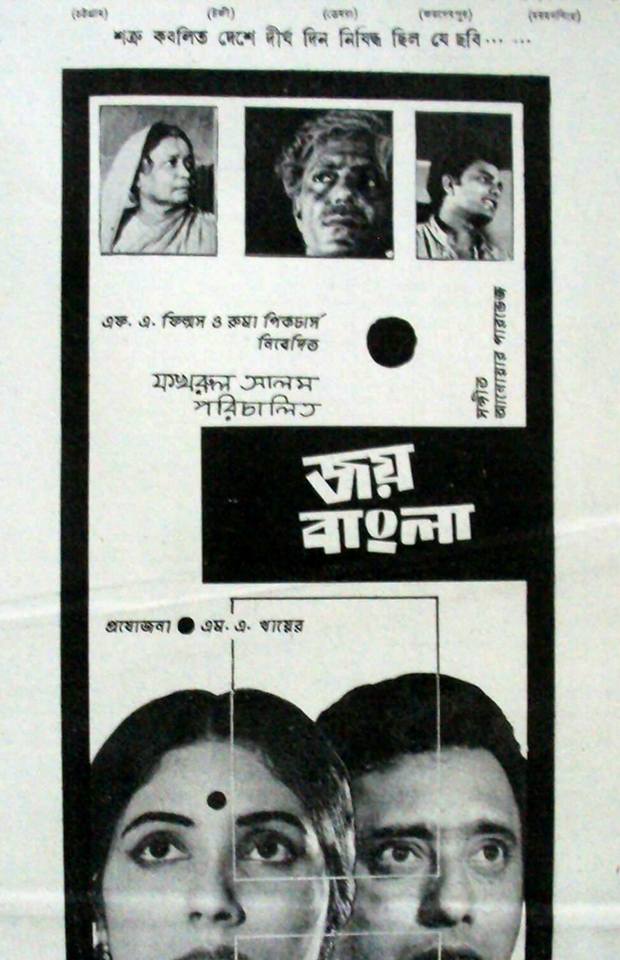
‘Joy Bangla’—a slogan of the Bengalis, a slogan of the Liberation War, a slogan of independence. The slogan emerged in 1969. The first mention of these words is found in the works of our national poet Kazi Nazrul Islam. In his poem Purno-Abinandon from the poetry collection Bhanger Gaan (1922), he wrote:
“Joy Banglar Purnochandro, Joy Joy Adi Antorin,
Joy Juge Juge Asa Senapati, Joy Pran Adi-Antohin.”
In an essay titled Bangali’r Bangla, published in the Nobojug newspaper on the 3rd of Boishakh, 1349 (1942), Kazi Nazrul Islam wrote: “Let Bengal belong to the Bengalis. Let the Bengalis triumph. Let the Bengalis triumph.”
As a slogan, “Joy Bangla” was first chanted on September 15, 1969. At a meeting of the All-Party Students’ Struggle Council held at Madhur Canteen, University of Dhaka, to observe Education Day, Aftab Ahmad and Chishti Helalur Rahman, second-year students of the Political Science Department, were the first to chant the slogan. Later, on January 19, 1970, student leader Sirajul Alam Khan used the slogan in his speech at a public gathering at Paltan Maidan in Dhaka. Bangabandhu Sheikh Mujibur Rahman himself first chanted “Joy Bangla” during his historic March 7, 1971, speech at the Racecourse Ground. Before this, the Bengalis had never raised such a powerful, unified, and meaningful slogan—one that encapsulated politics, culture, the beauty of language, and national sentiment in just two words. The film Joy Bangla, based on the Six Points, played a crucial role in popularizing this slogan among the masses.
Sheikh Mani first discussed the film’s production with Fakhrul Alam, known for his unconventional approach to cinema. Fakhrul Alam (1942–2004) was primarily a follower of Salauddin’s style but also had a keen interest in experimental work. His films, such as Manush O Amanush (1970), Bindu Theke Britto (Rebecca, 1970), and Shonibarer Chithi (1974), testify to his cinematic vision. Besides filmmaking, he was involved in politics—he, along with actress Ratri Roy (aka Rebecca), Nazir Hossain, Mofiz, and others, was associated with Sheikh Mani and Sirajul Alam Khan’s special and somewhat secret movement.
After discussions between Sheikh Mani and Fakhrul Alam, they decided to make a film on the Six Points, the charter of Bengali rights. Fakhrul Alam would direct, and industrialist, Awami League leader, and film producer Abul Khair (known for Kagojer Nouka and Sutorang) would finance it. Young professor and emerging writer Mahbub Talukdar (1942–2022), later a prominent bureaucrat, was brought in to write the story and screenplay.
According to Mahbub Talukdar:
“I was called to Dhaka from Chittagong University. Initial discussions were held with director Fakhrul Alam. We had known each other since the early 1960s. Fakhrul Alam was the undisputed student leader of Dhaka Polytechnic during the anti-martial law movement against General Ayub. During our first discussion about *Joy Bangla*, he told me I had to write the story for a film titled *Joy Bangla*, which would depict the deprivation of East Pakistan and the history of Pakistan’s exploitation. Detailed discussions could also be held with Sheikh Fazlul Haque Mani. I had known Sheikh Mani since 1959 when he was a student leader, and I was a university correspondent for *The Daily Ittefaq*. Regarding the film’s story, Mani said there should be six separate stories based on the Six Points, each highlighting a specific demand. I asked if the film would be documentary-style. He insisted it must be a feature film—six stories woven into one complete film. I argued that a feature film needed a continuous narrative, not disjointed stories. Mani replied, ‘Then why were you called from Chittagong? You write it.’ I countered, ‘If you make a film with six separate stories, only three people will watch it—you, me, and Fakhrul.’ Mani softened his tone and said, ‘It’s tough, I understand. That’s why the responsibility falls on you.’ Discussions with Fakhrul yielded no progress; he insisted on following Mani’s vision. Writing six separate stories for one film was challenging. I took a few days off from the university and came to Dhaka.
Fakhrul booked a hotel room for me and arranged a car on standby. I didn’t understand the need for a car until Fakhrul explained, ‘Writers don’t just sit and write—they need to go out for inspiration.’ Fakhrul asked me to write the stories as a screenplay and taught me how, assuring he’d polish it. I immersed myself in the Six Points and tried to extract stories from them. Due to time constraints, shooting began after I wrote the first four stories. I attended the shoots, where some dialogues were altered.”
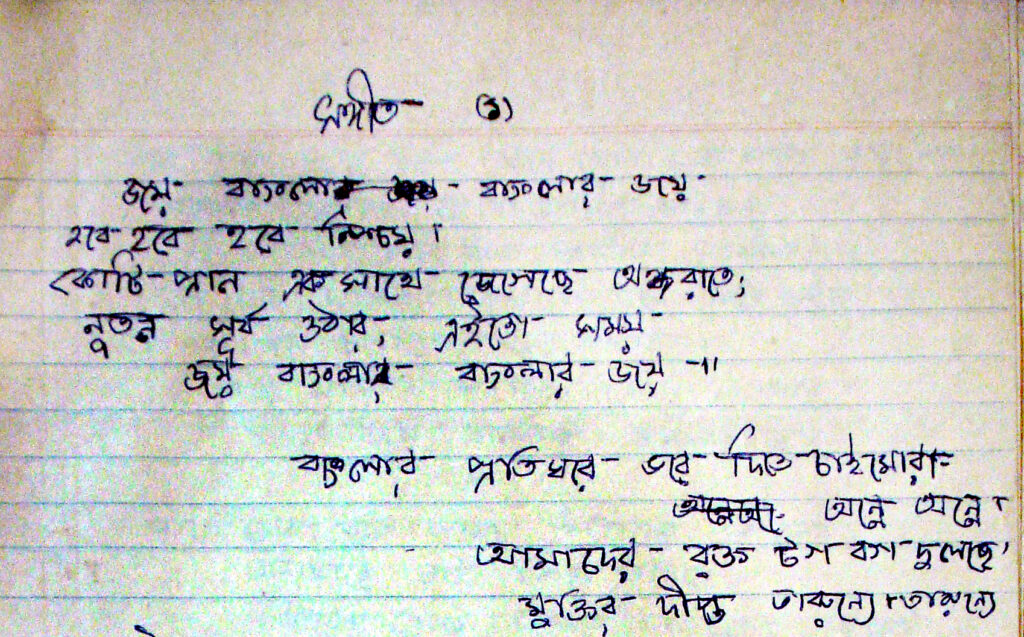
For this film, the song “Joy Bangla Banglar Joy, Hobe Hobe Hobe Nischoy” was written, composed, and recorded. The lyrics were by Gazi Mazharul Anwar, music by Anwar Parvez, and vocals by Shahnaaz Begum (Rahmatullah), Abdul Jabbar, and others. Additionally, the timeless patriotic song “Dhanodhanno Pushpo Bhora”, written and composed by Dwijendralal Ray in 1905, was also used.
The film’s production progressed swiftly. It starred Anwar Hossain, Hasan Imam, Inam Ahmed Shahana (Atiya Chowdhury), Kayes, Aleya, Sitara, Supriya, Kalipada, Aminul Haque Badsha, and others. Cinematography was handled by Rafiqul Bari Chowdhury and Aowlad Hossain. The film’s distribution was managed by Salauddin, the filmmaker behind Roopban, under his banner Salauddin Chitrakala.
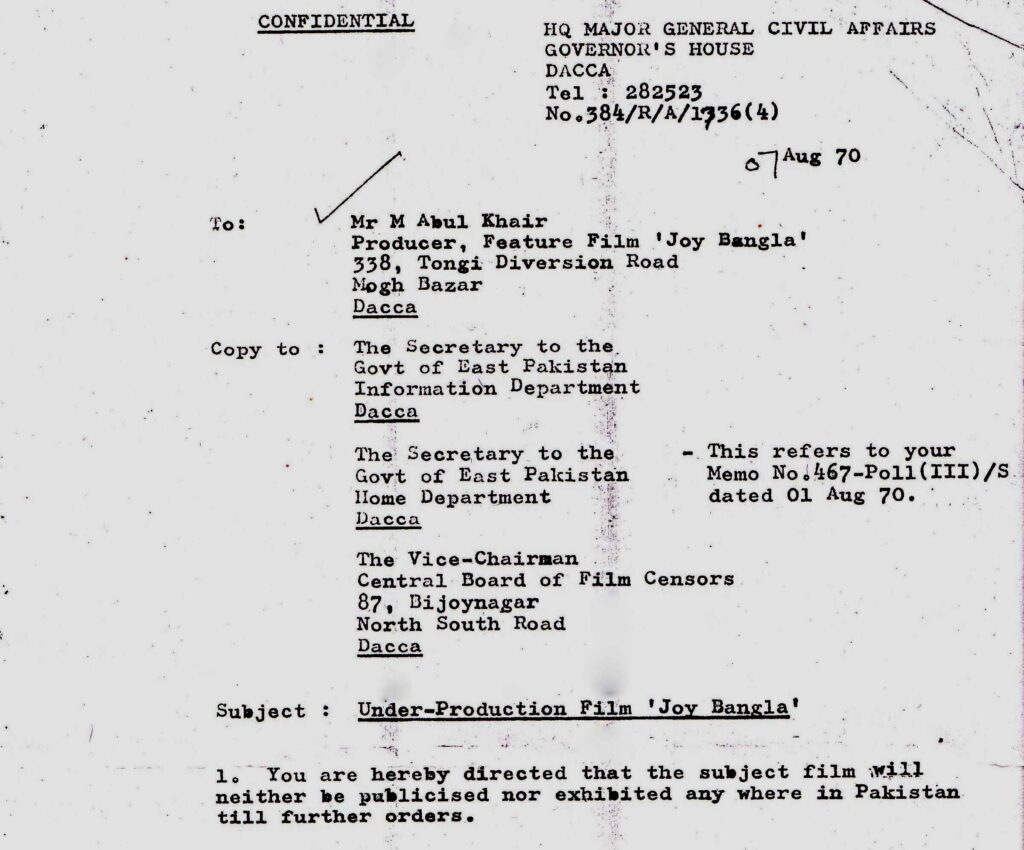
On June 25, 1970, a press conference was held to announce Joy Bangla. The next day, newspapers extensively covered the film. However, The Daily Sangram published a negative report titled “Political Aggression in Cinema”, accusing the film of promoting the Six Points, socialism, and secularism with ulterior motives. Despite completing production and submitting it to the censor board in June 1970, Yahya Khan’s military government banned the film. How could they allow a film reflecting the Bengali liberation movement during the volatile political climate of 1970? Producer Abul Khair made numerous appeals but failed to secure a censor certificate. Finally, on March 22, 1971, Major General Rao Farman Ali watched the film at the Dhaka Cantonment’s Garrison Cinema, but no decision was made—how could there be? The Pakistani military had already finalized plans to brutally suppress the Bengali independence movement.
During the 1971 Liberation War, Abul Khair took a copy of the film to Kolkata, where he was in charge of the exiled Bangladeshi government’s Film Division. After the commercial release of Zahir Raihan’s Jibon Theke Neya, preparations were made to release Joy Bangla, but the war ended before the process was completed. After independence, the film was released on January 26, 1972, but by then, Bangladesh’s independence had been achieved, and the film’s production quality was not up to par, so it was not commercially successful.
After the fall of dictator Ershad in 1990, under the supervision of Badal Rahman (son-in-law of producer Abul Khair and cultural secretary of the Awami League), a new positive print of Joy Bangla was made. The film was re-released with an introductory message from Sheikh Hasina and concluded with Bangabandhu’s historic March 7 speech at Abul Khair’s Purnima cinema in Karwan Bazar, Dhaka. However, it still failed to attract audiences. Due to Badal Rahman’s negligence, even this print was not preserved.
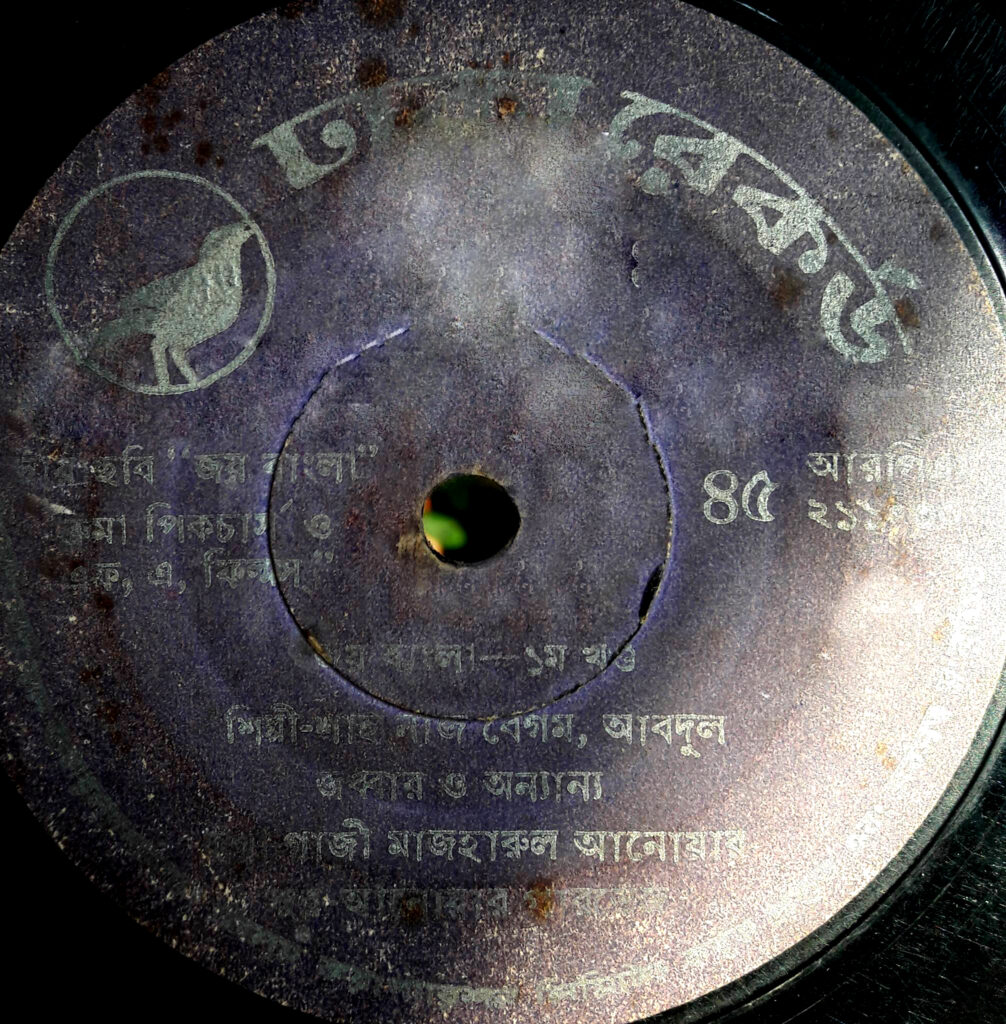
However, the song “Joy Bangla Banglar Joy”, written by Gazi Mazharul Anwar, composed by Anwar Parvez, and sung by Shahnaaz Rahmatullah and Abdul Jabbar, became immensely popular. Before the film’s release, Salauddin’s Pakistan International Film Corporation Ltd. released the song on a 78 RPM record under the Dhaka Record label. The song gained immediate popularity and became an anthem of liberation.
On May 24, 1971, during Kazi Nazrul Islam’s birth anniversary, the song was used as the tuning signal for the Swadhin Bangla Betar Kendra (Free Bengal Radio) in Kolkata, further cementing its status as a liberation anthem. The Awami League also adopted it as their party anthem. The chant “Joy Bangla” became the core mantra of Bengali identity and the resonance of our soul, embodying the spirit of liberation.
References:
1) Six Points: Our Demand for Survival, Sheikh Mujibur Rahman, 1966.
2) Our Joy Bangla, Mahbub Talukdar, Prothom Alo, March 20, 2014.
3) Film researcher Mir Shamsul Alam Babu’s Facebook post.

https://stapravda.ru/20221228/reyting_samyh_populyarnyh_hostingov_v_rossii_196445.html, рейтинг хостингов России подтверждает, что выбор надежного провайдера важен для бизнеса.