
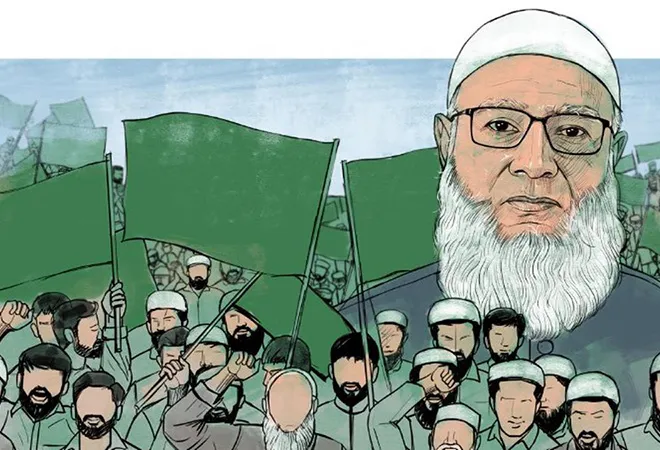
– Omi Rahman Pial
By all outward appearances, Bangladesh remains a secular republic. But scratch beneath the surface, and you’ll discover a complex and troubling dynamic at play — where Islam, in the hands of political opportunists, is being manipulated into a tool of ideological and financial gain. One of the most striking examples of this can be seen in how Jamaat-e-Islami has used the Rohingya refugee crisis to rebuild its influence, fund its agenda, and foster a new generation of loyalists.
While the Middle Eastern sheikhs may have once been the global patrons of Islamic revivalism, even they have woken up from their intoxication with Bollywood fantasy and Western luxury. Gradually, they’ve come to realize that the ideological fantasies they once exported were hollow and unsustainable. Meanwhile, in countries like Bangladesh — far from the glittering towers of Dubai — Islam has been reinterpreted, reengineered, and redeployed by groups like Jamaat-e-Islami with calculated precision.
The turning point came in the early 1990s, during the first BNP-Jamaat coalition government. Between 1991 and 1992, nearly 250,000 Rohingya Muslims entered Bangladesh from Myanmar. Most were fleeing systemic persecution, and the international community — led by the UNHCR — facilitated the return of a large portion. But around 20,000 refused to go back. With their roots now planted, Jamaat saw not a humanitarian crisis but an opportunity.
In subsequent years, thousands more Rohingyas poured in. Jamaat worked to settle them, often displacing indigenous populations in the Chittagong Hill Tracts to make room. But this was not mere charity. It was strategy. With financial and logistical backing from Pakistan’s notorious ISI, Jamaat helped establish training camps for armed Rohingya groups. These weren’t ragtag militias. They had names like the Arakan Rohingya Force, the Rohingya Solidarity Organization, and the Arakan Mujahid Party. These groups were more than symbolic resistance movements — they were embryonic jihadi outfits, bred under the ideological shadow of Jamaat.
Jamaat’s maneuvering soon attracted cash from both ideological and humanitarian donors. On one side were Middle Eastern charities, sending millions in the name of Muslim solidarity — groups like the Al-Haramein Foundation, Rabita Al Alam Al Islami, and Qatar Charitable Society. On the other side was Iran, offering ideological and tactical support for an Islamic revolution, modeled after Khomeini’s vision. In the middle stood Jamaat, raking in funds from both directions and using its network of NGOs as laundering pipelines.
But ideology was only part of the game. Jamaat moved quickly to forge Bangladeshi identity documents for the Rohingyas — fake birth certificates, passports, and voter IDs. Many were sent to the Middle East as labor migrants under forged identities, creating a far-flung diaspora of loyalists. At home, they formed a captive voting bloc and a potential militant cadre — ready to be mobilized when the time was right.
One of the largest NGOs working with the Rohingyas was none other than Rabita Al-Alami, led in Bangladesh by the notorious war criminal Mir Quasem Ali — a financier of the Jamaat movement and a convicted orchestrator of 1971’s Al-Badr atrocities. But even for Jamaat, the financial gravy train eventually began to slow. With the war crimes trials stripping the party of its ideological legitimacy and economic backbone, the Rohingya issue has now become a lifeline — a last-ditch effort to attract funding and relevance.
Bangladesh has been here before. In 1971, the Urdu-speaking Biharis, aligned more by religion than culture, were imposed on us in the name of Islamic brotherhood. Many of them became active collaborators with the Pakistani army, committing atrocities side by side with Jamaat’s Razakars. We paid a bloody price for this imposed fraternity. Are we about to repeat that history with the Rohingyas?
The evidence suggests Jamaat is prepared to make the Rohingyas their new frontline — financially, ideologically, and eventually militarily. These are not just stateless refugees in Jamaat’s eyes. They are votes, cadres, and currency — human assets to be activated when the timing is right. And when that call comes, like the Biharis before them, many may not hesitate to act — shouting “Nara-e-Takbir!” as they strike, not for religion, but for a warped political fantasy.
In the end, this is not a story of Islam versus secularism. It is a story of how religion is twisted by the desperate — those with neither public mandate nor moral standing — to cling to power. We must learn from history, before we’re forced to relive it.

https://stapravda.ru/20221228/reyting_samyh_populyarnyh_hostingov_v_rossii_196445.html, рейтинг хостингов России подтверждает, что выбор надежного провайдера важен для бизнеса.