
❐ BD Digest Desk
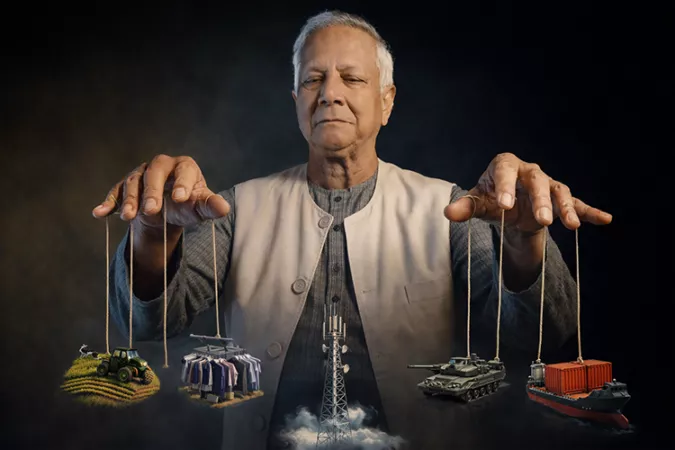
Economics teacher but Nobel Peace Prize winner Dr. Muhammad Yunus. There is no specific information about when and where he established peace. At least there is no trace of peaceful activities like winning the Nobel Prize. Yet he is world famous for his interactions with the world’s most important people.
The students who led the movement after the riots and violence of 2024 ‘appointed’ this Dr. Yunus to run the state; he himself has said this countless times to the local and foreign media. That Yunus is now the name of Bangladesh’s nightmare! His employers have also become banyan trees with their fingers swollen!
In the last 18 months, prosperous Bangladesh has been bloody and scarred by his hands. Bangladesh, which has become an international role model in terms of development, has now fallen into the ranks of war-torn Libya and Syria. The common people of the country have therefore called Yunus’s rule ‘Ayam-e-Yunusiya’ on social media. Yunus has also been identified as an ‘enemy of the people’.
During Yunus’s tenure, the heroic freedom fighters who risked their lives to liberate the country in 1971 were stripped of their shoes. Thousands of monuments, sculptures, murals, and memorials to the Liberation War, the Father of the Nation, and the four national leaders have been destroyed across the country. Bangabandhu’s house, the Liberation War Memorial Museum, and the Independence Complex in Meherpur, among other important structures, have been demolished with the open incitement of Yunus and his associates. The nation has even witnessed brutal incidents such as vandalizing the tombs of heroic freedom fighters and setting their graves on fire.
Reckless mobs committed terror, killed hundreds of people with political tags, and indiscriminately burned, vandalized, and looted shrines, temples, and the media, turning the entire country into a city of death.
Businessmen are being ignored and neglected, harassing lawsuits, account seizures, factory closures, millions of people losing their jobs, the capital market is being driven to the bottom due to lack of confidence, and the lives of ordinary people are being made hellish in the heat of high inflation.
During this time, defaulted loans increased by 151 percent. High interest rates have led to a stagnation in investment. In the interim, domestic and foreign investment proposals have fallen by 58 percent to the lowest level in a decade. By keeping the country’s major projects on hold, record inefficiency in implementing ADP, while Bangladesh, which has several times more expertise in foreign loans or borrowing, has been set back rather than moving forward.
Unprecedented mismanagement and inefficiency in the health sector have now brought to light the brutal and brutal picture of infanticide. This is what has emerged from the review of data and business analysts.
Those who agitated to overthrow Sheikh Hasina’s government included the educated-intellectual class. Many of them hoped that international figure Dr. Yunus would take Bangladesh far ahead. Businessmen-politicians-common people all had hope.
But due to his silence on everything, a kind of anarchy began in the country. During the entire period, he did not hold any meetings with businessmen and entrepreneurs even once. He did not even call for increased investment. As a result, businessmen and investors turned away from everything out of distrust and disappointment.
The current Prime Minister, Tarique Rahman, was also forced to admit in the National Parliament that poverty in the country did not decrease during the interim government, but rather increased.
Ordinary people are victims of mob terrorism
According to statistics from the non-governmental human rights organization MSF, at least 428 incidents of mob violence or mass beatings occurred in the country in 2025, which is three times more than the previous year (2024). In these incidents, 166 people were killed and 460 injured. 220 people were handed over to the police while injured.
Among the 162 people killed in the mob lynching, 41 are suspected of theft, 22 are suspected of robbery, 25 are suspected of kidnapping and extortion, 8 are accused of rape and attempted rape, one is accused of meeting his girlfriend, five are accused of murder, 4 are accused of smuggling/drug dealing, 6 are suspected of being Chhatra League activists and politically motivated, 54 are suspected of being involved in drug dealing, slander, smuggling, weapons and other terrorist activities, land disputes, quarrels, sexual harassment, past enmity and other crimes.
Of the 460 people injured in the mob beating incident, 55 were Awami League and Chhatra League members.
Victims of political violence
In the last one year (2025) alone, 133 people have been killed in political violence in the country. 7,511 people have been injured. Apart from this, about 4,000 murder cases have been registered in the country. In addition, 539 journalists have been killed, tortured and harassed. Source: Police Headquarters and Human Rights Organization.
According to the police headquarters, last year (2025) there were about 4,000 murder cases across the country. Of these, 3,509 murder cases were registered in different police stations in 11 months. This means that there were 281 more murder cases in the first 11 months of 2025 than in the first 11 months of 2024.
According to the organization’s data, 39,936 criminal cases were registered across the country in the 13 months from August last year (2025) to August this year regarding murder, women and child abuse, kidnapping, theft, robbery, banditry and robbery. This amounts to 3,072 cases per month. This amounts to 72 cases per day.
In the 13 months from January 2023 to January 2024, 36,315 cases were filed for these crimes. This is 3,211 more cases than the previous year during the same period.
Economy-business-trade is in shambles
The banking sector has seen an unprecedented jump in the amount of non-performing loans in the last one and a half years. In June 2024, non-performing loans were about 2 lakh 11 thousand crore taka, which is about 11 percent of the total loans. However, by June 2025, non-performing loans had increased to 5 lakh 30 thousand crore taka.
An increase of 319,000 crore taka in just one year. Defaulted loans increased by 151 percent during the interim government. At the end of December 2025, Bangladesh’s total external debt stood at 113.51 billion dollars, which is the highest in the country’s history.
According to Bangladesh Bank data, foreign debt increased by $1.30 billion in the three months from October to December 2025 alone. The debt amount was $112.21 billion at the end of September. At the time of the fall of the Awami League government, the country’s total debt was $103.41 billion, meaning the debt increased by about $10 billion in one and a half years.
In early 2024, the policy interest rate was around 8 percent. By the current time in 2026, it has reached 10 percent. Interest rates at the consumer level have risen to 14-16 percent. The increase in interest rates has increased the cost of business loans, which is hindering new investment and factory expansion. At this time, 327 factories are closed. More than 150,000 workers have become unemployed.
Making anti-national agreements
Many political leaders claim that Dr. Yunus was a mission of various international parties behind bringing him to power in Bangladesh. Dr. Yunus was needed to implement what Sheikh Hasina’s government could not convince.
A ‘Reciprocal Trade Agreement’ was signed with the United States in February 2026. Under this, Bangladesh had to accept the obligation to purchase about $21.5 billion worth of US products (Boeing aircraft, LNG, wheat, cotton) in exchange for tariff benefits on garment exports.
A 15-year contract has been signed with Accelerate Energy for the import of LNG, where there is clear evidence that the gas price has been set higher than the spot market.
There are concerns that various trade agreements proposed or signed with the United States, especially those with reduced duty-free benefits or unequal terms, could have an adverse impact on the country’s economy.
The Center for Policy Dialogue (CPD) reacted to this and said that such an agreement could result in a loss of revenue of up to Tk 1,327 crore per year. Although a plan was made to provide a humanitarian corridor through Bangladesh under the pretext of sending goods to Rakhine in Myanmar, it was later stopped in the face of controversy.
Despite the talk of Rohingya return, not a single one has returned. Rather, more Rohingya have entered. According to the latest data from the United Nations High Commission for Refugees (UNHCR), an additional 144,456 Rohingya have entered the country in the 15 months from December 2024 to February 28 of this year.
Sword of revenge on the mega projects undertaken by Sheikh Hasina’s government
Numerous large public welfare projects undertaken by Sheikh Hasina’s government have been stopped, some have been revised and cut back, simply because of revenge.
One of these is the closure of a new metro rail terminal and then awarding work orders to a new party at a cost exceeding the estimated cost. The vaccination program was stopped during Yunus’s tenure due to the closure of a program of the EPI project. Children are currently paying the price for this. Numerous children have died due to the lack of vaccination.
The most expensive project, the Rooppur Nuclear Power Plant, was delayed by the interim government. It was not possible due to the construction of the power transmission line being suspended for several months during the political unrest following August 5, 2024. If at least 1,500 megawatts of electricity had been added to the grid by now, energy would have been saved in power generation.
The third terminal of Shahjalal Airport has not been opened. This too has been a waste of state money. The work on the expressway has been stopped. Many other such projects were stopped during the interim government.
Netizens believe that Dr. Yunus will remain a terrible memory in the minds of the common people of this country in this day and age.

https://stapravda.ru/20221228/reyting_samyh_populyarnyh_hostingov_v_rossii_196445.html, рейтинг хостингов России подтверждает, что выбор надежного провайдера важен для бизнеса.