
Staff Correspondent
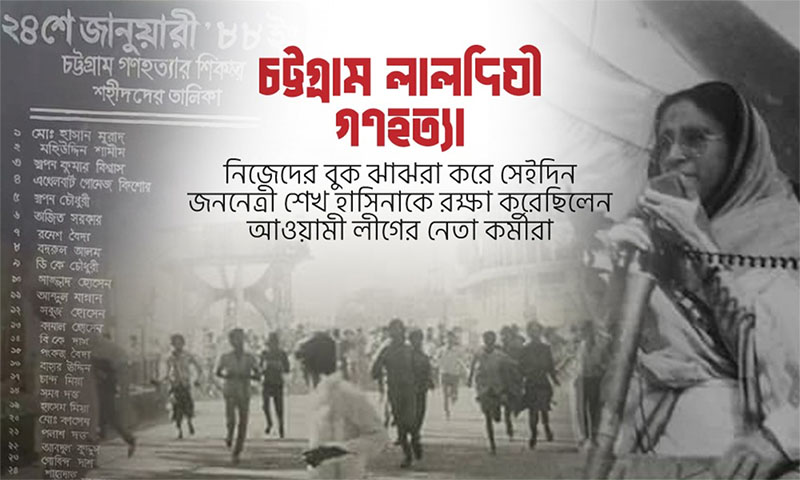
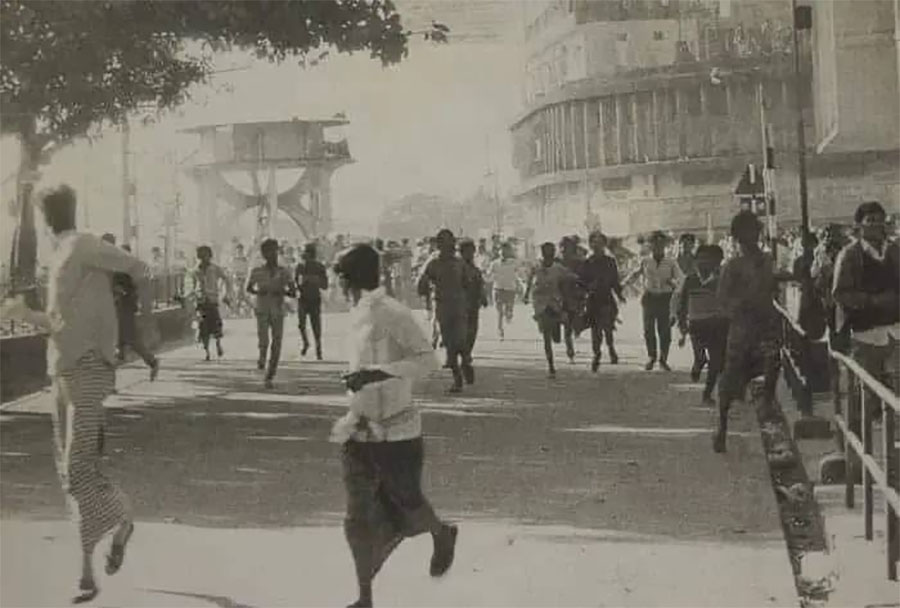
It was a turbulent time in the anti-dictatorship movement. On this day in 1988, when then opposition leader Sheikh Hasina went to attend a public meeting organized at the city’s Laldighi Maidan, the police force under the dictatorial Ershad government opened indiscriminate fire on Awami League leaders and activists and the general public, completely without provocation.
Twenty-four leaders and activists were killed on the spot. Later, it was reported that eight more unidentified people had been killed. More than 300 people were injured.
Even after Sheikh Hasina was shot that day, she was lucky to survive. When Sheikh Hasina was being shot, the leaders and activists protected her with human shields. At that time, many leaders and activists were shot. When one fell, another filled the gap. In this way, she was saved that day.

The police were shooting like rain. Suddenly, a policeman’s rifle connection belt accidentally came off, causing a slight interruption in the firing. The leaders and activists took the opportunity to take him away and leave. Fortunately, Sheikh Hasina survived.
But this break was only for a few seconds. The firing started again. By then, pro-Awami lawyers and activists formed a human shield and cordoned off Sheikh Hasina and took her to the Bar Association office to protect her. However, many leaders and activists fell into the trap.
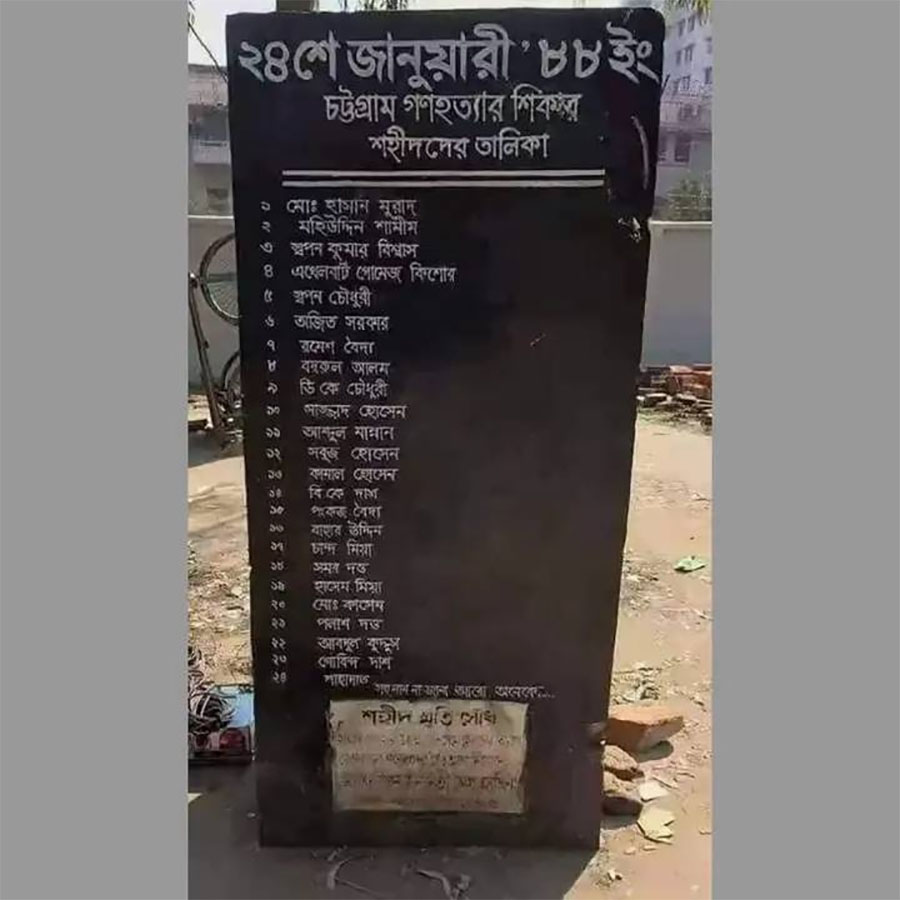
The martyred leaders and activists are – Md. Hasan Murad, Mohiuddin Shamim, Swapan Kumar Biswas, Ethelbert Gomez Kishore, Swapan Chowdhury, Ajit Sarkar, Ramesh Vaidya, Badrul Alam, DK Chowdhury, Sajjad Hossain, Abdul Mannan, Sabuj Hossain, Kamal Hossain, BK Das, Pankaj Vaidya, Bahar Uddin, Chand Mia, Samar Dutta, Hashem Mia, Md. Kashem, Palash Dutta, Abdul Quddus, Govinda Das and Shahadat.
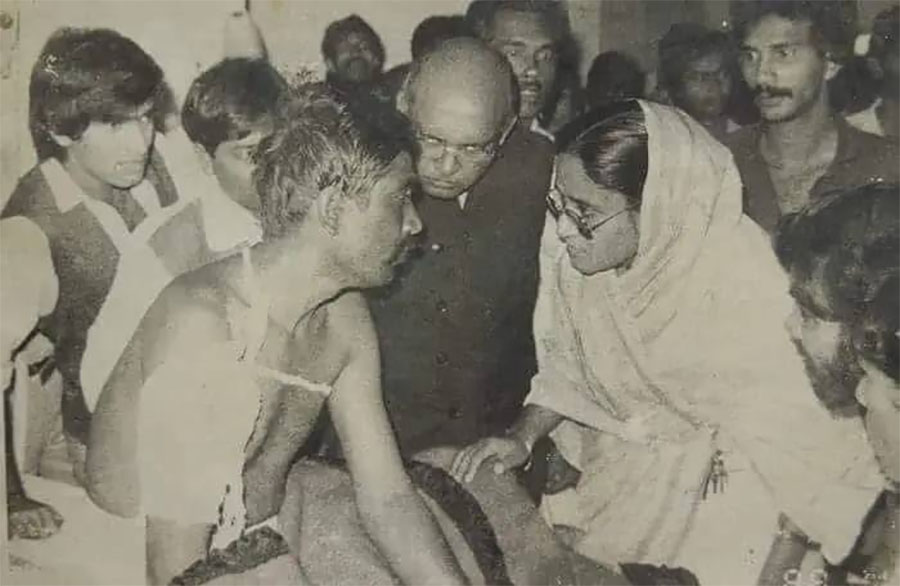
Sheikh Hasina visits injured activists in hospital
In history, this day is observed as Chittagong Genocide Day.
It is known that on that day of January 24, 1988, shots were fired indiscriminately like rain at Sheikh Hasina and the leaders and activists of the Awami League. Although the central leaders were fortunately spared, a total of 32 students, workers and professionals lost their lives. More than 300 others were injured.
At one stage of the atrocity, the bodies of most of the victims, regardless of religion or caste, were taken to the city’s Abhayamitra crematorium in the dark of night and cremated under heavy police guard. On the other hand, attempts were made to hide the bodies.
Four years after this incident, on March 5, 1992, lawyer Shahidul Huda filed a case with the Chittagong Chief Metropolitan Magistrate’s Court, accusing a total of 46 people.
The case was revived after the formation of the Awami League government in 1996. On the court’s order, the CID investigated the case and filed the first charge sheet on January 12, 1997 and the second charge sheet on November 3, 1998 after further investigation. The charge sheet named eight policemen, including the then CMP Commissioner, as accused.
The accused in the case are the then CMP Commissioner Mirza Rakibul Huda, Kotwali Zone Patrol Inspector (PI) Govinda Chandra Mondal, Constables Abdus Salam, Mostafizur Rahman, Pradeep Barua, Bashir Uddin, Shah Md. Abdullah and Momtaz Uddin.
On May 9, 2000, the court framed charges against the accused and began the trial.
The verdict in the case was announced on January 20, 2020. The verdict sentenced 5 accused to death. They are: Kotwali Zone Patrol Inspector (PI) Govinda Chandra Mondal, Constables Mostafizur Rahman, Pradeep Barua, Shah Md. Abdullah and Momtaz Uddin.
The then Chittagong Metropolitan Police Commissioner Mirza Rakibul Huda, Constables Bashir Uddin and Abdus Salam were relieved of their duties due to death.

https://stapravda.ru/20221228/reyting_samyh_populyarnyh_hostingov_v_rossii_196445.html, рейтинг хостингов России подтверждает, что выбор надежного провайдера важен для бизнеса.