


Special Correspondent | 24 October 2026
Today is United Nations Day. On this day in 1945, the UN Charter came into force, and since then, the day has been celebrated as United Nations Day around the world. This year marks the 81st anniversary of the organization’s founding.
The United Nations was born out of the devastation of World War II. In the wake of the deaths of millions and the destruction of city after city, the international community resolved that such bloodshed would never be allowed to happen again. Conflicts would be resolved not through war, but through consensus and compromise. This conviction ushered in a new era in human history.
Importance of the Yalta Conference
One of the most important steps towards the formation of the United Nations was the Yalta Conference in Crimea in February 1945. The war was in its final stages. The three top leaders of the Allies, Joseph Stalin of the Soviet Union, US President Franklin D. Roosevelt and UK Prime Minister Winston Churchill, met there. In addition to discussing the post-defeat Germany system and the shape of the post-war world, they unanimously decided to convene a conference in San Francisco to create a new international organization. They also reached agreement on the voting system of the Security Council, which paved the way for finalizing the organization’s structure.
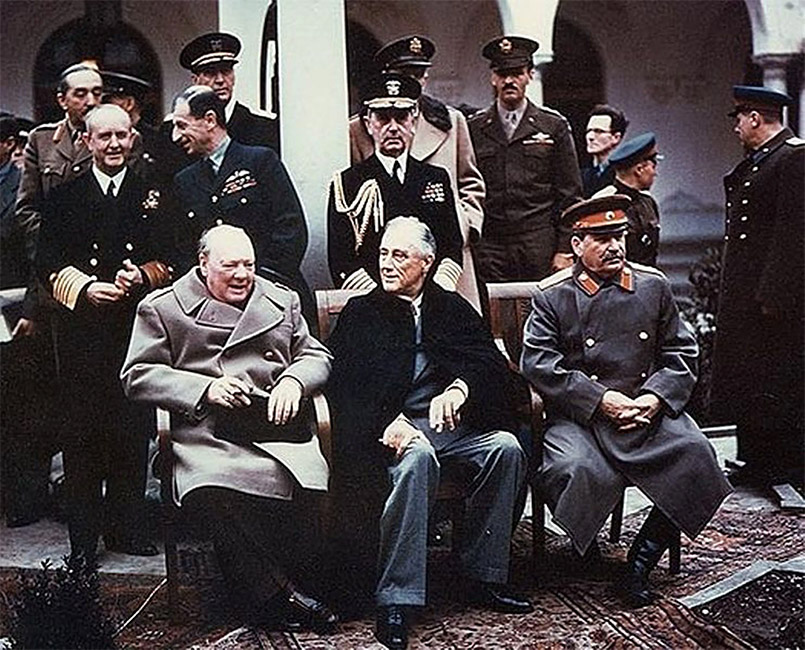
Franklin Roosevelt, Joseph Stalin, and Winston Churchill at the Yalta Conference. It was held from February 4 to February 11, 1945, at the Livadia Palace near Yalta, Crimea.
Despite their different political systems and conflicting interests, the leaders of this wartime alliance were able to agree on a common goal: to build a framework for lasting peace and collective security in the post-war world. Many historians see this consensus as the foundation of the United Nations.
Certificate valid from San Francisco
According to that decision, the conference began in San Francisco in April 1945. On June 26, 50 countries signed the UN Charter. Poland signed later as it was unable to attend the conference, bringing the number of founding members to 51. The charter officially came into effect on October 24 after most of the signatory countries, including China, France, the Soviet Union, the United Kingdom and the United States, ratified it.
Roosevelt died on April 12, 1945, two months after the Yalta Conference. As a result, he did not live to see the San Francisco Conference, which saw the birth of the United Nations.
Details about the Yalta Conference: The Yalta Conference
The Big Three
The three Allied leaders known in history as the ‘Big Three’—Joseph Stalin of the Soviet Union, Franklin D. Roosevelt of the United States, and Winston Churchill of Britain—played a crucial role in ending World War II and establishing a framework for peace and international security in the post-war world. Their discussions and decisions at the Tehran (1943) and Yalta (1945) conferences in the final stages of the war influenced the end of the war, the future of Germany, the reconstruction of Europe, and the outline of the post-war international order.
Their efforts paved the way for the establishment of the United Nations to safeguard international peace and security; the UN Charter came into force on 24 October 1945. However, as this new peace framework emerged, ideological and geopolitical conflicts between the three powers intensified, leading to the Cold War. As a result, the legacy of the ‘Big Three’ is both the institutional basis for post-war international peace and cooperation, and the history of the division of world politics into ‘The New Big Three’.
A complex legacy
The decisions of the Yalta Conference have been the subject of much debate in the years since. Historians have disagreed, particularly over the decisions taken regarding the future of Poland and Eastern Europe. This unity of the Allies also began to fray at the start of the Cold War, when Roosevelt and Churchill disappeared from the scene. However, the decision to establish the United Nations left a lasting international framework for the post-war world, with more than 190 member states today.
Even as conflicts rage in various parts of the world today, United Nations Day reminds us of that fundamental commitment: dialogue and compromise, not conflict, is the path for humanity.

https://stapravda.ru/20221228/reyting_samyh_populyarnyh_hostingov_v_rossii_196445.html, рейтинг хостингов России подтверждает, что выбор надежного провайдера важен для бизнеса.