
Opinion
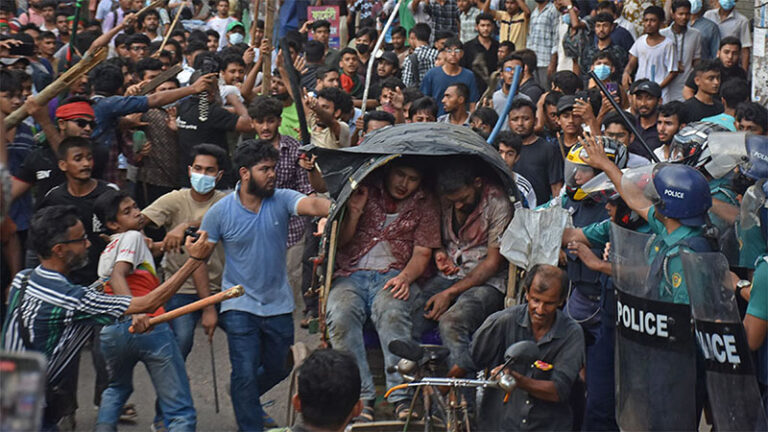
When the Office of the United Nations High Commissioner for Human Rights (OHCHR) published its fact-finding report on the July-August 2024 protests in Bangladesh, many thought it might be a major step towards accountability.
The report accuses the Awami League government and its security forces of repression, extrajudicial killings, and serious human rights violations. But reading this report, it seems that there are big questions about how transparent or impartial the investigation behind it is. Whether this document, published during the Yunus-led interim government, was truly independently prepared or was it designed to strengthen the new political system, remains a doubt.
The impression of bias at the beginning of the investigation
The report has pointed to the Awami League government as the main responsible party from the outset. It states, “There is ample reason to believe that state agencies have systematically violated human rights.” (UNOG Newsroom, 12 February 2025)
But the process of reaching this conclusion is completely unclear. Who was interviewed, how the evidence was verified, whether the army, police or Awami League leadership were spoken to—nothing is said. It is not even known whether the UN Human Rights Council had approval. This raises the question—is this an official UN mission, or an initiative influenced by the interim government?
The standard of proof for accusing any government of “systematic torture” should be of the highest order. But this report falls short of that. The allegations are presented as absolute truth without any basis in fact. This makes the whole thing seem more like a political story than an impartial investigation.
Selected testimony and one-sided statements
The OHCHR said it interviewed more than 250 people and looked at thousands of pieces of evidence. But it did not say who these people were—victims, witnesses, or government officials. As a result, the overall picture remained one-sided.
Another major problem is that the statements of the accused were not taken even once. No response was taken from Sheikh Hasina, her cabinet, or the police chiefs. So the report looks more like a one-sided indictment. Justice means hearing both sides—OHCHR did not provide that opportunity.
The August 5 incident and the questions raised
The report states that Sheikh Hasina ordered widespread shooting and violence on August 5. But she left the country that morning—after which time most of the killings occurred, the report claims.
So the question is, when he was no longer in control of the administration, how could the blame fall solely on his government? This confusion of timelines has changed the actual context of the events. This has made it easier to place the entire blame on one party.
The investigators are anonymous.
Unlike other UN commissions of inquiry, the names or qualifications of the members of the investigation team are not disclosed. People do not know who wrote the report, how they were selected, or whether they have any prior relationships that could affect impartiality. Without transparency, there is no credibility. This anonymous team has made the impartiality of the report questionable in the eyes of many.
Numerical discrepancies and lack of correction
Reports say up to 1,400 people were killed in the movement (UN Bangladesh, 12 February 2025). But there are many discrepancies in the numbers in local and international reports. An AFP fact check (14 August 2024) found that a Bengali daily initially reported 201 deaths, but after verification, the figure was reduced to 193. Prothom Alo’s investigation also revealed that some of the deaths had nothing to do with the movement—people who died in land disputes or accidents were also included in the “martyr list”. Some of those who were declared dead later returned alive.
Even after these facts were released, the OHCHR did not revise the figures. This raises questions about the factual credibility of the entire report. It seems that the figures were kept in such a way as to fit the desired narrative.
Ignoring forensic information
The report says many of the deaths were caused by 7.62mm bullets, but police say they do not use such bullets. Many of the incidents occurred in areas where police were not present, while others were shot inside homes. These unusual incidents are mentioned in the report, but there is no analysis or verification.
This suggests that some information may have been intentionally omitted. This further questions the credibility of the investigation. Such forensic deficiencies are completely unacceptable in a politically sensitive situation.
Not a report, now a political tool
The most worrying thing is how this report is being used. It clearly states that it cannot be used as the basis for any legal charges (The Daily Star, 12 February 2025). Yet this report is being cited in the International Crimes Tribunal case against Sheikh Hasina.
As a result, a report that was written to protect human rights is now being used for political purposes. This is setting a dangerous precedent—where “politics” rather than “justice” is winning.
Truth and transparency are essential for accountability
No one denies that the violence of July-August 2024 was horrific. Many innocent people were killed, tortured, and fear spread across the country. But the truth cannot be found through moral outrage or emotion alone. An impartial, transparent, and evidence-based investigation is needed.
If real accountability is to be sought in Bangladesh, a new international investigation is needed—one that hears all sides, verifies every death, and is completely free from political influence. Until then, the OHCHR report will remain a warning, not a justice, but a warning—that when human rights are used for political ends, justice is lost and credibility is damaged.
Source:
- The UN ‘Fact Finding’ Report On Bangladesh’s 2024 Protests: Accountability Or Political Instrument? – OpEd
- United Nations Bangladesh (12 February 2025)
- UNOG Newsroom (12 February 2025)
- The Daily Star (February 2025)
- bdnews24.com (February 2025)
- Prothom Alo (2024)
- AFP Fact Check (14 August 2024)
- The Business Standard (2024)
–Anjuman Islam

https://stapravda.ru/20221228/reyting_samyh_populyarnyh_hostingov_v_rossii_196445.html, рейтинг хостингов России подтверждает, что выбор надежного провайдера важен для бизнеса.