
Staff Reporter
The United Nations has requested Bangladesh to establish a humanitarian corridor to deliver aid to Rohingya refugees in Myanmar’s Rakhine state, where ongoing conflict has created a dire humanitarian crisis. UN Secretary-General António Guterres emphasized the need for Dhaka’s approval and cooperation to facilitate this initiative.
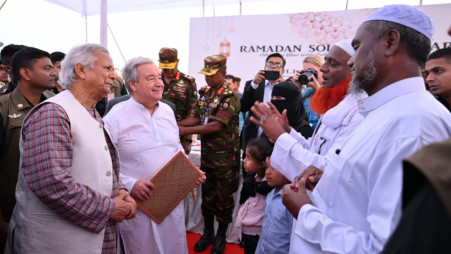
During a joint briefing with Bangladesh’s Foreign Affairs Advisor, Mohammad Tawhid Hossein, on Saturday, March 15, Guterres addressed the challenges of repatriating Rohingya refugees amid the ongoing conflict in Rakhine. He stated that the fighting between Myanmar’s military and the Arakan Army has made it extremely difficult to ensure the dignified return of Rohingya refugees. He called for a collective international effort to resolve the crisis, urging not only Bangladesh but also neighboring countries to pressure Myanmar to end the violence and create a pathway for a sustainable solution.
Guterres highlighted that ending the violence would pave the way for dialogue and a democratic resolution, facilitating the return of Rohingya refugees. He also stressed the need to increase humanitarian aid in Myanmar to create a conducive environment for repatriation. Discussions have been held about the possibility of sending aid from Bangladesh, but implementing this would require necessary approvals and cooperation.
When asked about sanctions on Myanmar, Guterres acknowledged that sanctions are a potential measure but noted that securing approval from the UN Security Council could be challenging. He suggested that if sanctions are not feasible, the international community and Myanmar’s neighboring countries should unite to pressure the country to cease hostilities and restore democracy.
Bangladesh’s Foreign Affairs Advisor, Tawhid Hossein, reiterated Bangladesh’s desire for the Rohingya to return to Myanmar with dignity and safety. He emphasized that the solution to the Rohingya crisis lies across the border and that collective efforts are being made to pressure Myanmar authorities. Hossein also mentioned ongoing discussions about sending humanitarian aid to Rakhine but did not confirm whether the UN Secretary-General had made a formal request.
Regarding the possibility of bringing ousted Prime Minister Sheikh Hasina back from India with UN assistance, Hossein clarified that no such discussions had taken place with the Secretary-General.
Guterres expressed deep concern over the deteriorating situation in Myanmar, citing widespread violence, human rights violations, and civilian casualties. He called on all parties in Myanmar to exercise maximum restraint, prioritize civilian protection under international humanitarian law, and avoid inciting communal tensions. He also urged the international community to provide greater financial and political support to both refugees and host communities, warning of a severe humanitarian crisis if funding cuts continue.
Potential Impacts of a Humanitarian Corridor on Bangladesh:
1. Economic Pressure: Establishing and managing the corridor would place additional financial burdens on Bangladesh, which already spends billions annually on Rohingya refugees. This could strain the country’s development budget, despite Guterres’ assurances of financial support.
2. Security Risks: The ongoing conflict in Rakhine between Myanmar’s military and the Arakan Army could escalate tensions along the border. There is also a risk of more refugees entering Bangladesh, further complicating the security situation.
3. Environmental Impact: The refugee camps in Cox’s Bazar have already caused deforestation and environmental degradation. Additional infrastructure for the corridor could exacerbate these issues.
4. Social Tensions: Local communities in Cox’s Bazar are increasingly frustrated with the refugee presence. The corridor could intensify competition for jobs and resources, potentially leading to social unrest.
5. Repatriation Prospects: While Guterres believes humanitarian aid could facilitate repatriation, analysts argue that without a reduction in political instability and violence in Myanmar, this plan will be difficult to implement.
In summary, while the proposed humanitarian corridor aims to address the immediate needs of Rohingya refugees in Rakhine, it poses significant challenges for Bangladesh, including economic, security, environmental, and social concerns. The success of such an initiative ultimately depends on resolving the underlying conflict in Myanmar and ensuring international support for both refugees and host communities.

https://stapravda.ru/20221228/reyting_samyh_populyarnyh_hostingov_v_rossii_196445.html, рейтинг хостингов России подтверждает, что выбор надежного провайдера важен для бизнеса.