
Despite the “trade agreement”, Bangladeshi products and higher education opportunities are decreasing in the US market
, while the market for US products is expanding in Bangladesh.

Special Correspondent. Dhaka, 15 October 2026.
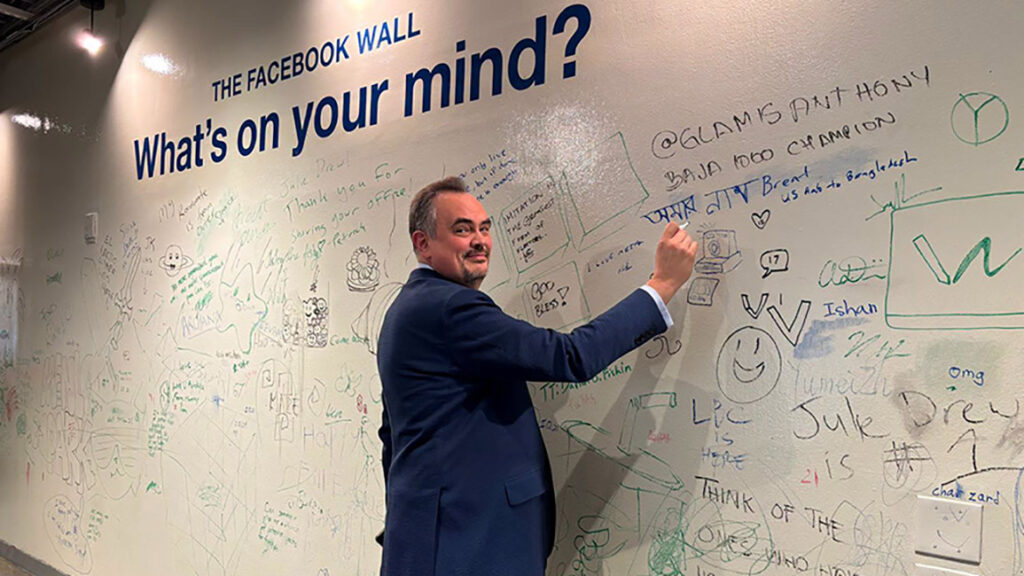
US Ambassador to Bangladesh Brent T. Christensen said in a Facebook post on the US embassy that he had a “lively discussion” with Meta “about opening up new opportunities for US business and trade in Bangladesh and leveraging US innovative technology.” In the same message, he wrote that Bangladesh’s love for Facebook is evident. According to him, the embassy in Dhaka has the largest Facebook page of all the embassies under the State Department.
Before arriving in Dhaka, Christensen said he would work to expand U.S. business opportunities, reduce trade barriers, and reduce the trade deficit if confirmed. During his visit to Chittagong in January, he attended the arrival of a ship carrying nearly 60,000 tons of U.S. wheat. He made recommendations in favor of the quality of the products during a meeting with U.S. agricultural importers, an embassy spokesman said. In a September 15 Facebook post, the embassy said he had discussed expanding market access for U.S. companies as part of a “reciprocal trade agreement.”
After the signing of the “US Trade Agreement”, all the doors of the Bangladesh market are opening one by one, and many parties including the government, BIDA, META are helping to open them. But why are the doors closing one by one for the 2,500 products that enjoy duty-free benefits in the US market?
Status after the US trade deal:
On February 9, 2026, three days before the national elections (February 12), the interim government led by Dr. Muhammad Yunus signed a “Reciprocal Trade Agreement” in Washington. This reduced the US countervailing duty on Bangladeshi goods from 20 percent to 19 percent. However, since this duty was in addition to the existing 15.5 to 16.5 percent general duty, the effective average duty was about 34 to 34.5 percent.
In July this year, five months after the signing of the “trade agreement,” Bangladeshi goods were slapped with an additional 10% tariff on them due to “forced labor.” The Office of the US Trade Representative (USTR) under the Donald Trump administration implemented the new tariff structure after an investigation under Section 301 of the Trade Act of 1974.
Currently, the total tariff on Bangladeshi products entering the US market stands at around 25.62% .
Tariff hiked three times in two years
This is the third tariff regime that Bangladeshi exporters have had to face in the last two years. Before the imposition of reciprocal tariffs under the National Emergency Act in April 2025, i.e.
In the 2023-24 fiscal year, the average tariff rate on Bangladeshi goods exported to the United States was 15.62 percent (knitted garments), and the average tariff rates for non-knitted garments were 18.7 percent and 15.8 percent, respectively.
When the US Supreme Court struck down the reciprocal tariff system in February of this year, a temporary global tariff of 10 percent was implemented under Section 122. The Section 301 tariff system was implemented in its place immediately after the 150-day legal period of that tariff expired on July 24.
Bangladesh is losing ground in the US market
Due to this additional tariff, Bangladesh has lost its previous position in garment exports to the United States. According to official data published by OTEXA (Oxygen Exports of Apparel) up to August 2026 (January-August), Bangladesh has dropped one place from second place to third place in garment exports to the United States. Vietnam remains in first place, while China has surpassed Bangladesh to become second.
In the first eight months of this year (January-August), Bangladesh exported $5.39 billion worth of apparel to the United States, down 4.43 percent from the same period last year . In the first eight months of 2025, apparel exports to the United States were $5.64 billion. The most recent period of apparel exports to the United States was January-August 2024, which amounted to $4.7 billion.
During the same period, China exported 5.63 billion or $5.66 billion and Vietnam exported 10.98 billion.
Higher education opportunities in the United States
In July, the US Department of Homeland Security announced a policy to limit the stay of F and J visa holders to a maximum of four years. This is expected to put Bangladeshi students at greater risk. There is also a rule to check social media posts of student visa applicants. From January, Bangladeshis will be required to pay a bond of up to $15,000 for business and tourist visas, but not for student visas. Higher education opportunities for Bangladeshi students are decreasing not only in the United States, but also in Australia and Europe.
Information about student visa rejection is coming from various sources. Most of the students complain that foreign universities are no longer issuing CAS (Confirmation of Acceptance for Studies) letters or CoE (Confirmation of Enrolment) letters if the full term fees are not deposited. In many cases, visa rejection is happening even after the university provides admission confirmation information to the embassy.
According to the annual report of the US Department of State (DOS), the number of US visas issued in Bangladesh in the last 4 years:
Year 2023 (US Fiscal Year 2023):
This period was one of the best years for Bangladeshi citizens to obtain visas. A total of 59,254 visas were issued during this fiscal year. Of these:
- Non-immigrant visas (tourist, student, business, etc.): 44,674
- Immigrant visas (for permanent residence): 14,580
Year 2024 (US fiscal year 2024):
A total of 13,210 immigrant visas were approved for Bangladeshi citizens in 2024 (US fiscal year 2024).
- Immigrant visas (permanent residence): 13,210
- Nonimmigrant visas (tourist, student, business, etc.): 35,793 (957 F-1 (student) visas)
Year 2025 (US fiscal year 2025):
This fiscal year, nearly 18,000 Bangladeshi citizens were granted US visas in the immigrant category alone. In addition, an average of 1,500 to 2,500 nonimmigrant B1/B2 (tourist/business) and F1 (student) visas were issued each month.
What Bangladesh has been forced to give in return:
- US will have duty-free access to 7,132 products, while Bangladesh will have 2,500 products (441 US products were duty-free before the agreement)
- $15 billion in US energy, mainly LNG, in 15 years
- 14 Boeing aircraft (Biman Bangladesh signed a $3.7 billion deal on April 30; some initial reports said 25)
- About $3.5 billion worth of US agricultural products, including wheat, soybeans, cotton, and corn
- Market advantage in US poultry, beef, dairy products, fruits and nuts
- US vehicle and FDA standards acceptance and import permit for remanufactured products
Critics say Bangladesh has opened its market in exchange for a 1 percentage point tariff reduction. If the United States takes border or trade measures in the interests of national security, Bangladesh will have to take “complementary restrictive measures.”
Within 8 months of signing the reciprocal tariff agreement, 7,132 US products and 2,500 Bangladeshi products have been granted duty-free access under the free market system, with only medicines being a major export sector in Bangladesh.
But there are also obligations in this sector. The exported drug must be either a generic or a specialized category listed by the US government, and must pass the strict standards of the US FDA . Specialized category drugs include all drugs used to treat rare diseases, drugs used to treat infertility, cell therapy, gene therapy, antibody drug conjugates and animal drugs, which are very rarely produced, re-produced or re-produced in Bangladesh, and also require FDA approval. However, there is no such approval, inspection, permission, hassle, no no, but, or if for US products.
How can this be a reciprocal trade relationship in a free market system, given the unequal agreements and trade discrimination imposed on Bangladesh, and the continued creation of opportunities for the United States?

https://stapravda.ru/20221228/reyting_samyh_populyarnyh_hostingov_v_rossii_196445.html, рейтинг хостингов России подтверждает, что выбор надежного провайдера важен для бизнеса.