
Staff Reporter
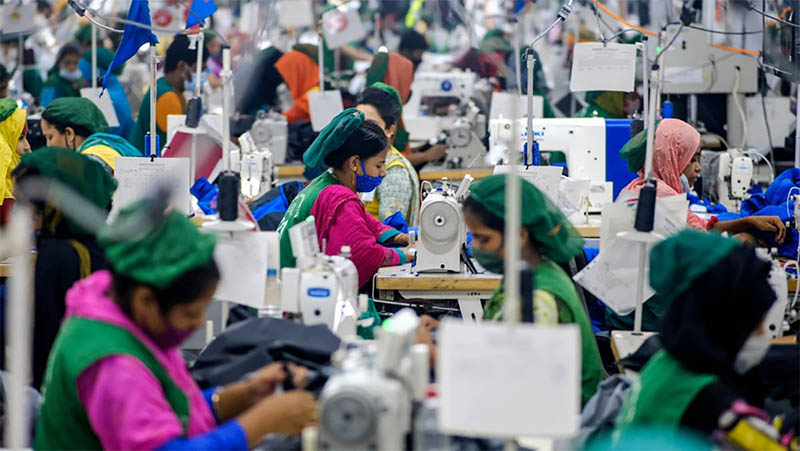
The recent reciprocal tariff decision by the United States has created significant uncertainty in Bangladesh’s export sector, particularly in the ready-made garment industry. Following US President Donald Trump’s announcement on April 2, Bangladeshi apparel exporters have experienced suspended and even canceled purchase orders.
Within hours of the 4 PM (Washington time) announcement, American buyers sent emails to Bangladeshi suppliers requesting them to halt new production activities. These messages stated that the impact of new tariffs was being assessed and requested no new production until further notice.
The United States has long been the largest export market for Bangladesh’s garment sector. Annual trade between the two countries stands at about $10.5 billion, with Bangladesh’s exports exceeding $8 billion – 87% of which are apparel products.
Major US retailers Walmart and Gap have already informed some factories that additional tariffs of up to 37% may apply to their supplied products, and these costs may have to be borne by manufacturers. Fearing damage to buyer relationships, many garment manufacturers are reluctant to speak publicly on the matter.
Former BGMEA President Dr. Rubana Huq said, “Some buyers have asked to suspend production, while others have canceled orders. Some brands are even delaying shipments to change price tags due to tariff issues.”
Former BKMEA President Fazlul Hoque said, “The biggest concern is about consignments already en route to the US or in negotiation phase. Many buyers may demand discounts or pressure for price reductions.”
According to the US Office of Textiles and Apparel (OTEXA), the US imported $7.28 billion worth of garments from Bangladesh in 2023, which increased to over $7.34 billion in 2024. In the first two months of this year alone, imports exceeded $1.5 billion – 26.64% higher than the same period last year.
Analysts say Bangladesh typically exports basic and low-value garments to the US. As these products are highly price sensitive, price increases will affect sales, which could also be detrimental to American buyers. However, this will increase competition, with the pressure falling directly on manufacturers.
Besides garments, other products at risk
The Export Promotion Bureau (EPB) states that besides apparel, other products exported from Bangladesh to the US include headgear, footwear, leather goods, pharmaceuticals, fish, furniture and feather products. Therefore, the impact of this tariff structure could extend to other sectors.
What does the future hold?
Experts say if US buyers directly pass on the additional tariff burden to manufacturers, Bangladesh’s industrial sector will suffer. With tariff implementation leading to suspended consignments, price renegotiations and contract cancellations, the garment industry now faces extreme uncertainty.
Economists believe it will be difficult to overcome this crisis without coordinated action by the government, exporters and sector-related organizations.

https://stapravda.ru/20221228/reyting_samyh_populyarnyh_hostingov_v_rossii_196445.html, рейтинг хостингов России подтверждает, что выбор надежного провайдера важен для бизнеса.