
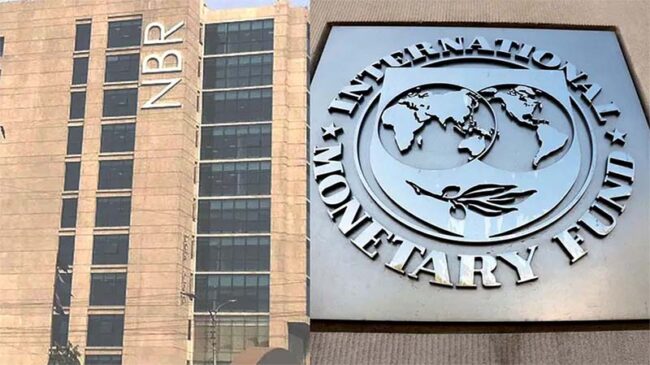
An official from the National Board of Revenue (NBR) has stated that the government is considering revoking the newly imposed VAT and taxes on eight products and services, including medicine and mobile phone talk time. However, there is pressure from the International Monetary Fund (IMF) regarding this matter.
He mentioned that the IMF has advised against retracting the VAT and customs duty hikes, warning that doing so could create a revenue shortfall, which might hinder Bangladesh’s loan activities and violate IMF conditions.
NBR Chairman Mohammad Abdur Rahman Khan has stated that the government is positive about reducing VAT and supplementary duties, but no final decision has been made yet.
The eight products and services under consideration for VAT reduction include Internet Service Provider (ISP) services, branded and non-branded clothing, non-AC hotels, motor garages and workshops, and sweets.
On January 30, 2023, the IMF approved a $4.7 billion loan to Bangladesh to tackle its foreign currency reserve crisis. In return, the IMF imposed economic reform conditions. As a result, the government has faced a significant revenue shortfall, exceeding 42,000 crore taka in the first five months of the fiscal year.
To address this shortfall, the government increased VAT and customs duties on more than a hundred products and services in January. Among these, VAT on restaurant services was raised from 5% to 15%.
As inflation reached double digits, economists and business communities opposed these measures. In particular, the Bangladesh Restaurant Owners Association strongly protested the VAT increase and threatened strikes.
The order included VAT and customs duty hikes on more than a hundred products and services, including medicine, LPG gas, powdered milk, biscuits, pickles, sauces, cigarettes, juices, tissue paper, fruits, soap, detergent powder, sweets, sandals, and airline tickets.
In response to protests from hotel-restaurant owners, the government decided on January 16 to reduce VAT on restaurant services back to 5%, and on the same day, the NBR announced that it would consider reducing VAT and customs duties on eight products and services, including medicine.
NBR officials have confirmed that the decision to reduce VAT on restaurant services will remain in place. They also mentioned that on January 16, the NBR had prepared proposals to reduce VAT on eight products and services, which were to be sent for vetting. However, due to pressure from the IMF, there is now a risk of these proposals being canceled.
Officials revealed that last Thursday, proposals were made to reduce VAT on mobile talk time from 23% to 20%, withdraw a 10% supplementary duty on ISP services, reduce VAT on branded and non-branded products from 15% to 10%, and reduce VAT on medicine from 3% to 2.4%. Additionally, proposals were made to withdraw the extra VAT on non-AC hotels, motor garages and workshops, and sweet sales.
However, after the new VAT and customs duty hikes were implemented, the IMF observed a slight improvement in revenue collection and is now opposing these proposals for reductions.
The IMF has already disbursed $2.31 billion to Bangladesh in three installments and is scheduled to release the full amount in seven installments by 2026 upon meeting the conditions.
As political changes occurred in Bangladesh, an interim government led by Dr. Yunus took charge on August 8. In response to the country’s economic crisis, the government requested additional loans from the IMF, and the fourth installment, worth $645 million, is expected in February.
The IMF’s loan agreement stipulates that the NBR must increase tax revenue as a percentage of GDP by 0.5% in FY 2023-24, another 0.5% in FY 2024-25, and 0.7% in FY 2025-26.
Currently, Bangladesh’s tax-to-GDP ratio is only 7%, and an NBR official stated, “A major condition for the IMF loan was to increase revenue collection by 0.5% of GDP every year. However, this condition was not being met, which is why the decision was made on January 9 to increase VAT and customs duties on nearly 100 products and services.”
NBR Chairman Mohammad Abdur Rahman Khan stated, “The proposal is still in process and has not been finalized. The advisor was unable to attend the office due to illness, but the government remains positive. Let’s see how much is possible.”
On January 16, after a meeting of the Government Procurement Advisory Committee, Economic Advisor Saleh Uddin Ahmed said, “The issue of additional VAT on essential products like medicine and clothing is being reviewed again.”
When asked by reporters if the increase in VAT had impacted prices in the market, he said, “The price changes have not only been due to VAT. In some cases, supply chain issues have also played a role. VAT has slightly increased the price of phones and imported fruit juices, but these increases are limited. We are currently reviewing the situation and decisions will be made for some items.”
He further said, “Essential items, like medicine and clothing, which directly affect the general public, are being re-examined.”
Three days after this statement, the NBR made a contradictory statement. An NBR official did not provide any further comments on this matter.

https://stapravda.ru/20221228/reyting_samyh_populyarnyh_hostingov_v_rossii_196445.html, рейтинг хостингов России подтверждает, что выбор надежного провайдера важен для бизнеса.