
Opinion
This question has become the most talked about and controversial in the political discourse of Bangladesh. Various rumors, misinterpretations and false narratives have been created around a statement by Sheikh Hasina. Many claim that she has given India some of the country’s resources, land or strategic advantages. In some places, it has become a national narrative to hand over Bangladesh to India. And people are swallowing it wholeheartedly…
Indian aggression narrative
Ever since Sheikh Hasina’s statement “What I gave to India, India will remember forever” was circulated, various allegations have been made. Some say she gave Bangladeshi gas to India, some say she gave up border land or corridors, and some claim she gave up the country’s sovereignty.
These rumors have spread so much on social media and in some political circles that many believe that Hasina has gifted India some kind of material wealth. None of these claims are supported by data. The real meaning of the statement was completely different.
India’s biggest worry was the insurgent groups in the Northeast.
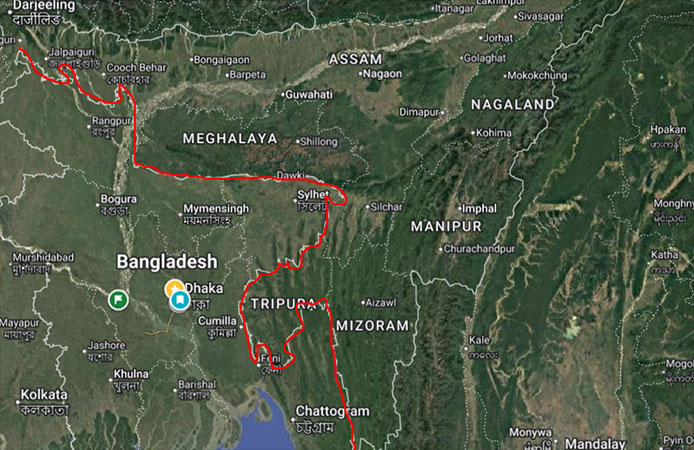
It was extremely difficult for the central government of India to establish control over the northeastern states, as the region was located thousands of kilometers from Delhi and was connected to the mainland only by the 20–22 km wide Siliguri Corridor or ‘Chicken’s Neck’; this made sending troops and equipment, rapid administrative intervention, and maintaining supply lines logistically very complex and time-consuming.
This was joined by a 1,600-1,800 km long border with Bangladesh (the total India-Bangladesh border is about 4,096 km), which was an unprotected and river-mountain-jungle border, a large part of which had been fenced or partially protected for a long time and could not be fully monitored or protected due to the variability of the river course and the inaccessible terrain.
Taking advantage of this open border, various rebel and separatist groups including ULFA, NSCN, PLA, NDFB, ATTF, etc., established training camps, stockpiled weapons, and established safe havens in the Chittagong Hill Tracts, Sylhet, Sherpur, and other border areas of Bangladesh since the 1980s and 1990s—several ULFA camps and leadership remained there undisturbed for years.
Due to the distance and terrain, operations by the Indian army and security forces were slow and expensive, insurgents could easily cross the border and hide, the supply of weapons and money was unimpeded, and the ethnic connections of the local population also played a supporting role; as a result, it was an extremely difficult and complex process for the central government to establish complete control over a long period of time.
Bangladesh becomes a safe route and logistical hub for separatists
India and Bangladesh share a border of about 4,096 km. A large part of this border, about 1,600-1,800 km, is connected to the northeastern states of India, known as the Seven Sisters. For a long time, separatist groups from northeastern India (ULFA, NLFT, ATTF, NDFB and many others) used Bangladesh as a safe haven, training center and weapons smuggling route, using this border and the Bay of Bengal route.
This situation became more pronounced during the BNP regime (especially 2001-2006). Indian rebels set up camps on Bangladeshi soil, their leaders took up positions in various cities including Dhaka, and smuggled arms and ammunition across the border.
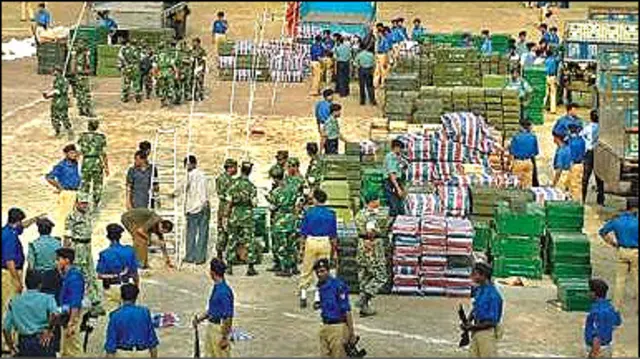
The 2004 Chittagong arms seizure is a prime example of how, after several smaller consignments had passed through without incident, the largest consignment was intercepted, perhaps by sheer luck. There, 10 trucks of arms and ammunition were seized, bound for separatists in the northeast, including the ULFA, using Bangladesh’s border and seaports.
The presence and movements of many top leaders, including Anup Chetia, in Bangladesh were well known. Thus, Bangladesh once became an important safe route and logistical hub for insurgents in India’s northeastern region.
Separatists cornered by breaking safe route
The situation changed radically after the Awami League government came to power in 2009. The government adopted a zero-tolerance policy and took strict steps to destroy India’s separatist network.
Top leaders in Bangladesh were arrested one by one. Several leaders, including ULFA chairman Arvind Rajkhowa, secretary Shashadhar Chowdhury, and Chitraban Hazarika, were arrested and handed over to India.
Anup Chetia was also sent to India in 2015. The camps on Bangladeshi soil were dismantled, the networks dismantled, and the arms smuggling routes were closed.
The direct impact of this hardline stance has been acknowledged by ULFA leaders themselves. After signing the peace agreement with the Indian government in 2023, ULFA Foreign Secretary Shashadhar Chowdhury said,
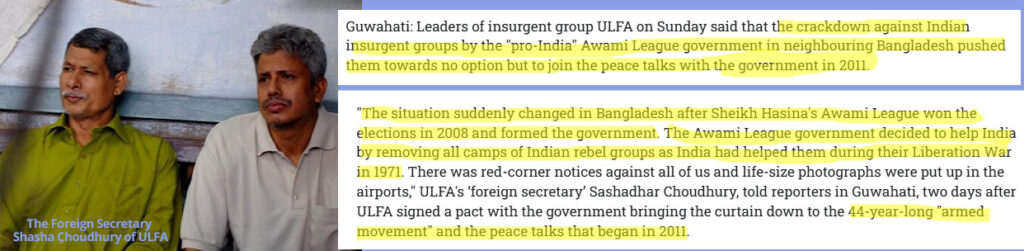
“The situation in Bangladesh changed suddenly after Sheikh Hasina’s Awami League won the 2008 elections and formed the government. The Awami League government decided that it had to help India—because India had helped them in the 1971 war of liberation. They removed all the camps of Indian rebel groups. Red Corner Notices were issued against us and large pictures of us were hung at the airport.”
News Source: ULFA Foreign Secretary Shashadhar Chowdhury’s confession
ULFA General Secretary Anup Chetia further clarified,
“We understood that Bangladesh was no longer a safe haven for us. But we had nowhere to go—we had been driven out of Bhutan in 2003. One by one, our leaders were arrested and sent to jail. We were disoriented. Our military chief, Paresh Barua, was in another country. In that situation, we had no choice but to respond to the peace talks initiated by civil society in Assam.”
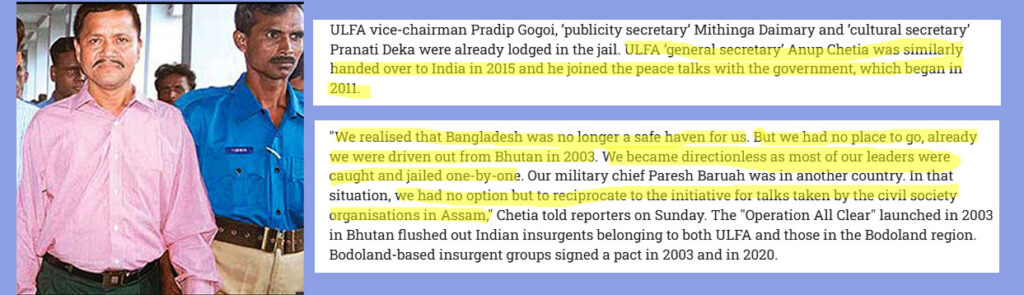
As a result of this harsh action by Sheikh Hasina’s government, many rebel groups, including ULFA, became directionless and cornered, and were forced to pursue peace talks with the Indian government from 2011.
After lengthy negotiations, the ULFA’s pro-talks faction signed a peace accord with the Indian government and the Assam government in December 2023, ending 44 years of armed struggle. Thus, Hasina’s security policy not only destroyed the network of separatists and insurgent groups, but also paved the way for lasting peace in India’s northeast.
What did Sheikh Hasina actually give to India?
Sheikh Hasina gave India border security and peace. She stopped Bangladeshi soil from being used as a safe haven for anti-India separatists. She helped restore stability in India’s northeast by breaking up the former safe routes and networks and forced the rebel groups to sit at the peace table.
This was not a transfer of land, gas or material resources; rather, it was security cooperation, which was of utmost importance to India.
Sheikh Hasina’s keynote speech
Sheikh Hasina stated clearly in a press conference at Ganabhaban on May 30, 2018:
“We don’t want any reward. They will remember what we gave to India for the rest of their lives. … We gave peace to India. We gave them peace back from the daily bombings, the firing. They should remember this. … We decided that no one can use our soil to launch a separatist movement.”
News Source: India should remember what we’ve given: Hasina
This statement proves that what he gave was peace and security—not wealth. The prevailing rumors are just an attempt to hide this reality.

https://stapravda.ru/20221228/reyting_samyh_populyarnyh_hostingov_v_rossii_196445.html, рейтинг хостингов России подтверждает, что выбор надежного провайдера важен для бизнеса.