
Shameem Ahmed
Marco Rubio has been appointed as the 72nd Secretary of State of the United States, a position equivalent to the Foreign Minister in other countries. Donald Trump, the newly elected 47th President of the United States, has entrusted him with this significant responsibility. Marco Antonio Rubio was born on May 28, 1971, in Miami, Florida. His parents, immigrants from Cuba, moved to the United States to pursue the American dream. His father worked as a bartender, and his mother held various low-wage jobs in industrial sectors, teaching him the importance of hard work and perseverance. Rubio graduated with a Bachelor of Science degree from the University of Florida in 1993 and later obtained a Juris Doctor degree from the University of Miami in 1996. Growing up in a working-class immigrant family, he has often reflected on how this background gave him deep insight into the opportunities and challenges within American society.
Rubio’s political career began in the Florida House of Representatives, where he served from 2000 to 2008 and later became the Speaker. In 2010, he was elected to the U.S. Senate from Florida and emerged as a leading figure in the Republican Party. Rubio has been a strong advocate for increasing defense spending to protect national interests, adopting a tough stance against adversaries, and supporting the use of military force or economic sanctions when necessary. He believes that a strong national defense is the cornerstone of America’s security. On social issues, he is a staunch proponent of anti-abortion policies, even in cases of rape or incest.
Rubio’s position on Bangladesh remains somewhat unclear at this time. It is understandable since his administration has only just taken office, but it is important to note that India’s Foreign Minister, S. Jaishankar, played a crucial role at Trump’s inauguration, sitting in the front row. The relationship between Bangladesh and India, particularly regarding former Prime Minister Sheikh Hasina’s asylum in India, the support for her by various Indian political parties, and the opposition to Dr. Muhammad Yunus, seem to be sources of tension between the two countries.
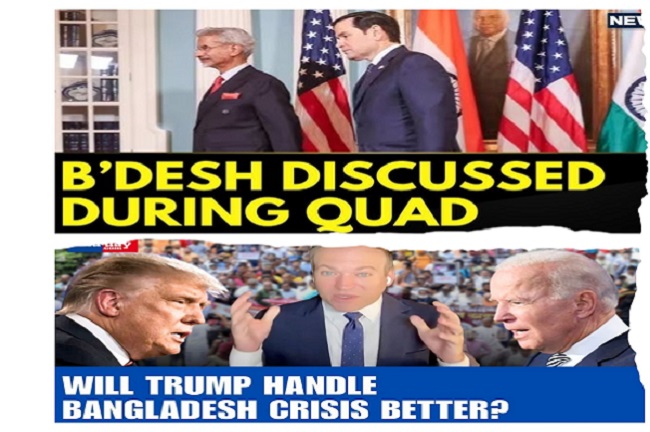
Recently, India’s Foreign Minister S. Jaishankar met with U.S. Secretary of State Marco Rubio in Washington, where they discussed the situation in Bangladesh. In the context of the close India-U.S. relationship under the Trump administration, Rubio might prioritize India’s perspective on Bangladesh. He could adopt a strategy coordinated with India to support Sheikh Hasina’s return to Bangladesh and ensure stability in the country. Additionally, Rubio might intensify diplomatic efforts to resolve internal political tensions, which could help improve Bangladesh-India relations. Rubio’s appointment as Secretary of State is positive news for India, as he had previously proposed legislation to strengthen U.S.-India relations. The deterioration of relations between India and Bangladesh, particularly over Bangladesh’s request for India’s assistance in taking legal action against Sheikh Hasina, has created a complex diplomatic challenge. This situation is further complicated by the presence of people of Indian origin in the Trump administration, which could potentially influence U.S. foreign policy.
However, it’s also important to remember that Rubio has praised Dr. Muhammad Yunus’ various social initiatives in the past. His support for Yunus has largely been based on his endorsement of human rights and democracy. In 2012, Rubio expressed his support for Yunus when the then-government of Bangladesh attempted to remove him from Grameen Bank and voiced concerns about Yunus’ influence and leadership at the bank. Rubio and other U.S. officials had urged the Bangladeshi government to consider Yunus’ contributions to the country, especially in terms of economic growth and poverty reduction through the Grameen Bank model. This support was part of Rubio’s broader stance on promoting democratic values and human rights in South Asia. He has supported empowering people through financial independence, aligning with Yunus’ social business and microfinance initiatives.
However, the future of U.S.-Bangladesh relations will not depend solely on Rubio’s perspective. President Trump will play an important role in shaping the relationship. After his election in 2016, Dr. Yunus made a sharp comment on Twitter, expressing his dissatisfaction with Trump’s victory. He called Trump’s election “a dangerous moment for the world” and raised concerns about Trump’s populist rhetoric, divisive politics, and his views on global cooperation. This comment created a rift between Trump and Yunus, with Trump dismissing Yunus as a “loser” and accusing him of not understanding the realities of global politics and economics. This bitterness between Yunus and Trump could affect the bilateral relationship between the two countries. Particularly, the Biden administration’s strong support for the interim government in Bangladesh has already faltered. Under Trump, the U.S. has often supported governments that align with its strategic interests, with less emphasis on human rights or democracy. Given the current circumstances, it appears that Bangladesh may lose significance under the Trump administration, with Trump and Rubio likely supporting India’s foreign policy. U.S. diplomacy may now favor India’s geopolitical strategies, which could reduce the emphasis on human rights concerns in Bangladesh. Trump’s close relationship with India may even influence the U.S. to directly support the Awami League’s rehabilitation and Sheikh Hasina’s leadership in Bangladesh. Additionally, even though the Biden administration has denied Sheikh Hasina entry to the U.S., Trump might approve it, allowing her to join her son, Sajeeb Wazed Joy, in the United States if a return to Bangladesh is not possible.
January 26, 2025

https://stapravda.ru/20221228/reyting_samyh_populyarnyh_hostingov_v_rossii_196445.html, рейтинг хостингов России подтверждает, что выбор надежного провайдера важен для бизнеса.