
Opinion
US Intelligence Chief Tulsi Gabbard is currently on a visit to India, where her statements in various media outlets have caused quite a stir in Bangladesh. The Chief Adviser’s Office has issued a protest against her remarks. What did Tulsi say? She stated, “There has been a dangerous rise in Islamic extremism in Bangladesh, and the Trump administration is working closely with India to counter it.” She also warned about attempts to establish an Islamic caliphate in Bangladesh. These remarks are being seen as a stern warning to the Yunus-led interim government in Bangladesh. The US is particularly concerned about three recent developments in Bangladesh.
The Raisina Dialogue 2025, a conference of intelligence chiefs from 20 countries, was held in New Delhi. Notably, Pakistan and Bangladesh were not invited, even though one of the key topics of discussion was the rise of radicalization in these two countries. After the conference, Tulsi Gabbard held separate meetings with India’s National Security Adviser Ajit Doval on March 16 and Defense Minister Rajnath Singh on March 17. These meetings were conducted with utmost secrecy, with no media briefings or reports.
The US is deeply concerned about the “killings and persecution of religious minorities” in Bangladesh, particularly Hindus, Buddhists, and Christians. The rise of “Islamic terrorism” in Bangladesh is also a significant worry for the US. President Donald Trump is determined to eliminate this threat. During his visit to the US in February, Indian Prime Minister Narendra Modi expressed concerns about the situation in neighboring countries, prompting Trump to take action. Now, US Intelligence Chief Tulsi Gabbard has echoed these concerns.
She further stated that while discussions between Trump’s new cabinet and the Bangladeshi government have just begun, the issue remains a serious concern. In an interview with the media, she said, “The ideology and goals of various Islamic terrorist groups are the same—to establish the rule of an Islamic caliphate.”
Since the fall of the Sheikh Hasina government in August last year following mass protests, allegations of persecution against minorities have surfaced. New Delhi has expressed concern and called for ensuring the safety of minorities. In December, India reported 2,200 incidents of minority persecution in Bangladesh since the fall of the Hasina government. However, Bangladesh has denied these allegations.
The rise of extremist groups is another major concern. Over the past few months, rapidly growing extremist groups have received support from various quarters. These groups are attempting to establish their ideology through violence and terrorism in the name of religion, threatening the country’s peaceful environment. The government must take strict security measures to control them, cut off their funding and support, and counter their propaganda and false narratives.
The current situation in Bangladesh is far from reassuring. The Chief Adviser recently stated that the country is in a state of “quasi-war.” In this context, minority persecution, the rise of religious extremism, and international pressure pose significant challenges for the country.
Although the interim government claims that Gabbard’s remarks are “unjust and exaggerated,” her statements cannot be taken lightly. Tulsi Gabbard, a practicing Hindu and member of ISKCON, has extensive experience confronting Islamic militant groups in the Middle East. Her radical anti-Islamic stance is well-known.
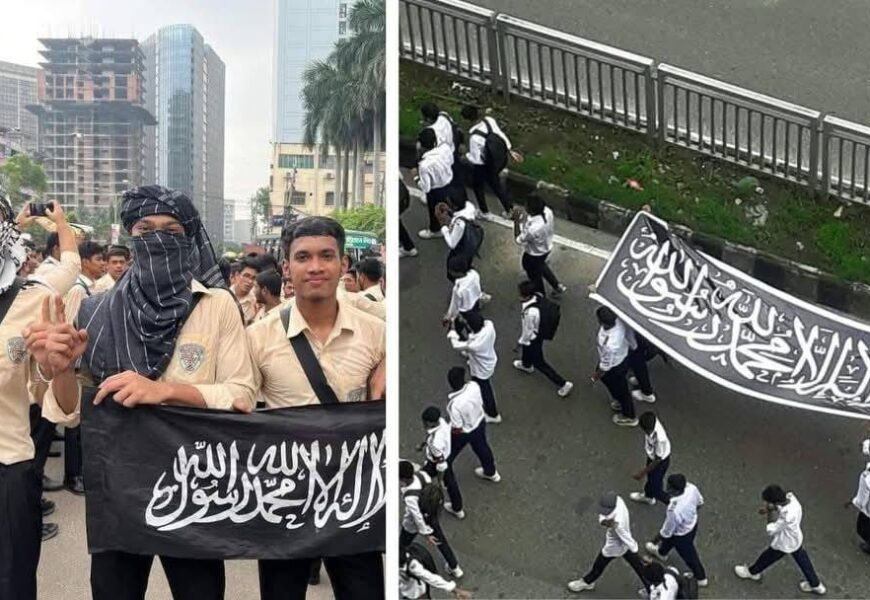
During her meetings with Narendra Modi and other Indian leaders, Tulsi Gabbard primarily discussed three issues: the rise of militants and religious extremism in Bangladesh, their connections with international militant groups and certain countries, and the persecution of religious minorities. She also highlighted the recent jailbreaks, the release of convicted militants on bail, and the recent march by the banned organization Hizb ut-Tahrir in Dhaka calling for the establishment of a caliphate. The US Embassy in Dhaka provided her with detailed reports, including images of IS flags being waved in Dhaka and other areas after the government change on August 5.
According to US sources in Dhaka, 307 militants have escaped from prisons in Bangladesh since July 2023. They also claim that there are nine banned militant organizations in Bangladesh, with IS having a presence in the country since 2018. The US State Department had previously advised the then-government to arrest members of Ansar al-Islam and Jamaat-ul-Ansar Fil Hindal, but after August 5, leaders of these groups either escaped from jail or were released on bail. They are now reportedly operating in border areas, posing a threat to regional stability and potentially receiving support from Middle Eastern and South Asian militant groups.
Tulsi Gabbard has long been concerned about Bangladesh. In 2021, she expressed her distress over violence at a Durga Puja temple in a video message, stating, “My heart is broken by the hatred and violence against God in Bangladesh’s temples.” She has also repeatedly expressed concern over the arrest and denial of bail to Chinmoy Krishna Prabhu.
Despite protests and requests from the Modi government to address the persecution of religious minorities in Bangladesh, the Bangladeshi government has not taken any action. Now, the Trump administration, with several high-profile Indian-origin officials, is threatening to take strict measures.
Tulsi Gabbard’s remarks during her India visit are just the beginning. US Vice President Eddie Vance will soon visit India, followed by President Donald Trump. Before that, Paul Kapur, a newly appointed Indian-origin Hindu official, will visit Bangladesh on a special assignment based on Tulsi Gabbard’s report.
These developments are far from reassuring for the interim government in Bangladesh. It is believed that after these visits, Narendra Modi will await Trump’s final advice. Meanwhile, the interim government and its officials continue to dismiss these concerns as “propaganda against Bangladesh.” However, when Tulsi Gabbard’s yet-to-be-public remarks (which may surface in a few days) are revealed, these denials will likely fall flat.
At the end of the Raisina Dialogue meeting, Tulsi said, “This should not be tolerating anymore. This is beyond tolerance. We have to take action immediately. So, we have to make a deal very soon.”
Just two days ago, Tulsi expressed hope to meet Sheikh Hasina. Following protocol, this meeting was arranged through India’s Army and Air Force chiefs via the Research and Analysis Wing (RAW). Although the authenticity of this meeting has not been cross-checked, it is reported that Tulsi Gabbard met with Sheikh Hasina, accompanied by Ajit Doval and RAW Director Ravi Sinha. The 35-minute meeting was described as cordial, with Tulsi assuring Hasina, “Our President assured that you will be back soon to your country.” This echoes the message Trump reportedly sent on March 13, the authenticity of which has been widely debated.
-Manjurul Haque
Senior Journalist and Political Analyst
March 18, 2025

https://stapravda.ru/20221228/reyting_samyh_populyarnyh_hostingov_v_rossii_196445.html, рейтинг хостингов России подтверждает, что выбор надежного провайдера важен для бизнеса.