
Staff Correspondent
Syed Moazzem Hossain Alal, advisor to the BNP chairperson, has demanded that Jamaat-e-Islami be banned for its alleged involvement in the 1971 genocide, rape and torture.
Calling for a ban on Jamaat like the Awami League, he said, “If the Awami League can be banned for murder, torture and vote rigging, then Jamaat must also be banned for the genocide and torture of 1971.”
He made this demand at a program at the National Press Club last Saturday. There, he also said that the BNP, freedom fighters and forces protecting national unity must re-evaluate the role of Jamaat and drew the attention of the chief advisor.
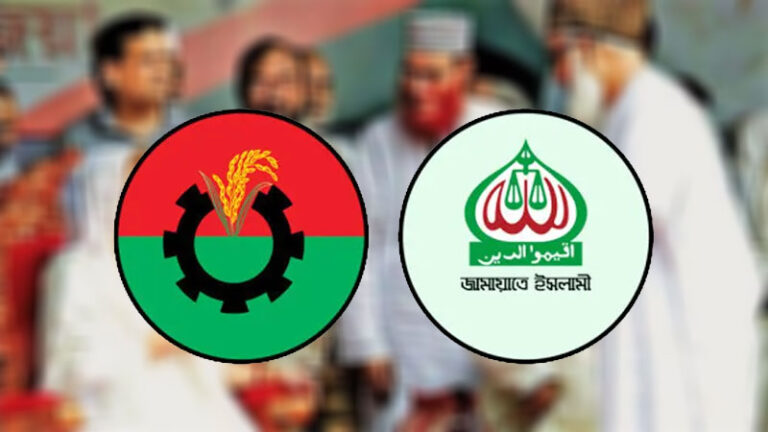
His comments have sparked a new controversy in the BNP political arena because Jamaat-e-Islami has long played a role in politics as an ally of BNP. The BNP-Jamaat alliance was a power partner several times, from the 1991 fifth parliamentary election to 2006.
Jamaat-BNP political relations from goodwill to hostility
After independence, religious parties were banned through a constitutional amendment in 1972. However, in 1979, military ruler and BNP founder Ziaur Rahman came to power and lifted the ban. As a result, Jamaat-e-Islami returned to politics. Since then, Jamaat has been positioned as a close political ally of BNP.
After the BNP won 140 seats in the 1991 elections, it came to power in an alliance with Jamaat-e-Islami, which needed 151 seats to form the government. In that election, Jamaat-e-Islami had 18 seats in parliament. Even before the elections, Jamaat-e-Islami and BNP had an informal alliance. Then, when conflict broke out between BNP and Jamaat over the caretaker government issue, Jamaat-e-Islami resigned from parliament in 1995.
Then, in the 7th National Assembly elections of 1996, when BNP and Jamaat-e-Islami contested separately, both parties suffered a setback. BNP’s 24 seats were reduced to 116 seats and Jamaat-e-Islami got only 3 seats. After that, a four-party alliance was formed on January 6, 1999 due to political necessity. In the 8th Parliament elections of 2001, BNP-Jamaat formed a four-party alliance and won a landslide victory and ran the government.
BNP made two top leaders of Jamaat-e-Islami, Ali Ahsan Mohammad Mujahid and Matiur Rahman Nizami, who were involved in crimes against humanity in 1971, ministers in the then coalition government’s cabinet. Then, in 2013, Jamaat-e-Islami’s registration was cancelled by a High Court ruling.
The court’s observation said that the party’s constitution is in conflict with the country’s constitution. Since then, the party has not been able to officially participate in elections, but has been active in politics as an independent candidate or under other identities. In the 2018 elections, the unregistered Jamaat-e-Islami elected a rice sheaf. After the political changes in August 2024, BNP became active in politics again, but the nature of their relationship with Jamaat is not clear. There is no public structure of the BNP-led alliance now.
Yet both parties were opposing the government’s policies in parallel.
In this situation, the demand to ban Jamaat from the top level of BNP has started a new discussion among political observers. This statement especially comes at a time when the issue of the trial of the Jamaat-led Islamic movement and the anti-liberation war forces has come back into the discussion.
Jamaat has strongly reacted to the BNP leader’s statement. The party’s Assistant Secretary General Abdul Halim claimed in a statement, “Alal’s statement is irresponsible and politically motivated. The allegations of genocide or torture in 1971 are completely baseless and propaganda of the political opponent.”
Given the long-standing political relationship between BNP and Jamaat, this statement is also seen by many as an indication of a change in the party’s position. However, BNP has not officially commented on the matter. Several leaders in the party’s central office said that Alal’s statement may be a “personal opinion” and that it is not a party decision.
On the other hand, Jamaat has said that demanding a ban until the allegations against them are proven is against political etiquette. They believe that if a BNP leader makes such a statement, it could destroy national unity.
Since 2006, the political cooperation between BNP and Jamaat has been on and off at various times. During the 2013 war crimes trial and the Shahbagh movement, there was a split within BNP over Jamaat’s stance. Some felt that Jamaat had damaged BNP’s international image. On the other hand, Jamaat felt that BNP was using them but not taking responsibility.
During the 2018 elections and the subsequent political turmoil, Jamaat apparently played politics in the shadow of BNP. But BNP never joined them in an open alliance, instead maintaining distance on the issue of “justice and national unity”.
In the current political environment, Jamaat-e-Islami, although not officially registered, is organizationally active across the country. At the field level, they are participating in the movement in many places in coordination with the local leadership of the BNP.
However, the BNP leadership has not yet announced the direction of its future relationship with Jamaat. Political observers believe that Alal’s recent statement has created uncertainty about the future of that relationship.

https://stapravda.ru/20221228/reyting_samyh_populyarnyh_hostingov_v_rossii_196445.html, рейтинг хостингов России подтверждает, что выбор надежного провайдера важен для бизнеса.