

Bangladesh, with its 710-kilometer long coastal area located between the Bay of Bengal and the Indian Ocean, is highly vulnerable to natural disasters. Cyclones, floods, and droughts are common occurrences here, but due to climate change, their intensity is increasing. As a result, more than 40 million coastal people are directly at risk. However, the strategies adopted by the Bangladesh government, particularly under the leadership of Prime Minister Sheikh Hasina in the last 15 years, for climate adaptation have been globally praised.
In 2023, Bangladesh was considered to receive $8 billion in aid for climate-related risks. The highest allocation for this $8 billion climate fund came from the Asian Development Bank (ADB), which contributed $400 million in 2023 and was set to provide another $2.25 billion for the climate sector between 2024 and 2026. The International Monetary Fund (IMF) contributed $1.4 billion, the World Bank $1 billion, the Asian Infrastructure Investment Bank (AIIB) $400 million, and the South Korean government provided $40 million. Other organizations also contributed to this fund.
The World Bank’s new report highlights Bangladesh’s adaptation strategies, which are serving as a model for other developing countries. Bangladesh will host the National Adaptation Plan (NAP) Expo in 2024, showcasing the country’s deep commitment to climate adaptation.
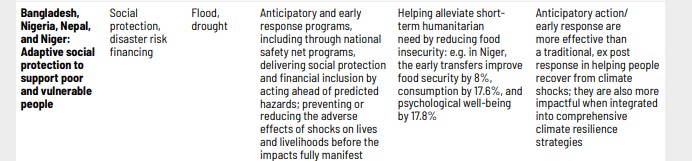

With the support of the World Bank, Bangladesh has developed a strong climate adaptation strategy, through which significant successes have been achieved in saving lives in disaster-prone areas. Particularly, through the construction of disaster shelters, which are used as primary schools during normal times, safe shelter has been ensured for local communities. Additionally, the construction of roads and communication infrastructure to facilitate easy access to disaster shelters has improved connectivity and boosted economic activities.
Such investments have significantly reduced the loss of life during cyclones. While nearly 300,000 people died in the 1970 Bhola cyclone, only 20 lives were lost in the 2020 Amphan cyclone. This demonstrates the success of Bangladesh’s adaptation strategies.
Main Adaptation Strategies of Bangladesh
One of the key strategies for climate adaptation in Bangladesh is the National Adaptation Plan (NAP), which is a comprehensive action plan for 2023-2050. This plan focuses on protecting highly vulnerable sectors such as agriculture, water resources, and coastal communities.
Community-Based Adaptation (CBA) projects, implemented in collaboration with UNDP and other partner organizations, are enabling local communities to actively engage in adaptation activities. Projects empowering local women and addressing climate risks in coastal areas have been especially effective.
Bangladesh’s disaster shelter and school projects have been a major success, as they not only serve as shelters during disasters but also continue to function as schools during normal times. Furthermore, the development of infrastructure, particularly roads and communication systems, has ensured quick access to disaster shelters and improved connectivity.
Role of Governance and Innovation
The success of Bangladesh’s climate adaptation strategy is largely due to strong governance and innovative strategies. Under the leadership of Prime Minister Sheikh Hasina, the government has been tirelessly working to build resilience and adaptation. By focusing on the needs and knowledge of local populations, the government has developed strategies that are not only practical but also acceptable to local communities.
Economic and Social Benefits
The dual-purpose disaster shelters are a major success in Bangladesh’s adaptation strategy. These shelters provide safe refuge during storms, floods, or other disasters, while also functioning as schools, contributing to education and social development. Improved infrastructure such as roads and communication systems has strengthened local businesses and economic activities.
Additionally, these investments have led to significant progress in public health and safety. By reducing the loss of life during cyclones, the quality of life for the population has improved. Furthermore, resilient infrastructure development has helped maintain the country’s economic stability, enabling communities to recover more quickly from climate-related disasters.
Looking ahead, Bangladesh plans to use more advanced technologies according to its National Adaptation Plan (NAP) 2023-2050 and increase international cooperation to take more effective steps in managing climate risks. The country’s long-term plans, research into new technologies, and participation in global cooperation will further advance its climate resilience.
Bangladesh’s climate adaptation strategy is now a successful global example, which will assist other countries worldwide in tackling their own climate challenges.

https://stapravda.ru/20221228/reyting_samyh_populyarnyh_hostingov_v_rossii_196445.html, рейтинг хостингов России подтверждает, что выбор надежного провайдера важен для бизнеса.