
Staff Correspondent
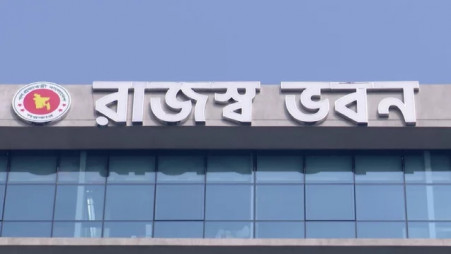
The National Board of Revenue (NBR) has collected less revenue than the revenue target set for the fiscal year 2024-25. This year, the collection was about Tk 92,626 crore (19.98 percent) less than the revised target of Tk 4,63,500 crore, or Tk 3,70,874 crore. Analysts believe that the lower revenue collection could have a major impact on social security programs.
According to experts, this is not just the result of a few months of agitation; rather, it is a manifestation of the Yunus government’s policy failures, administrative incoordination, and indifference to tax and customs reforms.
June is always considered a ‘successful’ month in terms of revenue collection compared to previous fiscal years. However, this time, volatile administrative measures—such as the sudden abolition of the NBR and its division into two parts and the continuous movement against that decision for a month and a half—have almost brought the revenue to a standstill. As a result, the revenue collected in June of the 2024-25 fiscal year was only Tk 43,920 crore, which is Tk 9,955 crore less than the same month of the previous year.
Those concerned believe that if the government had provided timely and effective solutions, this failed economic shock could have been avoided. Now, economists believe that it will be difficult to handle this shock.
Such a huge shortfall in the target despite limited growth proves that there are major failures in the government’s preparedness and crisis management system to keep economic activities going.
The political unrest since last August and the one-and-a-half-month-long strike against the announcement of dismantling the NBR—all in all, the economy was practically at a standstill for about three months. The situation has not yet normalized. The government is taking retaliatory measures against officials.
Sudden decisions on revenue administration, followed by ‘revised’ targets—these indicate that the government was not coordinated during budget preparation. Technology-based VAT collection, expansion of income tax registration, scanner automation to prevent tax evasion—most of the reforms that have been announced many times have remained on paper.
A top NBR official (who did not wish to be named) said that although at least Rs 2,000 crore was supposed to be collected daily in June during normal times, it was not possible due to the movement crisis. Even if some delayed tax deposits were made at the last minute, the chances of meeting the main shortfall are slim.
Economists say that without policy stability and rapid reforms that keep the revenue administration free from political pressure, this decline cannot be overcome. Otherwise, the government’s development spending and social security programs will be at risk – and the responsibility will fall squarely on the government’s shoulders.

https://stapravda.ru/20221228/reyting_samyh_populyarnyh_hostingov_v_rossii_196445.html, рейтинг хостингов России подтверждает, что выбор надежного провайдера важен для бизнеса.