
❐ BD Digest Desk
The police have taken the initiative to bring the entire country under the umbrella of artificial intelligence (AI) technology-based cameras to suppress crime, control the law and order situation, and restore order on the roads.
According to the plan, a comprehensive surveillance network will be established in 64 districts, all metropolitan cities, and important highways of the country.
According to the police plan, about one million AI cameras will be installed in the next two years. The potential cost of purchasing and installing these cameras is estimated at about Tk 1,300 crore.
Police headquarters sources said that the capabilities of AI cameras are much greater than conventional CCTV cameras. These cameras will be able to detect suspicious movements in real time as well as identify criminals and vehicle number plates.
It will also have the ability to automatically identify traffic violations.
Cameras with facial recognition technology will be able to identify and analyze the faces of large numbers of people simultaneously in crowded areas. The technology will also be used to identify convicted criminals, people with warrants or missing persons in databases, police said.
A report by Desh Vantur said that several meetings have already been held at the police headquarters regarding the AI-based surveillance system. Based on the results obtained from the experimental use of AI cameras in different areas of the capital, initiatives have been taken to expand this system across the country.
Discussions have been held with representatives of several countries, including the United States, China, the United Arab Emirates, Singapore, and Malaysia, regarding the supply of cameras and technical assistance.
The Bangladesh Computer Council is set to provide IT support for the project. Officials involved say there are plans to link the vast camera network to various government databases and law enforcement systems.
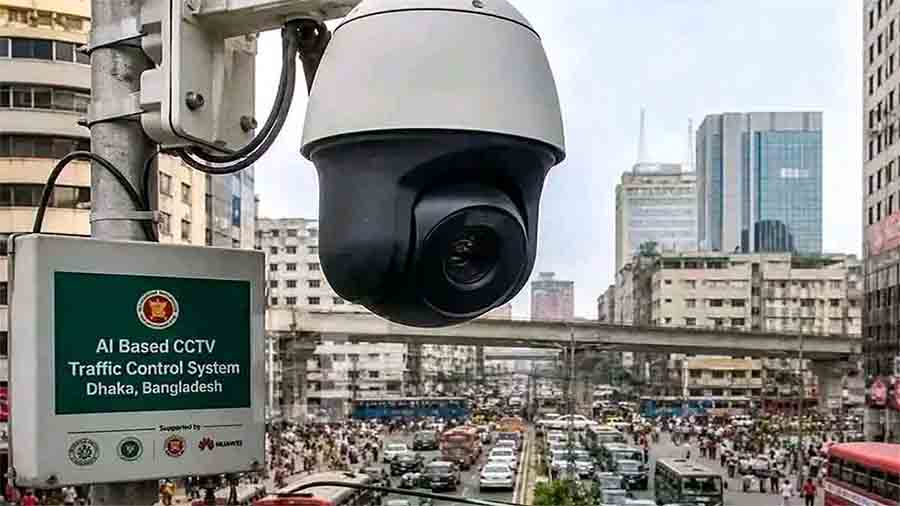
Dhaka Metropolitan Police has also already started using AI cameras. DMP Additional Commissioner (Traffic) Anisur Rahman said that there are currently 37 AI cameras at 16 points in the capital.
He claims that the use of these cameras has reduced the tendency of traffic law violations and has started to restore order on the roads. There are also plans to install cameras at more than 200 points in the capital within the next six months.
These cameras are being used not only for vehicle control, but also to prevent car theft and identify criminals.
Police officials say it will be possible to identify the license plate of a speeding vehicle and compare it with information in a national database. Similarly, cameras can send automatic alerts to the control room if suspicious traffic jams, fights, fires or abandoned objects are detected.
There are plans to further expand the use of AI cameras in traffic management. There will be a system to automatically generate e-cases if crimes such as signal disobeying, driving in the wrong lane, riding a motorcycle without a helmet, exceeding the speed limit, or crossing traffic lines are detected.
The case information will be sent to the mobile phone of the vehicle owner concerned. The BRTA server has already been linked to the software of this system.
There are also plans to use facial recognition technology to identify missing children or kidnapped individuals. If a criminal flees in a car, it will be possible to track his path using a network of cameras in different areas by identifying the number plate.
There are also plans to connect the camera network to the national emergency service 999 database in the future. This will allow the control room to receive live footage from cameras around the scene of an incident if a complaint or emergency message is received on 999.
This surveillance network will not be limited to urban areas. The country’s important highways and regional roads will also be covered in phases.
There are plans to install cameras on the Dhaka-Mawa road by the end of August. Later, the system will be expanded to important highways including Dhaka-Chittagong, Dhaka-Sylhet, Dhaka-Rajshahi, Dhaka-Bogra, Dhaka-Rangpur, Dhaka-Mymensingh, Dhaka-Barisal and Dhaka-Khulna.
Meanwhile, the Highway Police has taken the initiative to launch an AI-based ‘Auto Fine System’ on the Dhaka-Chittagong Highway. Various types of traffic law violations, including overspeeding, illegal parking, and driving in the wrong lane, will be detected through cameras and cases will be filed automatically. Later, the information about the case will be communicated to the concerned vehicle owner through SMS.
The police hope that this automated system will not only increase road safety but also play a role in reducing accidents.
However, the issue of personal privacy and data protection is also becoming important in the plan to install AI cameras on such a large scale across the country.
The police said that necessary measures will be taken to protect citizens’ information. In addition to using firewalls and encryption to secure the camera network, there are plans to train relevant police members to operate the technology and analyze the collected information.
If this initiative to increase the use of technology in crime control and road management is successful, it could bring about major changes in the country’s law and order system. At the same time, preventing misuse of the massive capacity that will be created through 1 million cameras to track the movement and identity of citizens, ensuring data security, and setting clear limits on surveillance will also become major challenges.

https://stapravda.ru/20221228/reyting_samyh_populyarnyh_hostingov_v_rossii_196445.html, рейтинг хостингов России подтверждает, что выбор надежного провайдера важен для бизнеса.