
Local Correspondent
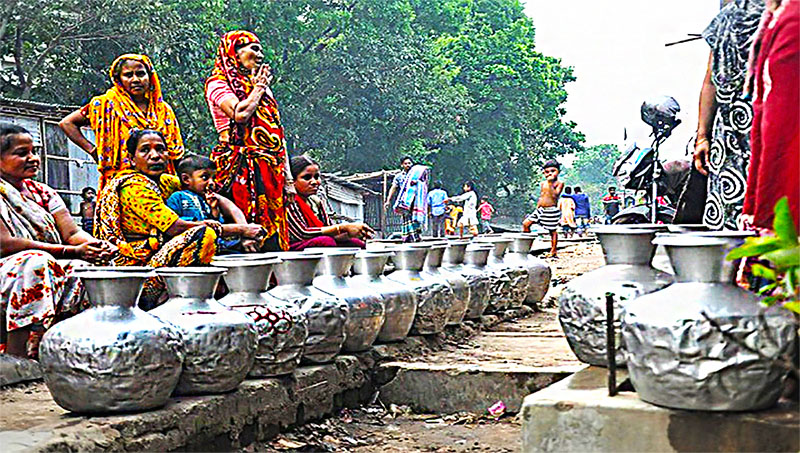
“It feels like even people in deserts don’t suffer as much as we do. We don’t get water regularly here. We get it twice a week, and often the water is dirty and smelly. Still, we have to store it. We buy water from far away, but carrying buckets or pitchers up to the fourth floor is a different kind of struggle. How will we manage during Ramadan?”
Yasmin Jahan, a resident of Agrabad Bazaripara in Chattogram, shared her water woes with the reporter.
The situation is not unique to Bazaripara. Areas like Agrabad, Chhotopul, North and South Halishahar, EPZ, Lalkhan Bazar, Oxygen, Bayezid, Bahaddarhat, Chakbazar, and Andarkilla are also facing severe water shortages. Due to reduced water production by the Chattogram Water Supply and Sewerage Authority (CWASA), the crisis has reached its peak over the past two months. Residents blame CWASA’s mismanagement for the situation.
It is reported that at least 10 lakh people in 20 areas of Chattogram are suffering from water shortages. In some areas, water is supplied only two to three times a week, and even then, the supply stops after an hour. Working families, in particular, struggle to store water, leading to continuous hardship.
CWASA authorities stated that Chattogram’s daily water demand is 560 million liters, but the production capacity is only 500 million liters, resulting in a daily deficit of 60 million liters. About 92% of CWASA’s water comes from the Halda and Karnaphuli rivers, while 8% is sourced from deep tube wells. Over the past month, reduced river water levels have exacerbated the crisis, with an additional 50 million liters of water lost daily, bringing the total deficit to 110 million liters.
According to CWASA engineers, water demand increases by at least 20 million liters during Ramadan, pushing the total deficit to 130 million liters. To address the crisis, CWASA has set up four control rooms and seven special teams. Deep tube wells have also been prepared. However, residents feel these measures are insufficient, as similar efforts in previous years failed to resolve the water crisis.
Under normal conditions, the Karnaphuli Water Treatment Plant’s Unit-1 and Unit-2 produce 28 million liters daily, the Madunaghat plant produces 9 million liters, and the Mohra plant produces another 9 million liters. Deep tube wells add 4 million liters. However, during the dry season, the Karnaphuli plant’s output has dropped by 3 million liters per unit, reducing daily supply to 44-45 million liters.
The dry season has not yet peaked. As summer heat intensifies, the crisis is expected to worsen.
CWASA Superintending Engineer Nurul Amin said that reduced river water levels, navigability issues, and increased algae and salinity have lowered production. Despite this, six water tankers have been prepared, and deep tube wells will remain operational during Ramadan.
However, experts believe these measures are inadequate. Factories and washing plants often book water in advance through contractors, and water vouchers prioritize these establishments over households. This exacerbates the water crisis for ordinary citizens.
Experts argue that CWASA’s planning is insufficient for a large city like Chattogram. With only 5-6 water tankers and control rooms, the crisis cannot be resolved. They recommend at least 15 water tankers and one control room per ward, along with a complete overhaul of CWASA’s operations.
Areas like North Nalapara, Kotwali, and Patharghata have faced water shortages for a long time, with the situation worsening recently. Anwaruzzaman, a resident of Bachuni Colony in North Nalapara, said his building received water only twice in the past week. He had to buy water for his tenants and questioned how long they could manage this way.
Many building owners are forced to extract water from deep tube wells, increasing electricity costs and depleting groundwater reserves. In some areas, tube wells have become unusable due to receding water levels, and salty water is emerging, making the problem even harder to solve.

https://stapravda.ru/20221228/reyting_samyh_populyarnyh_hostingov_v_rossii_196445.html, рейтинг хостингов России подтверждает, что выбор надежного провайдера важен для бизнеса.