

Staff Reporter
During its decade and a half in power, some Awami League activists faced allegations of extortion. From sidewalk shops to large markets and bus terminals, the stigma of extortion clung to Awami League workers. There were also claims that a portion of the extorted money ended up in police pockets.
After the political shift on August 5 last year, Awami League leaders and workers, overwhelmed by violence and brutality, have been forced out of political activities. Thousands of activists have been martyred in brutal attacks by opponents, while at least 20,000 more are in jail. Several thousand police personnel are missing, also victims of violence. The current administration has filled vacant positions with their own people.
Yet, scanning newspaper reports reveals that extortion has multiplied compared to before. Who is behind this extortion? Is the blame being conveniently shifted to Awami League to absolve others?
Media reports frequently highlight BNP activists being caught in extortion, kidnappings for ransom, and coercing businesses for money. The party has been compelled to take action, expelling over 1,500 members in the past eight months due to involvement in extortion and other crimes.
Their former ally, Jamaat-e-Islami, is not far behind. While its student wing, Islami Chhatra Shibir, may not openly extort, they engage in large-scale extortion through hostage-taking, false cases, and later withdrawing charges. While BNP workers are involved in small-scale extortion, Jamaat-Shibir deals in millions.
Leaders of the anti-government “Baisa” (Bangladesh Students Against Discrimination) movement, linked to militant attacks during the July-August protests, are now outdoing BNP-Jamaat in extortion. Posing as coordinators, they have infiltrated government and administrative positions, amassing enormous wealth. The more these activists split into factions—such as Nagarik Committee and Nagarik Party—the more their extortion rackets grow.
Many have become billionaires, flaunting fleets of cars in their localities. Questions about their financial sources remain unanswered.
The Changing Face of Extortion
A Dhaka-based businessman explained the difference between past and present extortion: “Before, we had to pay one person. Now, we have to pay four or five. Unknown numbers calling for money terrify us. But refusing isn’t an option—otherwise, bodies will litter the streets.”
Even those unaffiliated with any party are being extorted under threat of false cases. The businessman alleged that those demanding money claim to be from BNP.
Truck driver Mozammel, who transports vegetables from Jashore to Dhaka, said extortion has increased. “From Jashore to Narail, Faridpur, and Jatrabari, I have to pay at four spots—50 to 100 taka each. In Karwan Bazar, parking costs another 200 taka.” He added, “I hear about changes, but extortion hasn’t stopped—it’s only gotten worse.”
Another driver, Siddique, echoed this: “Our lives haven’t changed. Power may have shifted, but extortion remains—with more spots now.” Both drivers avoided commenting on whether police are involved.
After August 5 last year, extortion in Karwan Bazar paused briefly but soon resumed with spots divided among groups. A trader lamented, “Within days of Sheikh Hasina’s government leaving, extortionists returned—some calling themselves Jubo Dal, others Chhatra Dal, Labor Dal, or Jamaat’s Labor Welfare Federation. Who do we pay? We’re exhausted.”
Street vendors in Gulistan and surrounding areas also face extortion. Mohammad Hanif, who sells children’s clothes, said, “I thought Bangladesh was free now—no more bribes. But within a week, extortionists returned, demanding money or threatening eviction.”
Investigations reveal that extortion resumed in September, with vendors forced to pay up to 1 lakh taka to secure spots. One vendor, speaking anonymously, said, “They demanded 9,000 taka monthly. When I refused, they beat me and destroyed my stall.”
Most fear naming the extortionists, but some anonymously identified them as local BNP and Jamaat leaders.
In Feni, a Jamaat leader was expelled after extortion allegations surfaced. Similar allegations have emerged against Baisa leaders. In Rangpur, a video of a leader demanding extortion went viral. One Baisa leader extorted money from an Awami League leader’s father, promising police would not arrest his son.
Extortion Thrives in Transport Sector
Extortion in the transport sector is rampant. While transport owners’ and workers’ associations previously collected tolls, the controlling groups have now changed—with Jamaat’s Labor Welfare Federation dominating.
At Dhaka’s Mohakhali bus terminal, each bus must pay 520 taka openly. Investigations reveal that over 2 crore taka is extorted daily from terminals and stands across the city.
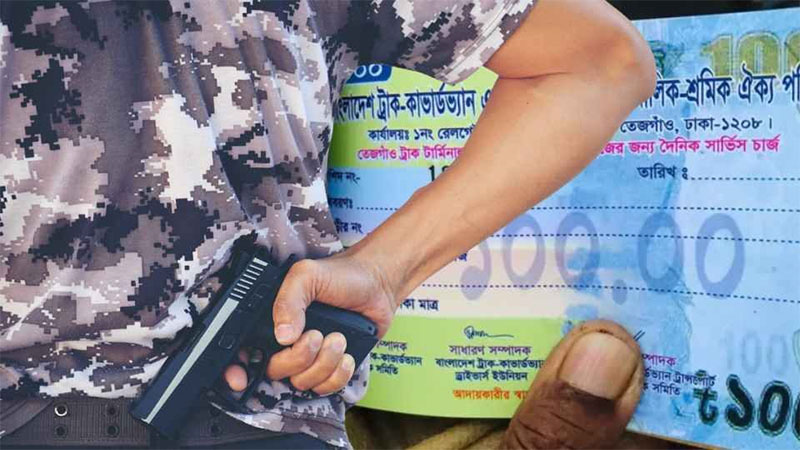
An extortion collector boasted, “This is the system here. Buses must pay before leaving—it’s the owners’ association’s directive.”
Three groups control toll collection: Bangladesh Road Transport Owners’ Association, Dhaka Road Transport Owners’ Association, and Labor Welfare Federation.
After August 5, BNP leaders took control of the Bangladesh Road Transport Owners’ Association office in Eskaton. Its president is now FBCCI director Haji Alauddin, while the secretary is Saiful Islam, also secretary of Dhaka Road Transport Owners’ Association.
The Labor Welfare Federation’s acting president is BNP’s Abdur Rahim Baks, and its secretary is Humayun Kabir Khan.
In Tejgaon’s truck stands, each vehicle pays 140 taka—100 to the truck owners’ association, 20 to the drivers’ union, and 20 for security guards. Similar tolls are collected at Gabtoli and Sayedabad terminals.
A recent intelligence report submitted to the Road Transport and Bridges Ministry estimated that around 2.21 crore taka is extorted daily from Dhaka’s transport hubs.
Denials from Associations
Transport associations deny extortion claims. Dhaka Road Transport Owners’ Association president Baten said, “We’ve stopped what used to happen before. The money collected now is for operational costs—office rent, salaries, tickets—not extortion.”
Truck Owners’ Association president Tofael Hossain Majumder claimed, “The 100 taka fee is for stand development, the rest for worker welfare.”
BNP leaders say they take action when specific extortion allegations are proven but deny controlling the transport sector. Party sources say over 1,500 members have been expelled in eight months for misconduct, including extortion, with more than 12 committees dissolved.

https://stapravda.ru/20221228/reyting_samyh_populyarnyh_hostingov_v_rossii_196445.html, рейтинг хостингов России подтверждает, что выбор надежного провайдера важен для бизнеса.