
Opinion
“Who are the journalists working in Bangladesh now?”
After August 5, more than 1,000 journalists across the country have been dismissed from their jobs. Private TV channels and newspapers have been taken over. Renowned and emerging journalists from various levels of media have been terminated.
A total of 327 journalists have been accused of murder and other cases. At different times, 31 journalists have been arrested. In four phases, the press accreditation cards of 168 journalists have been canceled. From the National Press Club and other press clubs across the country, 92 journalists have been expelled, and their memberships have been suspended. Under the guise of banking inquiries, 47 journalists are being harassed. More than a hundred journalists have been banned from traveling abroad. The bank accounts of many have been frozen. During the July-August movement and thereafter, 8 journalists were killed.
All of this is recorded and known. However, it is impossible to calculate how many journalists have been socially and personally harassed and continue to face harassment daily. In a previous article, I mentioned that during the Awami League era, only a handful of journalists received government patronage and benefits. But after August 5, everyone was branded as Awami League agents and terminated. The question arises, who and what kind of people are replacing these terminated journalists?
Here, I feel the need to mention the names of some dismissed journalists. This will help readers understand whether capable journalists have emerged to fill their positions.
2.
Experienced and skilled editors have been dismissed from various media outlets. Dismissals or resignations in journalism are quite normal. However, what happened after August 5 is far from normal—it has become an abnormal event. Those with extensive experience in editing and management have been replaced by uneducated, unskilled, inexperienced, and dishonest journalists. As a result, the standard of journalism in Bangladesh is continuously and rapidly declining.
Among daily newspapers, editors like Saiful Alam of Jugantor, Alamgir Hossain of Samakal, Abul Kalam Azad of BSS, Enamul Haque Chowdhury of Daily Sun, Mostafiz Shafi of Protidiner Bangladesh, Kamalesh Roy of Samayer Alo, Mostafa Mamun of Desh Rupantor, and Arun Kumar De, executive editor of Jaijaidin, can be mentioned.
In private TV channels, Ahmed Zubayer of Somoy TV, Zayedul Ahsan Pinto, Pranab Saha, and Naiem Tarik of DBC News, Shakil Ahmed, Farzana Rupa, and Bayezid Milky of Ekattor TV, Ashish Soikat of Independent TV, Rahul Raha of News 24, Prabash Amin of ATN News, J. E. Mamun of ATN Bangla, Ashok Chowdhury, Saiful Islam, and Sanchita Sharma of Boishakhi TV, Manas Ghosh and Belal Hossain of Asian TV, Rashed Chowdhury of Ekushey TV, Nazrul Kabir of Bangla TV, Dip Azad of Nagarik TV, Munni Saha and Sukanta Gupta Alok of Ek Takar Khobor, and Jewel Mazhar of Banglanews24 are noteworthy.
These individuals have been removed, dismissed, and in many cases, faced multiple murder charges and other forms of harassment. Many of them have made significant sacrifices and tireless efforts for the advancement of Bangladesh’s media. Yet today, they have been marginalized, which has already become a disgraceful and shameful example for free and independent journalism globally.
It is worth mentioning that media outlets like Prothom Alo, The Daily Star, The New Age, Tribune, Jamuna TV, Bangla Vision TV, Ekhon TV, Channel i, and NTV have remained unaffected both before and after. It is hard to say whether this is a result of pleasing everyone or professionalism! Even these outlets are not free from controversy! Yet, they remain untouchable. What is the mystery behind this?
3.
The media is referred to as the fourth pillar of the state, built by skilled, ethical, and experienced journalists. However, after August 5, the media and journalists have been silenced, their pens stopped, and their hands and feet tied. They could have played an effective role in strengthening democracy.
Here are some notable names, such as former AP Bureau Chief Farid Hossain, former editor of Samakal and Sokaler Khobor Mozammel Hossain Monju, prominent journalist Manjurul Ahsan Bulbul, chief editor of Dhaka Journal Syed Ishtiaq Reza, ATN Bangla’s J. E. Mamun, DBC editors Zayedul Ahsan Pinto and Pranab Saha.
This list can be extended further. Those who have watched their talk shows know that these journalists have always criticized wrongdoing. Yes, they were never neutral on one issue: Liberation War, Bangabandhu, Bangladesh, secularism, and accepting the truth. A simple YouTube search will provide countless examples. Just as they criticized BNP, they also lambasted the Awami League. They raised logical questions on all matters.
Yet, in today’s Bangladesh, they are banned. Their voices have been silenced. They are unemployed, unable to write anywhere, and cannot speak out. Many are facing murder charges, frozen bank accounts, social harassment, and other obstacles.
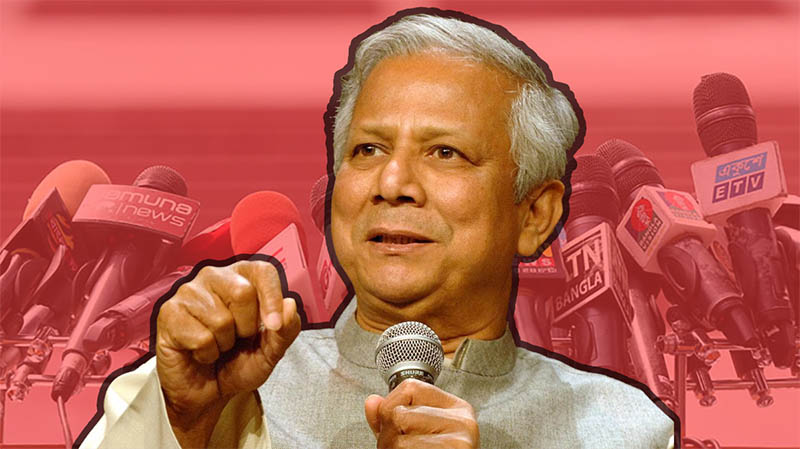
They might not agree, but I firmly believe if Dr. Yunus’s government walked the path of progress, democracy, truth about the Liberation War and Bangabandhu, good governance, justice, and corruption-free governance, these individuals could have contributed to the country’s advancement with constructive criticism. But Dr. Yunus has started moving from light to darkness. The result is evident.
Now, tell me, who and what kind of people are speaking on talk shows in place of these individuals? Only a handful like Mahbub Kamal and Masud Kamal. Does anyone else’s talk show appeal to you? Dr. Yunus’s government claims freedom of speech is flourishing while hammering nails at every corner of free expression.
4.
A promising group of journalists has been pushed toward premature demise. They could have given the nation and the media positive perceptions and good news.
Here are a few names: Naiem Tarik, Chief News Editor of DBC News, whose books are part of the curriculum in various universities, who tore up a government bank appointment letter to join journalism, and who is widely recognized for his skills across all media branches. Yet, even such a journalist has been sent to limbo by the interim government.
Rashed Chowdhury, news chief of Ekushey TV, who has earned fame in journalism nationally and internationally, is renowned for writing news in both Bangla and English. Even such a talented journalist has been sent home by the government.
The names of Gazi TV and Sarabangla’s Rahman Mustafiz, Asian TV’s Manas Ghosh, and Bangla TV’s Nazrul Kabir deserve special mention. They dreamed of free thought, freedom of speech, intellectual freedom, and ensuring the free flow of information, but those dreams have been shattered.
Now, in Bangladesh, it’s a season of heartbreak, in the guise of Yunus!
Bright young talents in television journalism have been dismissed and imprisoned in darkness. In their place, semi-educated, ignorant party workers have been hired, turning viewers away from TV to YouTube.
Final Words
Tell me, why does *Prothom Alo*’s Anisul Hoque not write prose cartoons, or why can’t he? Has anyone asked this question in the last nine months? Will we ever get an answer in the Yunus era?
April 26, 2025
-Sabbir Khan
Senior Journalist and Columnist

https://stapravda.ru/20221228/reyting_samyh_populyarnyh_hostingov_v_rossii_196445.html, рейтинг хостингов России подтверждает, что выбор надежного провайдера важен для бизнеса.