
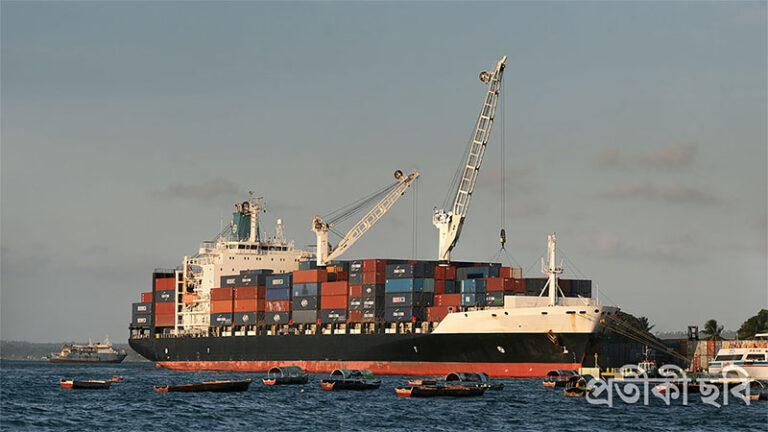
❐ Special Correspondent
The US Supreme Court has declared President Donald Trump’s retaliatory tariffs illegal, creating a new equation in the global trading system. Although the court’s ruling effectively nullified the previously imposed tariffs, Trump later issued a new executive order imposing a 15 percent import tariff on products from almost all countries. As a result, the international trade situation is still not completely stable or clear.
According to analysts, this changing reality has created uncertainty for Bangladesh, but it has also created some new opportunities.
As the US is Bangladesh’s largest single export market, the impact of the new tariff structure is being closely reviewed. They also believe there is an opportunity to negotiate favorable terms.
Economic analyst Mashrur Riaz said that although the court ruling annulled the previous countervailing duties, the new executive order has complicated the situation.
According to him, instead of completely scrapping the existing bilateral trade framework, it is more realistic to identify the areas where Bangladesh’s interests have been harmed and enter into new negotiations. In the geopolitical reality, it is not easy for Bangladesh to sever trade relations with a powerful country like the United States. Therefore, it is necessary to ensure an advantageous position through strategic negotiations.
Fazlul Haque, former president of the knitwear sector organization BKMEA, believes that the Supreme Court’s verdict has created an opportunity to reconsider the existing trade arrangements with the United States. If any tariff structure is automatically abolished, it can be positive for Bangladesh. If not, it is necessary for the government to take initiatives to reconsider, because all the previous conditions were not in favor of Bangladesh.
According to him, the current situation has presented an opportunity to obtain relatively better terms.
BGMEA President Mahmud Hasan Khan Babu said that the imposition of uniform tariffs globally has reduced the tariff gap with competing countries, which could be advantageous for Bangladeshi exporters.
However, the frequent changes in the tariff structure have created uncertainty among US importers, making them cautious in placing new orders and setting prices. If this uncertainty persists, the trend towards short-term contracts may increase, which will affect production plans.
He is optimistic that Bangladesh will be able to return to a strong position in the competition once the situation stabilizes.
Commerce Secretary Mahbubur Rahman said that the court’s ruling has brought the countervailing duty structure to a more or less equal level. However, the impact of the bilateral agreement is not yet clear. It will take some time for the matter to become clear.
He noted that the zero-tariff benefit on products made using imported US cotton is important for Bangladesh. In addition, the positive impact of initiatives taken to reduce the trade deficit may continue.
After the Trump administration imposed tariffs on bulk goods, pressure was created in global trade. Various countries later tried to reduce tariffs through bilateral negotiations. Bangladesh also made concessions in some cases. At one stage, the additional tariff was fixed at 20 percent and in subsequent negotiations, it was reduced by another 1 percent, bringing the total tariff to 34.1 percent. However, it was assured that if US cotton was used, the tariff would be zero, otherwise the previous rate would remain.
The new Supreme Court ruling has also raised questions about the future of those agreements. BKMEA President Mohammad Hatem said that the agreements made during the previous government are now in uncertainty. The US has already taken various benefits, but Bangladesh has not received the expected benefits. Therefore, the new government should renegotiate with the US and clarify the terms.
Although the countervailing duties have been canceled, a huge amount of money has been collected from import duties during the Trump administration. Many companies have passed on the burden of additional duties to consumers. The official announcement regarding the duty refund is still unclear. As a result, doubts remain among businessmen.
The United States is an important trading partner of Bangladesh. Bangladesh’s exports are over $8 billion, but its imports are comparatively low, leading to the Trump administration raising the issue of a trade deficit. As part of the bilateral agreement, Bangladesh decided to import aircraft and agricultural products from the United States.
However, the country’s economists and businessmen were not satisfied with the terms of the agreement. According to them, most of the clauses of the agreement were more favorable to the United States.
Overall, the new situation presents both risks and opportunities for Bangladesh. The real impact will be determined only after clarity on the tariff structure and bilateral agreements emerge. In the meantime, analysts advise exporters to take a cautious and strategic stance.

https://stapravda.ru/20221228/reyting_samyh_populyarnyh_hostingov_v_rossii_196445.html, рейтинг хостингов России подтверждает, что выбор надежного провайдера важен для бизнеса.