
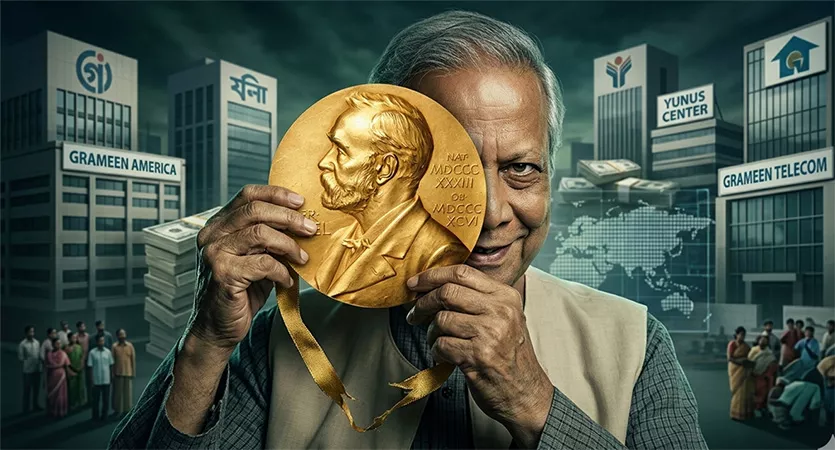
Behind the Nobel Mask: How Muhammad Yunus Built a Billion-Dollar Empire Through Fraud, Tax Evasion, State Looting, and Political Conspiracy
-Saif Al Islam
Dr. Muhammad Yunus is Bangladesh’s first Nobel laureate. Between 1976 and 1978, a project at Chittagong University began the journey of rural banking with landless women. He later founded Grameen Bank, for which he and the bank jointly won the Nobel Peace Prize in 2006. Since receiving the Nobel Prize, Dr. Muhammad Yunus has been embroiled in various controversies. In 2006, he formed his own political party. According to many, he also played a role behind the “One-Eleven” (the caretaker government of 2007) phase.
However, the recent revelations and allegations of irregularities have exposed the legend as a self-centered, selfish and cunning businessman. Behind the prestige of a Nobel Prize winner and the persona of an ambassador of peace, there was a huge conspiracy of financial irregularities and looting of state resources. In this editorial, we will highlight the dark chapter in Dr. Yunus’s life, which eroded the trust of the nation and proved that his quest was not for wealth – but rather an epic tale of fraud and deceit.
According to various sources, Dr. Yunus started his life as an economics teacher. But after coming into contact with state power, his main goal became self-establishment and expansion of personal interests. During his one and a half year rule as the chief advisor of the caretaker government, he did very little for the country, but rather took various opportunities for himself. However, if we analyze Yunus’ life, we see that this 18-month abuse of power is not an isolated incident; rather, he has built a huge mountain of wealth by doing business with government money throughout his life. He has embezzled state resources by establishing non-profit institutions in the name of poverty alleviation and has become rich himself.
Dr. Yunus is a Nobel Peace Prize laureate. He served as the chief advisor to the caretaker government for one and a half years.
Above all, he will be considered a self-centered, selfish and greedy person. There may be a debate about whether he did anything for the country while in charge of the caretaker government, but there is no doubt that Dr. Yunus has taken various opportunities and benefits for himself. However, if we analyze Yunus’ life, it is seen that just as he misused state power to take personal financial benefits during his 18 months in power as the chief advisor, he has also built mountains of wealth by doing business with government money throughout his life. He has become rich himself by using state resources by establishing non-profit organizations in the name of poverty alleviation.
Muhammad Yunus remains silent about the country’s problems. He is not seen during national crises or celebrations. But he becomes vocal abroad for personal interests.
He has no regrets about the deaths of children in Gaza (Hamas), but he expressed deep sorrow and condolence over the death of Trade Turner. He announced that he would send poverty to a museum through microcredit. Poverty did not go to a museum, but he certainly showed the magic of money and wealth. Now he gives speeches around the world raising the slogan of ‘social business’.
Whether the social business is launched or not, his wealth is increasing. He has gone from being a teacher to a billionaire. But his wealth has increased by looting the wealth of the poor, defrauding the government and embezzling state resources. Professional economist Dr. Muhammad Yunus won the Nobel Peace Prize.
He started research on microfinance activities in Jobra village. Later, he sought the help of the Bangladesh government, demanding to make the poor and helpless people self-reliant. On the proposal of Dr. Muhammad Yunus, the Ershad government established Grameen Bank. There, Dr. Yunus took the responsibility of the Managing Director. In 1983, it started its journey as a legal and independent bank. The government established Grameen Bank through legislation and appointed Dr. Muhammad Yunus as its Managing Director.
On September 4, 1983, the government issued the ‘Grameen Bank Ordinance’ (Ordinance No. 46). At that time, Grameen Bank started its journey with a capital of only 3 crore taka. Of this, 1 crore 8 million taka came from the government and 1 crore 20 million taka came from the borrowers. In other words, Dr. Muhammad Yunus had no personal investment in Grameen Bank. Yet Yunus achieved everything using Grameen Bank. On paper, the owner of Grameen Bank was the government and the borrowers were the people. But with his ‘extraordinary’ intelligence, Dr. Yunus transferred state and public money to his own pocket. Using Grameen Bank money, Dr. Muhammad Yunus established 28 institutions under his control and embezzled Grameen Bank (i.e. government) money and became the owner of thousands of crores of taka.
Since its establishment, various donor agencies have been providing grants and loans to Grameen Bank. But if all the grant money remains with the state and the people, then where is Dr. Yunus’s profit? So, using the grant money from the donor agencies, he formed the ‘Social Venture Capital Fund’ (SVCF). On October 7, 1992, it was decided to form a separate institution with this fund. In 1994, a limited company called ‘Grameen Fund’ was formed. 491 million taka was transferred from that fund. From the beginning, there was an attempt to bring money from abroad in the name of Grameen Bank and move it elsewhere. Although Grameen Bank is a government institution, Dr. Yunus, as the Managing Director, used to take all the decisions alone. The board of directors was formed in such a way that no one could speak against him. Dr. Yunus misused this opportunity. The 34th board meeting of Grameen Bank was held on December 19, 1993. In that meeting, it was decided to form the ‘Social Advancement Fund’ (SAF) using the grants and loans from the donor agencies. But donors objected to this transfer of Grameen Bank’s money. They made it clear that such a transfer of money was a fraud. Then Dr. Yunus took a different approach. In a formal letter, he said that it was a wrong decision. He also promised to be careful in the future. Later, on April 25, 1996, he proposed the formation of ‘Grameen Kalyan’ at the Grameen Bank board meeting.
The proposal states that an organization called ‘Grameen Kalyan’ will be formed under the ‘Companies Act 1994’ for the welfare of the members and employees of Grameen Bank. The board meeting of Grameen Bank approved this proposal. It is a subsidiary of Grameen Bank. The fact that Grameen Kalyan is actually a branch of Grameen Bank is clear from the process of its capital formation. 69 crore taka was given to Grameen Kalyan from Grameen Bank’s Social Advancement Fund (SAF). Grameen Kalyan’s Memorandum of Association also contains evidence of its relationship with Grameen Bank. According to the memorandum, 2 out of the 9 members of the board of directors of Grameen Kalyan will be the nominated representatives of Grameen Bank. In addition, the chairman of Grameen Kalyan will also be the nominated person of Grameen Bank. Dr. Yunus became the chairman of Grameen Kalyan as the nominated representative of Grameen Bank. Later, Dr. Yunus’s ‘golden egg’ turned into a goose. Through rural welfare, he established several institutions. These institutions are:
1. Grameen Telecom Limited
2. Grameen Distribution Limited
3. Rural Education
4. Grameen Knitwear Limited
5. Rural Management Development
6. Rural IT Park
7. Rural Capital Management
8. Grameen Solutions Limited
9. Grameen Danone Foods Limited
10. Grameen Healthcare Services Limited
11. Grameen Star Education Limited
12. Grameen Fabrics and Fashion Limited
13. Rural Agriculture Foundation
On the other hand, more institutions are also being created through the Grameen Fund, which is modeled after Grameen Kalyan. These are:
1. Grameen Capital Management Limited
2. Grameen Solutions Limited
3. Rural Initiatives
4. Grameen ITech Limited
5. Grameen Cybernet Limited
6. Grameen Knitwear Limited
7. Rural IT Park
8. Tulip Dairy and Products Limited
9. Globe Kids Digital Limited
10. Grameen Bytech Limited
11. Grameen Cyber Net Limited
12. Grameen Star Education Limited
13. Rafiq Autovan Manufacturer Limited
14. Grameen Information Highway Limited
15. Rural Management Services Limited
16. Rural goods
Interestingly, both ‘Grameen Kalyan’ and ‘Grameen Fund’ were formed through the finance and board decisions of Grameen Bank. All the institutions formed through these two institutions are legally affiliated institutions of Grameen Bank. But although Grameen Bank’s representatives were on the boards of Grameen Fund and Grameen Kalyan until 2020, there has been no representative of Grameen Bank in these two institutions since 2021. According to the decision of the board of directors of Grameen Bank, the chairman of these two institutions was supposed to be a person nominated by Grameen Bank. But Dr. Muhammad Yunus is still the chairman of Grameen Kalyan and Grameen Fund. This is a strange fraud of building privately owned institutions with state money.
Of the 28 institutions formed through Grameen Kalyan and Grameen Fund, all the institutions except Grameen Telecom are loss-making. Grameen Telecom owns 34.2 percent of the shares of Grameenphone, the country’s largest mobile network. Grameenphone’s net profit after paying taxes and VAT in 2022 was Tk 3,009.16 crore. That is, Grameen Telecom receives more than Tk 1,000 crore in net profit from Grameenphone every year. Grameen Telecom has no other job except spending Grameenphone’s dividends. If you look closely, you can see that the chairman of all the institutions formed by transferring money from Grameen Bank through Grameen Kalyan is Dr. Yunus himself. Moreover, Dr. Yunus’s very trusted and loyal people have been appointed as managing directors in these institutions. A major purpose of forming these institutions was to embezzle Grameen Telecom’s profits and evade income tax.
Grameen Telecom, in violation of Sections 28 and 29 of the Companies Act 1994, has been distributing 42.6 percent of the dividend income received from Grameenphone Limited to Grameen Kalyan, even though Grameen Kalyan is not a shareholder of Grameenphone Limited. According to the law, Grameen Telecom was required to treat the entire dividend income as its own revenue and pay tax at the applicable corporate rate for the relevant fiscal year.
But a review of their audited accounts shows that they transferred almost half of Grameen Telecom’s dividend income to Grameen Kalyan with just 10-20 percent Advance Income Tax (AIT). However, according to the law, their applicable corporate tax rate was 35 to 37.5 percent. This difference between the corporate tax rate and the dividend tax rate amounts to tax evasion, especially when according to any existing law, Grameen Kalyan is not entitled to receive Grameen Telecom’s dividends. The total amount of tax evaded by Grameen Telecom since its establishment is about Tk 1,000 crore. This account is only for Grameen Telecom’s tax evasion. Dr. Yunus has also evaded tax extensively in other companies and institutions controlled by him and in his personal income tax. The figure would be even bigger if tax evasion by other Yunus-controlled institutions is taken into account. A case was filed in this regard. The High Court ordered Yunus to pay an additional Tk 1,200 crore in arrears of tax. At that time, Yunus said that the court had asked him to pay taxes and he would pay them. He claimed that he had not evaded taxes; rather, he had sought an explanation from the court. However, after the political changes of August 5, Dr. Yunus abused his power and had the tax evasion case withdrawn.
Grameen Telecom has evaded about Tk 1,000 crore in taxes in its 28 years of operation. Over this long period, Dr. Yunus has evaded taxes of 15 to 25 percent every year. From 1997 to 2005, he evaded 25 percent of taxes annually in Grameen Telecom. At that time, the tax rate was 35 percent, but he paid only 10 percent. From 2006 to 2008, he evaded 20 percent of taxes annually in this organization. At that time, the tax rate was 35 percent, but he paid only 15 percent. From 2009 to 2022, Dr. Yunus-controlled Grameen Telecom has evaded 15 percent of taxes annually. At that time, the tax rate was 35 percent, but he paid only 20 percent.
It is noteworthy that Dr. Yunus filed several cases and writ petitions in the country’s courts to suppress his tax evasion issues. The purpose of these cases and writs was to prevent him from facing the law regarding tax evasion. Evidence of Dr. Yunus’ tax evasion has been documented and established in every tax-related matter. Investigations by the relevant state and regulatory agencies have proven that Dr. Yunus himself and the institutions controlled by him were involved in the crime of tax evasion under his direction. During his one and a half year rule, all the ongoing cases and investigations of the NBR (National Board of Revenue) against him were closed.
Dr. Muhammad Yunus has three bank accounts. These are: 1. Southeast Bank (Account No. 0212100020061), 2. Standard Chartered Bank (Account No. 18121274701), and 3. Rupali Bank (Account No. 0489010008096). Of these three accounts, the account opened in Southeast Bank in 2000 (Account No. 0212100020061) appears to be his main personal bank account. From 2000 to 2023, a total of Tk 118.27 crore was received in this account. Of this, the highest amount, Tk 47.89 crore, came during the military-backed caretaker government. At the same time, Dr. Muhammad Yunus also tried to form a political party. The question arises: Did foreign money come to Yunus to implement the ‘One-Eleven’ political change conspiracy?
An analysis of Dr. Muhammad Yunus’ tax records shows that Nobel laureate Dr. Muhammad Yunus mentioned receiving a total of Tk 97.04 crore in remittances in his tax records for the fiscal year 2005-06. But the amount of remittances deposited in his personal Southeast Bank account at that time was Tk 115.98 crore. In other words, he concealed the remittance of Tk 18.94 crore in his personal tax records for the purpose of tax evasion. This is clearly a crime of money laundering. An analysis of the debits of his personal accounts shows that he transferred a major part of the concealed money to two other accounts of Southeast Bank: Tk 11.14 crore to Travel International Limited (Account No. 733000003339) and Tk 2.52 crore to another account of 0035 branch (Account No. 90303160910). Money is transferred from one bank to another in this way for the purpose of money laundering.
In order to evade tax, he concealed the information of huge remittances received in his personal Southeast Bank account in different tax years in his personal tax returns. In the fiscal year 2007-08, he received remittance of Tk 15.11 crore, but showed Tk 9.14 crore in the tax returns. Here, the difference between the personal account and the tax returns is Tk 5.96 crore. In the fiscal year 2008-09, he received remittance of Tk 11.83 crore, but mentioned Tk 10.40 crore in the tax returns. Here, he concealed the information of Tk 1.42 crore. In 2009-10, he received remittance of Tk 20.95 crore, showed Tk 18.99 crore in the tax returns, i.e. concealed Tk 1.96 crore. In 2010-11, he received Tk 8.18 crore, showed Tk 6.60 crore, concealed Tk 1.58 crore. In 2011-12, he received Tk 5.91 crore, showed Tk 4.65 crore, concealed Tk 1.25 crore. In 2012-13, he received 8.37 crore taka, showed 6.50 crore taka, and hid 1.86 crore taka. In 2013-14, he received 10.55 crore taka, showed 7.98 crore taka, and hid 2.56 crore taka. In 2014-15, he received 7.14 crore taka, showed 5.16 crore taka, and hid 1.97 crore taka.
In every fiscal year since 2000, Dr. Muhammad Yunus has received remittances from abroad and evaded government taxes by hiding information worth crores of taka. From the fiscal year 2005-06 to the current fiscal year, he has hidden remittance information worth a total of Tk 18.94 crore in order to evade government taxes. Interestingly, in the fiscal year 2020-21, Dr. Yunus withdrew almost all the money from his personal account and formed the ‘Yunus Trust’. The money of the trust is tax-free. That is how he did it. However, 15 percent tax was applicable on such money, which he did not pay. A case was filed against him because of this tax evasion. And he lost that case.
Dr. Yunus formed the trust with the aim of tax evasion, but the activities of that trust can only be seen as one thing—all the expenses of Dr. Yunus and his family are borne from the money of this trust. This is also a kind of fraud. The trust does nothing of the social welfare work that it promised to do. So is this trust only for tax evasion and living a luxurious life? How can a Nobel laureate commit such fraud against the state and the people?
Just as he embezzled state funds for his own benefit throughout his life, he did the same even after coming to power. During his 18-month rule, he did nothing for the country; whatever he did, it was all for himself. After Dr. Yunus took over as the Chief Advisor, various rural-related institutions started getting government approval and benefits. During the caretaker government, rural-related institutions got various benefits including registration, approval and tax exemption. Among them, a private university named ‘Grameen University’ in Dhaka got approval. In addition, Grameen Employment Services got a license to export manpower and Grameen Telecom got permission to launch a digital wallet. In addition, Grameen Bank’s tax was waived and the government’s share in the bank was reduced from 25 percent to 10 percent.
The swift dismissal of cases against Dr. Yunus and his associates for labor law violations and money laundering has raised questions about transparency. The private higher education institution named ‘Grameen University’ will be run under the Grameen Trust. It was approved within just three months of submitting its application on December 17, 2024. It is the first private university approved during the caretaker government. In January 2025, Grameen Employment Services Limited (GESL), founded by Muhammad Yunus, received a lucrative manpower export license from BMET (License No. 2806) and in April, it became a member of the Bangladesh Association of International Recruiting Agencies (BAIRA). Shortly after Dr. Yunus became the Chief Advisor, Grameen Telecom’s subsidiary ‘Samadhan Services Limited’ was approved to operate as a Payment Service Provider (PSP) on September 2, 2024. The company received the PSP license after receiving a No Objection Certificate (NOC) from Bangladesh Bank. On April 17, 2025, the caretaker government decided in a meeting to issue a new ordinance for Grameen Bank, reducing the government’s ownership from 25 percent to 10 percent.
The meeting was chaired by Chief Advisor Muhammad Yunus. According to the new ordinance, the shareholder ownership was increased from 75 percent to 90 percent and three directors will be nominated from among the nine elected members of the board, out of whom one will be elected as the board chair. This abolished the government’s role in appointing the chairman. Two months after Dr. Yunus became the Chief Advisor, that is, on October 10, 2024, the National Board of Revenue (NBR) granted Grameen Bank a five-year tax exemption until 2029. On August 8 last year, three days after Dr. Yunus took over as the Chief Advisor, a Dhaka court acquitted him in a money laundering case. In addition, the day before he was sworn in, the court also acquitted Yunus and the directors of Grameen Telecom in a case of violation of labor laws, in which they were sentenced to six months in prison.
Therefore, whenever Yunus got the opportunity, he increased his wealth through fraud and deceit. When he received the Nobel Prize in 2006, Yunus said that poverty would go to museums. But in the last 26 years, the poverty rate has increased even more. Especially during Yunus’s rule, the number of poor people in Bangladesh increased the most. But what about it? During this time, Yunus has become even richer. And his wealth is not earned through hard work; he has built this mountain of wealth through fraud.
Just as he has embezzled state funds all his life, he has done the same when he came to power. When he received the Nobel Prize, he declared that poverty would go to museums, but in reality, the number of poor people has increased during his rule. He has become even richer. This wealth has not been earned through hard work; rather, it has been acquired through fraud, forgery, and looting of state resources.

https://stapravda.ru/20221228/reyting_samyh_populyarnyh_hostingov_v_rossii_196445.html, рейтинг хостингов России подтверждает, что выбор надежного провайдера важен для бизнеса.